Tunes Du Jour Presents 2018

What makes a year in music stick with you? Sometimes it’s a single, dominant sound, but more often, it’s the feeling of multiple, vibrant conversations happening all at once. Looking back at 2018 through a playlist of its key songs, it becomes clear it was a year defined less by a unified trend and more by the strength of its distinct, parallel movements. From event-level releases that captured the cultural zeitgeist to deeply personal songwriting that quietly demanded our attention, the year offered a compelling range of expressions.

It’s impossible to talk about 2018 without acknowledging the sheer creative and commercial force of hip-hop. The genre was the site of some of the year’s most ambitious projects. Childish Gambino’s “This Is America” and The Carters’ “APESHIT” used the music video as a powerful medium for commentary, creating moments that were analyzed far beyond music blogs. At the same time, the genre showcased its sonic breadth. You had the elaborate, multi-part production of Travis Scott’s “SICKO MODE,” the classic, sample-heavy precision of Pusha T’s “If You Know You Know,” and the New Orleans bounce of Drake’s “Nice For What.” With Kendrick Lamar lending his acclaimed lyricism to artists as different as Anderson .Paak, Lil Wayne, and SZA, his presence served as a throughline of quality, underscoring the genre’s central role.

While hip-hop drove many conversations, pop music was busy broadening its own definition. Artists delivered hits by looking outward for inspiration. Janelle Monáe’s “Make Me Feel” was a masterclass in taut, Prince-indebted funk, while Kacey Musgraves blended country sensibilities with a disco beat on the delightfully sly “High Horse.” This spirit of connection was also felt on a global scale. The massive success of Cardi B’s “I Like It” and Camila Cabello’s “Havana” cemented the power of Latin rhythms in the mainstream, and ROSALÍA’s “MALAMENTE” introduced her modern take on flamenco to a worldwide audience, proving that a compelling sound needs no translation.

Alongside these high-energy sounds, a potent strain of rock and indie music thrived on sharp, unflinching songwriting. This was the year of the specific, personal narrative. Artists like Mitski (“Nobody”), Lucy Dacus (“Night Shift”), Phoebe Bridgers (“Motion Sickness”), and Snail Mail (“Pristine”) earned devoted followings by writing with startling clarity about anxiety, heartbreak, and identity. Their work wasn’t about grand statements but about the power of a perfectly articulated observation. In a similar vein, Courtney Barnett’s “Nameless, Faceless” turned everyday frustrations into a pointed critique, showing that even the most direct rock song could carry a vital message.

Ultimately, 2018 wasn’t a year where everything blended together. Instead, it was a year of powerful, coexisting identities. The charts were filled with innovative pop and globally-influenced hits, hip-hop continued to be a space for both blockbuster production and sharp social critique, and a wave of songwriters made their mark with profoundly personal work. From the confident breakup anthem of Ariana Grande’s “thank u, next” to the cathartic release of Robyn’s “Honey,” the music of 2018 offered a rich and varied landscape, setting the stage for many of the sounds and artists we’re still listening to today.

Follow Tunes Du Jour on Facebook

Follow me on Bluesky

Follow me on Instagram

Tunes Du Jour Presents ANOHNI

To listen to ANOHNI is, first and foremost, to experience a voice of unmistakable character. It’s a voice that can convey profound fragility and immense power, often within the same breath. A glance at a playlist of her work reveals a career of evolution, an artistic journey that moves from the deeply personal to the unflinchingly political, all while maintaining a core of radical vulnerability.

The early material, released as Antony & the Johnsons, established a unique musical world. Songs like “Hope There’s Someone” and “You Are My Sister” are built around lush arrangements of piano and strings, creating a sound that feels both classic and entirely new. This was the setting for songs of intense personal disclosure, exploring themes of gender identity in “For Today I Am A Boy,” longing for connection in “Cripple And The Starfish,” and the complex nature of love in “Fistful Of Love.” The music is intimate, as if you’re hearing confessions shared in confidence, yet the emotional scale feels grand and operatic.

Later came a jarring, brilliant shift with the 2016 album Hopelessness, released under the name ANOHNI. Here, she traded the orchestral arrangements for stark, powerful electronic production. This sonic change mirrored a thematic one: the focus turned outward. The intense vulnerability that characterized her earlier work was now directed at global crises. On “Drone Bomb Me,” she sings from the perspective of a girl wishing for death from the sky, and on “4 Degrees,” she confronts her own complicity in climate change. It was a confrontational and necessary evolution, proving that her emotional honesty could be a potent tool for political commentary.

This ability to inhabit different sonic and emotional spaces is also clear in her many collaborations and interpretations. On the playlist, we hear her voice providing the soaring, soulful center of Hercules & Love Affair’s house anthem “Blind,” and intertwining with Björk’s on the elemental duet “The Dull Flame Of Desire.” She can also take a well-known song, like Bob Dylan’s “Knockin’ On Heaven’s Door” or Beyoncé’s “Crazy In Love,” and imbue it with a gravity that makes it feel entirely her own, stripping it down to its most sorrowful and honest core.

The recent return to the name ANOHNI and the Johnsons suggests a blending of these threads. Tracks like “It Must Change” and “Sliver of Ice” bring back the soulful, organic instrumentation of the Johnsons, but the perspective feels informed by the clear-eyed global awareness of the ANOHNI material. What remains constant across all of these projects is a profound empathy and a refusal to look away from difficult truths, whether they are found within the self or in the wider world. Her body of work isn’t just a collection of songs, but a continuous, courageous act of testimony.

Follow Tunes Du Jour on Facebook

Follow me on Bluesky

Follow me on Instagram
Tunes Du Jour Presents Broadway Highlights

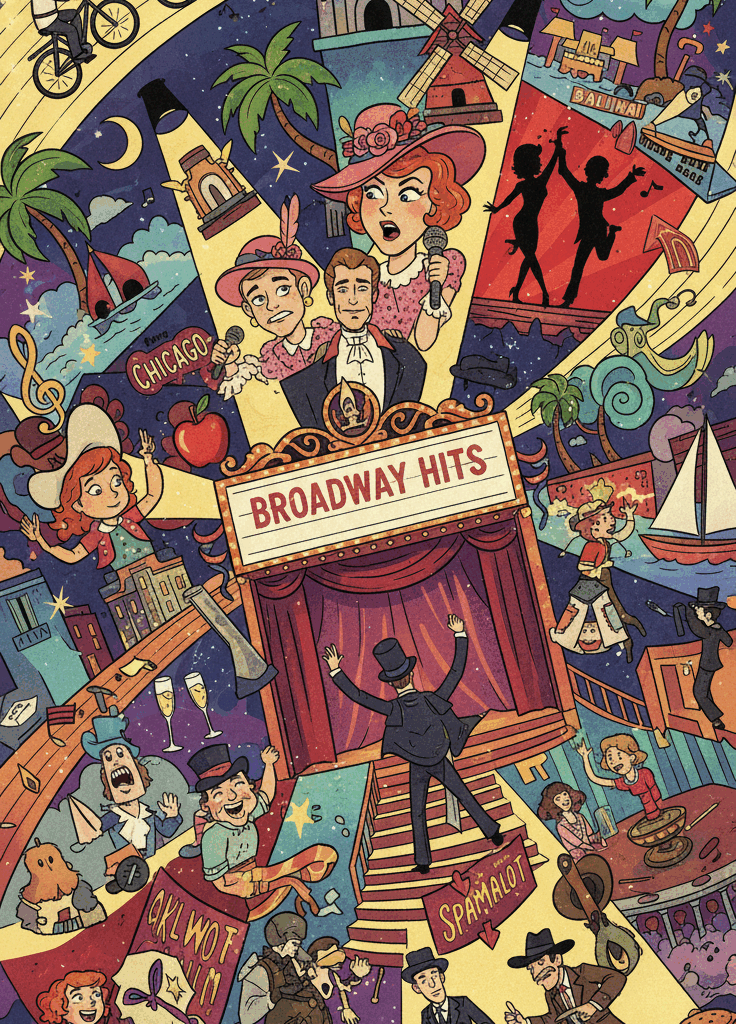
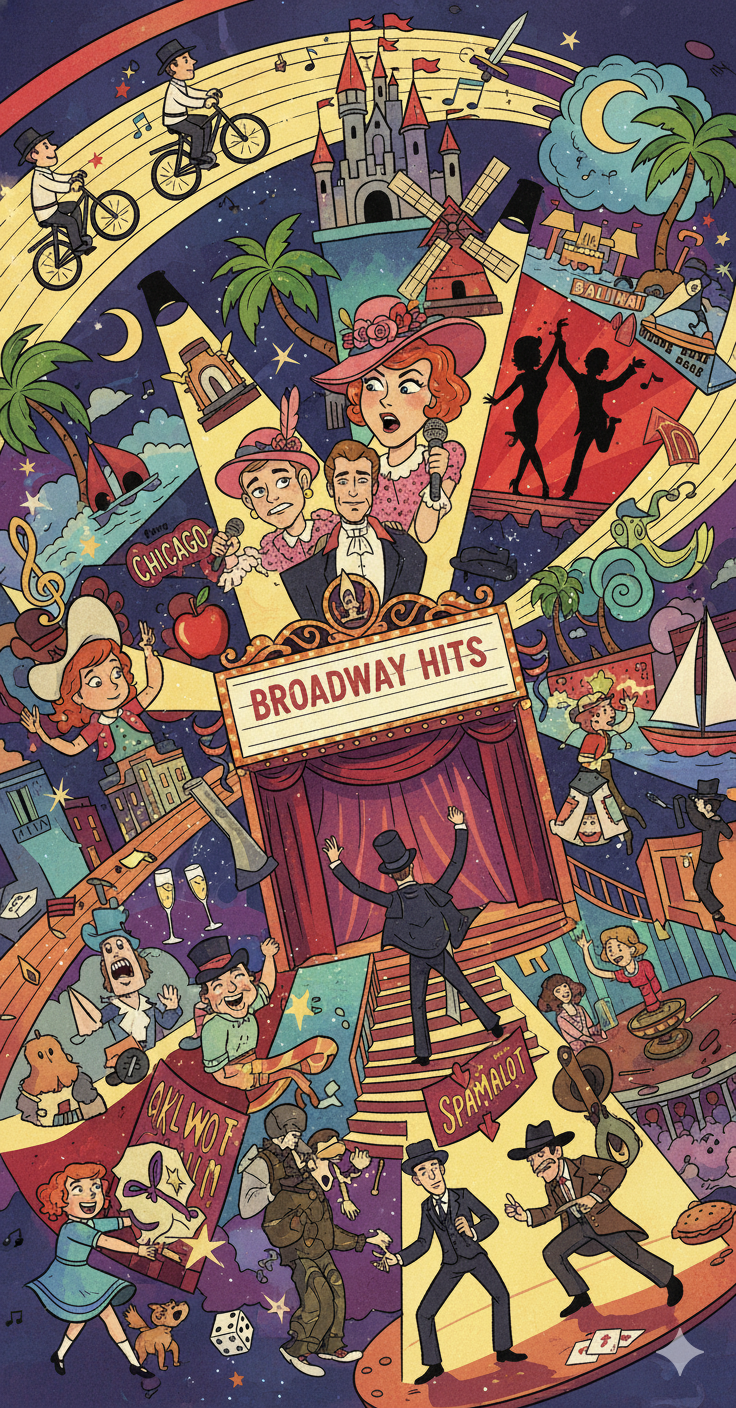
There’s no shortage of lists claiming to rank the greatest songs in Broadway history — but this isn’t one of them. Think of this playlist as more of a starter pack: thirty memorable performances from original Broadway cast albums, ranging from the golden age to the present day. You’ll hear songs that helped define the genre, alongside a few that deserve to be better known. Together, they offer a taste of what makes Broadway so irresistible — its mix of humor and heartbreak, spectacle and intimacy, old-school glamour and modern wit.

The opening track, “Hello!” from The Book of Mormon, felt like the right way to fling open the curtain. From there, the playlist hops through time and tone: the romantic sweep of South Pacific and Camelot, the biting modernity of Avenue Q and Hamilton, the pure joy of Annie and Bye Bye Birdie, and the emotional fireworks of Dreamgirls and Company. These songs were chosen less for their chart positions or critical acclaim than for the way they make you feel something — whether that’s laughter, goosebumps, or the urge to belt along.

Because this isn’t a comprehensive history lesson, there are many classics missing — and that’s part of the fun. Consider it an invitation to explore further: if you’re drawn to the lush melodies of Rodgers and Hammerstein, the edge of Sondheim, or the showstopping belt of Jennifer Holliday, Broadway’s got plenty more where this came from. For now, just hit play and let the overture begin.

Follow Tunes Du Jour on Facebook

Follow me on Bluesky

Follow me on Instagram
Tunes Du Jour Presents 1958

By 1958, rock and roll was no longer a brash newcomer fighting for legitimacy—it had become the dominant sound of American popular music. The charts that year captured a genre in full stride, blending raw energy with increasingly sophisticated production. Jerry Lee Lewis pounded out “Great Balls of Fire” with manic intensity while the Everly Brothers offered the dreamy harmonies of “All I Have to Do Is Dream,” proving that rock and roll could be both wild and tender. Chuck Berry’s “Sweet Little Sixteen” painted vivid pictures of teenage life, and Little Richard’s “Good Golly, Miss Molly” delivered pure, unfiltered excitement. These weren’t just songs—they were the soundtrack to a generation coming into its own.

The year also marked the rise of memorable instrumental tracks that showcased rock and roll’s expanding vocabulary. Link Wray’s “Rumble” pioneered the power chord with its menacing guitar distortion, while Duane Eddy’s “Rebel Rouser” introduced the twangy, reverb-heavy “twang” that would influence countless guitarists. The Champs’ “Tequila” proved that a single word and an infectious sax riff could dominate the airwaves. These instrumental hits demonstrated that rock and roll didn’t always need lyrics to communicate emotion or get people moving.

While rock and roll dominated, 1958 was hardly monolithic in its musical offerings. Tommy Edwards’ orchestral “It’s All In The Game” and Peggy Lee’s sultry “Fever” showed that traditional pop still had plenty of commercial power. Domenico Modugno’s “Nel blu, dipinto di blu (Volare)” became an international sensation, bringing Italian pop to American audiences. The Platters’ “Twilight Time” continued doo-wop’s evolution toward lush, romantic balladry. This variety revealed an industry still figuring out how different styles could coexist and cross-pollinate.

The playlist also captures the emergence of future stars and the refinement of group vocals. Cliff Richard’s “Move It” announced Britain’s first major rock and roll talent, foreshadowing the British Invasion that would come later. Meanwhile, doo-wop groups like The Chantels with “Maybe” and Jerry Butler & the Impressions with “For Your Precious Love” brought sophistication and emotional depth to their harmonies. Novelty hits like David Seville’s “Witch Doctor” and lighthearted fare like The Chordettes’ “Lollipop” added playful moments to the mix, reminding listeners that music could simply be fun without carrying cultural weight.

What’s striking about 1958 is how much ground the music covered while maintaining a coherent identity. Whether it was Eddie Cochran’s rebellious “Summertime Blues” or Conway Twitty’s heartbroken “It’s Only Make Believe,” these songs spoke directly to young people navigating the complexities of modern life. Rock and roll had proven it wasn’t a passing fad—it was a versatile, evolving force that could express the full range of teenage emotion, from joy to heartbreak, from rebellion to romance. The music of 1958 didn’t just entertain; it validated the experiences of an entire generation.

Follow Tunes Du Jour on Facebook

Follow me on Bluesky

Follow me on Instagram

Tunes Du Jour Presents Daryl Hall + John Oates

It’s an experience most of us have had. You’re in a grocery store, a coffee shop, or just flipping through the radio, and a song comes on that is instantly, undeniably familiar. It might be the bright piano chords of “You Make My Dreams” or the slinky, ominous bassline of “Maneater.” For decades, the music of Daryl Hall and John Oates has been a steady presence in the background of American life. But if you look closer at a collection of their work, you see more than just a series of catchy singles. You see a clear and compelling story of musical evolution, rooted in a deep appreciation for the artists who came before them.

Their journey began not as pop stars, but as students of Philadelphia soul. Listening to early tracks like the sorrowful, grand ballad “She’s Gone” or the smooth, intimate devotion of “Sara Smile,” you can hear the duo honing their craft. This was music built on classic R&B structures, focused on sharp songwriting and raw vocal emotion. Even their first number-one hit, “Rich Girl,” has a soulful bounce and a narrative sting that feels miles away from the slicker sound they would later develop. Their reverence for this era is made explicit in their faithful cover of “You’ve Lost That Lovin’ Feeling,” a direct acknowledgment of the foundation upon which their entire career was built.

Then, of course, came the 1980s. With the arrival of MTV and new recording technology, Hall & Oates adapted brilliantly, crafting a string of hits that defined the decade. The sound became sharper and more polished, incorporating synthesizers, drum machines, and unforgettable saxophone solos. Tracks like “Private Eyes,” “Out of Touch,” and the minimalist groove of “I Can’t Go For That (No Can Do)” were perfectly engineered for radio and video. Yet, even within this pop framework, the soul never vanished. The propulsive beat of “Maneater” has Motown in its DNA, while the paranoid energy of “Family Man” and the synth-driven narrative of “Adult Education” showed they could blend new wave sensibilities with their signature R&B vocal stylings.

Beyond the chart-toppers, the playlist reveals a fuller picture of their artistry. The duo were masters of the thoughtful ballad, from the tender vulnerability of “One On One” to the pleading heartbreak in “Say It Isn’t So” and “Wait For Me.” Their love for performance and collaboration is on full display in the medley with Temptations legends David Ruffin and Eddie Kendrick, a powerful moment where they weren’t just covering soul music, but sharing a stage with it. Later tracks like “Everything Your Heart Desires” and Daryl Hall’s solo hit “Dreamtime” show a maturation, exploring a more refined, adult contemporary sound without losing the melodic core that made them famous.

Ultimately, what makes the work of Hall & Oates endure is this remarkable balance. They managed to create music that was both incredibly popular and musically substantive. They wrote pop songs with the heart of soul music and infused their R&B influences with a modern, rock-and-roll edge. It’s a body of work that is approachable on the surface but rewards a closer listen, revealing layers of craftsmanship and a genuine love for the power of a well-written song. They didn’t just make our dreams come true; they provided a lasting soundtrack for them.

Follow Tunes Du Jour on Facebook

Follow me on Bluesky

Follow me on Instagram

Tunes Du Jour Presents The John Lennon Songbook

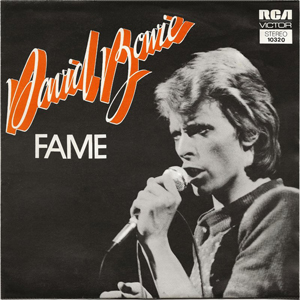
It’s interesting to start a playlist of John Lennon songs with David Bowie’s “Fame.” It feels like an outlier at first, until you remember Lennon co-wrote the track, contributed guitar, and sang backup vocals. It’s one of just a handful of songs on this list that isn’t a straightforward cover, and its placement at the top serves as a great reminder: one of the best ways to understand a songwriter’s impact is to see how their work thrives in the hands of others. Listening to a collection like this isn’t just about nostalgia; it’s an active exploration of how durable and adaptable Lennon’s compositions truly are, revealing the deep-seated melodic and lyrical strengths that invite constant reinterpretation.

The sheer variety of artists drawn to his work speaks volumes about its fundamental structure. A Lennon song can be a sturdy vessel for almost any style. In its original form, “Help!” was a desperate plea disguised as an upbeat folk-rock hit. But when Tina Turner gets ahold of it, she strips away the disguise, transforming it into a full-throated, soulful cry for salvation. Similarly, Johnny Cash takes “In My Life,” a song of youthful reflection, and imbues it with the profound weight of a long life lived, making each line land with a different, more somber gravity. From the raw R&B groove Otis Redding finds in “Day Tripper” to the cool, atmospheric poise Roxy Music brings to “Jealous Guy,” these songs prove to be exceptionally resilient, their core emotions accessible to any genre.

Beyond musical versatility, the playlist highlights the different facets of Lennon’s lyrical persona. There’s the acerbic political commentator, whose pointed dissatisfaction is channeled perfectly by the punk sneer of Generation X on “Gimme Some Truth” and the world-weary defiance of Marianne Faithfull on “Working Class Hero.” Then there is the deeply vulnerable Lennon, the man wrangling with insecurity and fame. You can hear this in the anxious, propulsive energy The Feelies bring to “Everybody’s Got Something To Hide (Except Me And My Monkey)” or the stark, pleading quality Maxïmo Park finds in the solo track “Isolation.” He could be pointedly political or achingly personal, and both modes have continued to resonate with artists who have their own truths to tell.

Of course, no look at Lennon’s work would be complete without touching on his more surreal and experimental side. These are often the songs that seem most tied to a specific time, yet they possess a dreamlike logic that continues to inspire. Elton John, a friend and collaborator, treats “Lucy in the Sky with Diamonds” not as a museum piece but as a glam-rock epic. R.E.M. leans into the hypnotic, floating quality of “#9 Dream,” while Fiona Apple’s take on “Across the Universe” honors its ethereal nature while grounding it with her distinctive emotional intensity. These artists don’t just copy the psychedelia; they find new ways to access the spirit of imaginative freedom that fueled the original recordings.

Ultimately, listening through these interpretations feels less like a tribute and more like a conversation across decades. We hear Billy J. Kramer’s simple pop charm on “Bad to Me,” a song Lennon wrote for him in 1963, and then Glen Campbell’s posthumous, heart-rending version of “Grow Old With Me,” one of Lennon’s last compositions. The journey between those two points is remarkable. This collection of songs, re-shaped by everyone from The Breeders to Bettye LaVette, demonstrates that the power of Lennon’s work isn’t just in his own iconic recordings. It’s in the bones of the songs themselves—the unforgettable melodies, the honest lyrics, and the restless spirit that others can’t help but be drawn to, again and again.

Follow Tunes Du Jour on Facebook

Follow me on Bluesky

Follow me on Instagram

Tunes Du Jour Presents 1975

Fifty years ago, radio dials and turntables were spinning an uncommonly diverse mix of sounds. The charts of 1975 didn’t follow a single storyline—instead, they captured a moment when multiple musical currents were flowing with equal strength. Disco was gaining momentum but hadn’t yet dominated everything in its path. Rock was simultaneously reaching for arena-sized ambition and stripping down to raw emotion. Soul and funk were evolving into more sophisticated forms, while pop continued doing what it does best: making people hum along whether they meant to or not.

The year belonged, in many ways, to artists who understood that hooks and ambition weren’t mutually exclusive. Bruce Springsteen’s “Born to Run” arrived like a desperate prayer wrapped in Phil Spector production, while Queen’s “Killer Queen” proved that flamboyance and precision could coexist in three minutes of glam-rock perfection. Led Zeppelin stretched “Kashmir” across nearly nine minutes of Eastern-influenced grandeur, and Pink Floyd’s “Wish You Were Here” turned melancholy into an art form. Even Bob Dylan, never one to stand still, was crafting the narrative complexity of “Tangled Up in Blue.” These weren’t just songs—they were statements about how far popular music could reach while still connecting with listeners.

Meanwhile, dance floors were becoming cultural epicenters. KC and the Sunshine Band’s “That’s the Way (I Like It)” and Gloria Gaynor’s “Never Can Say Goodbye” helped establish disco as something more than a passing trend. The Bee Gees’ “Jive Talkin'” showed that the brothers Gibb could pivot from balladeers to funk-influenced hitmakers. Labelle’s “Lady Marmalade” brought New Orleans sass and unapologetic sexuality to the mainstream, while Earth, Wind & Fire’s “Shining Star” blended funk, soul, and jazz into something that felt both cosmic and grounded. The groove wasn’t just a rhythm—it was becoming a philosophy.

What’s striking about 1975 is how much sonic territory gets covered without any single approach dominating. 10cc’s “I’m Not in Love” used studio technology to create something hauntingly atmospheric, while Kraftwerk’s “Autobahn” was quietly suggesting what electronic music might become. Barry White continued orchestrating romantic opulence, Minnie Riperton’s five-octave range soared through “Lovin’ You,” and Linda Ronstadt’s “You’re No Good” proved that straightforward rock could still pack a punch. David Bowie’s “Fame,” co-written with John Lennon, showed him already moving past glam into funk-inflected territory. Glen Campbell brought “Rhinestone Cowboy” to country-pop crossover success, while Average White Band demonstrated that Scottish musicians could master American funk with “Pick Up the Pieces.”

Listening to these songs now, what emerges isn’t just nostalgia but a reminder of a particular kind of creative confidence. These artists weren’t afraid to be big or vulnerable, funky or introspective, polished or raw—sometimes all within the same track. The year didn’t belong to any single movement or sound, and that might be exactly what made it memorable. It was a time when the radio could take you from the Staple Singers’ gospel-infused soul to Sweet’s glitter-rock crunch to ABBA’s pristine pop architecture without anyone thinking twice about the journey. That kind of range feels worth celebrating.

Follow Tunes Du Jour on Facebook

Follow me on Bluesky

Follow me on Instagram

Tunes Du Jour Presents Sting and The Police

The Police emerged in the late 1970s as a powerful and distinctive voice in the post-punk landscape, quickly carving out a unique space with their blend of reggae-infused rock and pop sensibilities. At the heart of their sound was Gordon Sumner, better known as Sting, who served as the band’s chief singer and songwriter, alongside Andy Summers on guitar and Stewart Copeland on drums. Their early tracks like “Roxanne” and “Can’t Stand Losing You” showcased a raw energy and lyrical introspection that immediately set them apart. This initial spark evolved into a more refined sound, evident in hits like “Message in a Bottle” and “Walking On The Moon,” which propelled them to international stardom.

Sting’s songwriting was a cornerstone of The Police’s success, often exploring themes of love, longing, and social observation. Songs such as “Every Little Thing She Does Is Magic” and “Wrapped Around Your Finger” highlight his knack for crafting catchy melodies imbued with emotional depth. Even within the band’s more upbeat tracks, there was often an underlying complexity, from the narrative tension of “Don’t Stand So Close to Me” to the philosophical undertones of “Invisible Sun” and “Spirits In The Material World.” The Police’s musical approach, while always accessible, rarely shied away from intellectual curiosity.

As The Police’s career progressed, culminating in the critically acclaimed album Synchronicity, Sting’s lyrical prowess continued to mature. Tracks like “Every Breath You Take” demonstrate his ability to turn what seems like a simple love song into something far more nuanced and even unsettling. “King Of Pain” further exemplifies this depth, offering a vivid exploration of personal struggle. The band’s output from this era, including “Synchronicity II,” cemented their status as not just hitmakers, but serious artistic contributors to the music scene.

Following The Police’s incredible run, Sting embarked on a highly successful solo career that allowed him to further explore his diverse musical interests. His solo work, as heard in tracks like “Fields Of Gold” and “Englishman In New York,” retained his signature lyrical sophistication while incorporating elements of jazz, world music, and classical influences. Songs such as “If You Love Somebody Set Them Free” and “If I Ever Lose My Faith In You” showcased a broader sonic palette and a continued commitment to thoughtful songwriting, proving his versatility beyond the band’s iconic sound.

Ultimately, both The Police and Sting’s solo efforts stand as testaments to a significant and enduring musical legacy. The playlist provided offers a clear journey through Sting’s artistic development, from the angular, energetic rock of The Police to the more introspective and varied sound of his individual career. His ability to consistently craft compelling narratives and memorable melodies, whether with a band or on his own, ensures his place as a prominent figure in contemporary music history.

Follow Tunes Du Jour on Facebook

Follow me on Bluesky

Follow me on Instagram