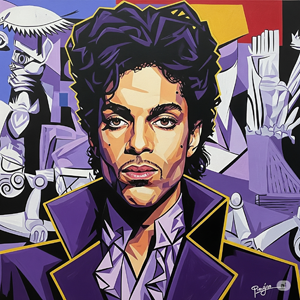
Tunes Du Jour Presents The Prince Songbook

Prince’s genius as a performer is well-documented, but his legacy as a songwriter may be even more far-reaching. The songs he wrote—sometimes directly for others, sometimes borrowed or reimagined—traveled in unexpected directions, often landing in voices very different from his own. Sinéad O’Connor’s haunting version of “Nothing Compares 2 U” turned emotional restraint into a global anthem, while Chaka Khan’s take on “I Feel for You” transformed a tightly wound synth-funk track into a dancefloor juggernaut with help from Melle Mel and Stevie Wonder. The Bangles’ jangly “Manic Monday” showed his facility with classic pop forms.

Sometimes Prince gave away songs without credit. Stevie Nicks has said “Stand Back” wouldn’t exist without his impromptu help; he played the synth part that defined the track, and then slipped away, declining a formal writing credit. His fingerprints are on the Sheila E. hit “The Glamorous Life” and The Time’s “Jungle Love,” both written and produced by Prince but performed by his protégés. Even artists as distinct as Alicia Keys and Tom Jones found new depths and textures in his work, whether covering “How Come You Don’t Call Me” or reinterpreting “Kiss.” In many cases, he gave female artists some of their most complex and empowered material: see Sheena Easton’s risqué “Sugar Walls” or Martika’s spiritual “Love… Thy Will Be Done.”

What’s most remarkable is how well these songs hold up when refracted through other voices. Cyndi Lauper brought vulnerability to “When You Were Mine,” TLC made “If I Was Your Girlfriend” even more intimate, and even idiosyncratic takes like Sufjan Stevens on “Alphabet Street” or P.M. Dawn’s dreamlike “1999” as incorporated in “Fantasia’s Confidential Ghetto” show how flexible his songwriting was. Prince’s compositions had structure, hooks, and heart, but they were never rigid. That elasticity allowed other artists not just to sing his songs, but to inhabit them.

Follow Tunes Du Jour on Facebook

Follow me on Bluesky

Follow me on Instagram

Tunes Du Jour Presents Sly & The Family Stone

In the annals of music history, few bands have left as indelible a mark as Sly & The Family Stone. Led by the enigmatic genius Sly Stone, this multiracial and multicultural collective reshaped the landscape of popular music in the late 1960s and early 1970s with their infectious blend of funk, soul, rock, and psychedelic sounds. Their influence can still be felt today, echoed in the rhythms and messages of countless artists across genres.

At the heart of Sly & The Family Stone’s music lies a celebration of diversity and inclusivity. Tracks like “Everyday People” and “Stand!” resonate with themes of unity and acceptance, serving as anthems for a generation seeking harmony amidst societal upheaval. Sly Stone, with his visionary approach to composition and performance, became a symbol of multiculturalism in an era fraught with racial tension. His bold experimentation with sound, highlighted in songs like “Dance To The Music” and “Thank You (Falettinme Be Mice Elf Agin),” challenged conventions and paved the way for future generations of artists to explore new sonic territories.

Beyond their musical contributions, Sly & The Family Stone were also champions of social justice and philanthropy. In an era marked by civil rights struggles, they used their platform to advocate for equality and empowerment. Sly Stone, in particular, was known for his involvement in various charitable endeavors aimed at uplifting marginalized communities. From organizing benefit concerts to supporting grassroots initiatives, he demonstrated a commitment to making a positive impact beyond the realm of music.

As we revisit classics like “Family Affair” and “If You Want Me To Stay,” it’s important to recognize the enduring relevance of Sly & The Family Stone’s message. In an age where diversity and inclusion remain pressing concerns, their music serves as a reminder of the power of unity and the potential for change. Through their timeless grooves and unwavering commitment to social justice, they continue to inspire listeners to strive for a more equitable and harmonious world.

Accompanying this reflection is a curated playlist featuring not only Sly & The Family Stone’s iconic hits but also tracks produced by Sly and performed by The Beau Brummels, Bobby Freeman, Little Sister, and 6ix, plus Sly’s 1986 guest feature on a track by Jesse Johnson of The Time. As we immerse ourselves in their music, let us also honor their dedication to diversity, inclusion, and philanthropy, ensuring that their message continues to resonate for years to come.

Follow Tunes du Jour on Facebook

Follow Tunes du Jour on Twitter

Follow me on Instagram

Your (Almost) Daily Playlist: 9-2-23

“Will It Go Round In Circles,” Billy Preston’s second US number one single, was borne from a comment Preston made to his songwriting partner, Bruce Fisher, about having a song but no melody. From there the pair came up with lyrics about having a dance with no steps and added to those words a very catchy melody. A session that included pre-stardom guitar and bass players The Brothers Johnson brought the groove and the funk.

Billy Preston’s first time having his name appear at the top spot of the Hot 100 was in 1969 with “Get Back,” credited to The Beatles With Billy Preston. Following The Beatles’ breakup, Preston continued working with its members, including playing with George Harrison at the Concert for Bangladesh. Preston was the first artist to record Harrison’s My Sweet Lord,” which Harrison co-produced and later recorded himself.

“Will It Go Round In Circles” entered the Hot 100 at number 99. It reached the top ten eleven weeks later, at which time the number one song was Paul McCartney and Wings’ “My Love.” “My Love” was knocked from the top spot by George Harrison’s “Give Me Love (Give Me Peace On Earth),” which was knocked from the top spot by “Will it Go Round In Circles.” The b-side of the Preston single was his cover of The Beatles’ song “Blackbird.”

The late Billy Preston was born on this date in 1946. A handful of his songs feature on today’s playlist.

Follow Tunes du Jour on Facebook

Follow Tunes du Jour on Twitter

Follow me on Instagram

Your (Almost) Daily Playlist: 12-13-22

Today’s playlist celebrates the December 13 birthdays of Television’s Tom Verlaine, Taylor Swift, Blink-182’s Tom DeLonge, Jamie Foxx, Ted Nugent, Evanescence’s Amy Lee, The Time’s Morris Day, Steve Forbert, Dick Van Dyke, and John Anderson; and the December 14 birthdays of Jane Birkin, The Waterboys’ Mike Scott, Spike Jones, Beth Orton, The Big Pink’s Robbie Furze, Charlie Rich, The Searchers’ Frank Allen, Linda Jones, Dandy Livingstone, and The Beatnuts’ Juju.

A Prince Playlist

I missed Prince’s debut album, For You, when it was released in 1978. My first exposure to him was hearing “I Wanna Be Your Lover” on the radio. It became a hit when I was in high school. Good song. Then I saw the video. Not what I expected. Before then I thought Prince was a trio of Black women, like The Emotions. My first visual exposure to Prince and already he was throwing my expectations.

His third album, 1980’s Dirty Mind, got a fair amount of press in music magazines, and its cover art made an impression. I was interested in the guy.

“Controversy” was a single my freshman year in college. The song grabbed me, and so I bought the 45, my first Prince record.

The life-changing moment came the following year, when I heard “1999” on KISS-FM in Boston. Holy crap! It blew my mind. It sounded like nothing else on the radio at that time or any other time. At that moment I became a big fan. I got a ride into Harvard Square, went to the Harvard Coop (the university’s bookstore/ record store/ probably other things I can’t remember store) and bought the 1999 album. (The same day I bought Michael Jackson’s Thriller. Can you believe the two albums came out a month apart? What a time to be alive!)

From that point on I was a certified Prince fanatic. I bought the first four albums. I bought subsequent albums on the days of release. I bought the twelve-inch singles, and eventually the CD singles. And for quite a stretch there Prince continued to blow my mind. I’m still awed by his genius and marvel at how he thought to do unconventional things with his music, such as removing the bassline from “When Doves Cry,” the only number one on the dance chart to not have a bassline.

I’ve met many great talents over the years. Brian Wilson. Tina Turner. Smokey Robinson. Norman Fell. But nothing compared 2 meeting Prince. It was in 1988. He didn’t say a word, though he did sign my work stationery:

Putting together a Prince playlist and disciplining myself to keep it to thirty songs is a tough task, especially as a Prince fanatic, but I persevered. I’m not saying these are his thirty best songs, nor are they his thirty most popular songs, nor are they my thirty favorites of his songs. It’s a mixture of all three of those categories (which, of course, have a lot of overlap). I threw in some of the hits others had with songs he wrote. It’s by no means complete, but it’s a start.

(The Spotify embed feature is STILL broken. Here is the link: https://open.spotify.com/playlist/3TrbpWDHR6CzcYRHmvSrRA?si=4367f868ddcf4e52)

Follow Tunes du Jour on Facebook.

Follow Tunes du Jour on Twitter.

Follow me on Instagram.