The Grammys Are Coming And I Need To Dance!

Friday is dance day at Tunes du Jour. Today’s playlist includes the five recordings nominated for a Grammy Award in the category Best Dance Recording. Those nominated recordings are:

“We’re All We Need” – Above & Beyond Featuring Zoë Johnston
“Go” – The Chemical Brothers Featuring Q-Tip
“Never Catch Me” – Flying Lotus Featuring Kendrick Lamar
“Runaway (U & I)” – Galantis
“Where Are Ü Now” – Skrillex And Diplo With Justin Bieber

The Best Dance Recording category was introduced in 1998. It hasn’t been the most accurate barometer of innovations in dance music. The nominating committee has a thing for Gloria Estefan, who was well past her prime in 1998, as she was in 1999, when she was nominated, and 2000, when she was nominated, and 2002, when she was nominated.

In 2001, the Grammy for Best Dance Recording was awarded to “Who Let the Dogs Out?” by the Baha Men. I admit that I love that song, but Best Dance Recording? What the fur? Other tracks nominated that year were performed by Jennifer Lopez, Enrique Iglesias and Eiffel 65, which suggests that 2000 was a very bad year for dance music. It was not. The fifth nominee, Moby’s “Natural Blues,” is the kind of record that should win. It sets itself apart from the other recordings in this field. Of course, one could say “Who Let the Dogs Out?” is unlike the other dance recordings of 2000, mostly because it is not a dance recording.

There are no embarrassing nominees this year in this category. Tune in Monday evening to see who wins. Actually, this may not be one of the four or so awards presented in the telecast, so you may have to find out who won online.

For now, enjoy this playlist consisting of this year’s nominees plus fifteen of the better recordings nominated in this category in past years.


Click here to like Tunes du Jour on Facebook!
Follow me on Twitter: @TunesDuJour

Throwback Thursday – 1957

Nineteen fifty-seven was a banner year in the nascent days of rock and roll.

Buddy Holly and the Crickets had their first chart hit with “That’ll be the Day,” which hit #1 in September. “Peggy Sue” became their second top ten single before the year was out.

Sun Records, the label that brought us Elvis Presley (among others), released “Whole Lotta Shakin’ Going On,” performed by Jerry Lee Lewis. It became Lewis’ first hit single, peaking at #3.

Gospel singer Sam Cooke released his first secular recording on Keen Records. The song was “You Send Me,” and it spent three weeks at #1 in December. Cooke would go on to score 28 more top 40 pop hits.

The Everly Brothers cracked the pop chart for the first time with “Bye Bye Love,” which peaked at #2. Their follow-up single, “Wake Up Little Susie,” went to #1 and stayed there for four weeks.

Chuck Berry, who cracked the pop top ten in 1955 with “Maybellene,” had two more top ten hits in 1957 – “School Day” and “Rock & Roll Music.” He wouldn’t have a #1 single until 1972.

Elvis Presley was at #1 on the pop singles chart for exactly half the year with “All Shook Up,” “Jailhouse Rock,” “(Let Me Be Your) Teddy Bear,” and “Too Much.” So his increasing amount of fans wouldn’t be bothersome to his neighbors and to have more security, in 1957 Presley purchased the Graceland mansion in Memphis for $102,500.

Jackie Wilson, formerly a member of Billy Ward and His Dominoes, released his first solo single, “Reet Petite (The Finest Girl You Ever Want to Meet),” co-written by an up-and-coming songwriter named Berry Gordy, Jr. Though the song only reached #62 on the US pop chart, it went top ten in the UK, earning Gordy enough money to fund the launch of Motown Records. Ultimately, Wilson would have 24 top 40 hits on the US pop chart.

Little Richard, who first cracked the pop chart in 1956 with “Tutti-Frutti,” had three more top 40 hits in 1957 – “Keep a Knockin’,” “Jenny, Jenny” and “Lucille.” The latter hit #1 on the r&b chart, while the other two titles peaked at #2 r&b.

The Coasters teamed up with the production/songwriting team of Jerry Leiber and Mike Stoller and in doing so, scored with the double-sided hit single “Searchin’” (#3 pop / #1 r&b) and “Young Blood” (#8 pop / #1 r&b). With Lieber and Stoller The Coasters would score several more top ten hits over the next few years.

Also, in 1957, the television program American Bandstand was syndicated nationally. It would air for the next 32 years.

Tunes du Jour’s Throwback Thursday playlist this week focuses on the great music of 1957.


Click here to like Tunes du Jour on Facebook.
Follow me on Twitter: @TunesDuJour.

100 Greatest Artists

Last week my close friend Laura forward to me a link to Rolling Stone magazine’s “100 Greatest Artists” and asked for my impression.

My 100 Greatest Artists list includes many of the same acts as Rolling Stone’s list; however, there is a large handful of acts on my roll that are not on that publication’s slate.

I won’t disparage their choices (but seriously, Aerosmith at #59?). Instead, I will share with you music from twenty artists that made my roster but are not among Rolling Stone’s top 100.

Feel free to share your choice acts in the Comments section.


Click here to like Tunes du Jour on Facebook!
Follow me on Twitter: @TunesDuJour

Winston + EWF

It’s Friday And I Need To Dance – Maurice White Edition

Winston + EWF
The world lost another great music artist this week when Maurice White, founder of Earth, Wind & Fire, passed away from the effects of Parkinson ’s disease at age 74.

Formed in 1969, Earth, Wind & Fire have sold over 90 million records; been nominated for 17 Grammy Awards, winning six; been nominated for 12 American Music Awards, winning Favorite Soul, R&B Band, Duo or Group in 1975, 1976, 1977, 1978 and 1980; were inducted into the Rock and Roll Hall of Fame; won the Rhythm & Soul Heritage Award from the American Society of Composers and Publishers; won a Lifetime Achievement Awards from the BET Awards; received a star on the Hollywood Walk of Fame; were inducted into the NAACP Hall of Fame; won the Soul Train Music Awards’ Legend Award; became the first African-American performers to receive the Columbia Records Crystal Globe Award for selling more than five million albums outside the United States; and became the first African-American act to sell out Madison Square Garden.

Outside of Earth, Wind & Fire’s nominations, Maurice White received an additional four Grammy nominations, winning one. He was inducted into the Songwriters Hall of Fame. As a producer, songwriter, vocalist or musician, he has worked on records by Weather Report, Barbra Streisand, Cher, Neil Diamond, Minnie Riperton, The Emotions, Ramsey Lewis, The Tubes, Barry Manilow, Deniece Williams, Atlantic Starr and Jennifer Holliday.

Earth, Wind & Fire scored seven platinum-certified albums, with 16 top 40 albums on the pop chart and 23 top 40 albums on the r&b chart. They’ve had 16 top 40 pop singles and 38 top 40 r&b singles. Many of their best-known songs are ballads – “That’s the Way of the World,” “After the Love Has Gone,” and “Reasons” among them – but Friday is dance day at Tunes du Jour, so today’s playlist will focus on the group’s uptempo work, with tracks co-produced by White for The Emotions and Deniece Williams thrown in.


Click here to like Tunes du Jour on Facebook!
Follow me on Twitter: @TunesDuJour

Throwback Thursday – 1999

Eminem has often been accused of being homophobic. Maybe it’s because he rapped “I’ll still be able to break a motha-fuckin’ table over the back of a couple of faggots and crack it in half.” Maybe it’s because he rapped “My words are like a dagger with a jagged edge / That’ll stab you in the head whether you’re a fag or lez.” And “All you lil’ faggots can suck it / No homo, but I’ma stick it to ’em like refrigerator magnets.” And “Little gay-looking boy / So gay I can barely say it with a straight face-looking boy / You witnessing massacre like you watching a church gathering taking place-looking boy / ‘Oy vey, that boy’s gay,’ that’s all they say looking-boy / You take a thumbs up, pat on the back, the way you go from your label every day-looking boy.” And “You fags think it’s all a game.” Anyone can see how the artist born Marshall Mathers got labeled a homophobe, even if he pretends he doesn’t see it.

So it’s ironic that in his first hit single, the song that put him on the map and into the international consciousness, the music bed is based around a sample from an openly gay singer-songwriter.

“My Name Is” became Eminem’s first single to crack the Billboard Hot 100, peaking at #36. Its music is taken from a 1975 release called “I Got the…,” written and performed by Labi Siffre. Siffre, who was born in England in 1945, says he knew he was gay since age four. He met his life partner, Peter John Carver Lloyd, in 1964. They remained a couple for 49 years, until Lloyd’s death in 2013.

Before Siffre would allow Eminem to use the sample, he made the rapper change some of the words on “My Name Is.” The lyric “My English teacher wanted to have sex in junior high / The only problem was, my English teacher was a guy” became “My English teacher wanted to flunk me in junior high / Thanks a lot, next semester I’ll be 35.” The lyric “Extraterrestrial killing pedestrians, raping lesbians while they’re screaming, ‘Let’s just be friends!’” became “Extraterrestrial running over pedestrians in a spaceship while they’re screaming, ‘Let’s just be friends!’”.” Said Siffre, “Dissing the victims of bigotry – women as bitches, homosexuals as faggots – is lazy writing. Diss the bigots, not their victims. I denied sample rights till that lazy writing was removed. I should have stipulated “all versions” but at that time knew little about rap’s “clean” & “explicit” modes, so they managed to get the lazy lyric on versions other than the single and first album.”

For Throwback Thursday this week, Tunes du Jour revisits some of the musical highlights of 1999, kicking off with Eminem’s “My Name Is.”


Click here to like Tunes du Jour on Facebook!
Follow me on Twitter: @TunesDuJour

A Hint Of Mint – Volume 39: Back To The Bench Where Your Clothes Were Stolen

It’s dancey. It’s retro. It’s desperate. It’s freeing. It’s new wavey. It’s sexy. It’s vintage. It’s the truth.

Artists include Frankie Goes to Hollywood, Dead or Alive and Erasure.

[8tracks width=”300″ height=”250″ playops=”” url=”http://8tracks.com/mixes/7603719″] Click here to like Tunes du Jour on Facebook!
Follow me on Twitter: @TunesDuJour

Ruth Brown 327410_1258221698098_full

Ruth Brown And 1950s Rhythm And Blues

So successful was Ruth Brown in the 1950s that her label, Atlantic Records, which started in 1947, was nicknamed The House the Ruth Built.

Her first single for the label, “So Long,” reached #4 on the Rhythm & Blues chart in 1949. Her next hit, “Teardrops from My Eyes,” spent 11 weeks at #1 on that chart. She earned the nickname the Queen of R&B, and over the next ten years scored an additional nineteen r&b top ten singles, including four more number ones. In total she spent thirty-two weeks at #1 on the r&b singles chart. In 1953, Brown crossed over to the pop top 40 with “(Mama) He Treats Your Daughter Mean.”

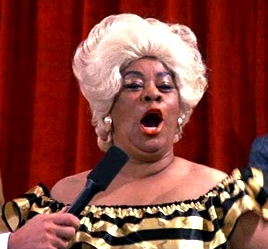
In the 1960s Brown focused on her family life. She returned to music the following decade, and added acting gigs to her resume. In 1979 she was a regular character on the sitcom Hello, Larry, and she famously portrayed Motormouth Maybelle in the original 1988 movie version of Hairspray, a role which had echoes of her life performing at segregated dances in the sixties. She won the 1989 Tony Award for Best Performance by a Leading Actress in a Musical for her performance in the Broadway show Black and Blue. Her companion album, Blues on Broadway, won Brown the Grammy Award for Best Jazz Performance, Female.

Ruth Brown 327410_1258221698098_full
Brown was also influential in the creation of the Rhythm and Blues Foundation, founded in 1988. Per the nonprofit’s mission statement, the Rhythm and Blues Foundation is “dedicated to the historical and cultural preservation of Rhythm & Blues music and recognition of participants in its community by providing services and programs to Rhythm & Blues artists and their fans.”

In 1993, Ruth Brown was inducted into the Rock and Roll Hall of Fame.

She died in 2006 from complications resulting from a heart attack and stroke.

Inspired by Ruth Brown, who was born on January 12*, 1928, today’s playlist presents twenty of the best rhythm and blues recordings from the 1950s.


(*I initially prepared this entry to be posted on January 12. However, once I was about to post it, I read in a few places that the information I had was incorrect, and that Brown’s birth date was January 30, so I saved it for today. Just after I finished re-editing it this afternoon, I looked on Wikipedia and see they (now) list her birthday as January 12, which some other sites confirmed.)

Click here to like Tunes du Jour on Facebook.
Follow me on Twitter: @TunesDuJour


It’s Friday And I Need To Dance!

Jada Pinkett Smith announced that she is boycotting the Academy Awards this year due to the lack of diversity among the acting nominees. I’m sure that will put a huge dent in the show‘s ratings, as the 40 million people who tend to tune in to the telecast do so to see Jada Pinkett Smith. Following in Pinkett Smith’s footsteps, Spike Lee and Pinkett Smith’s husband Will Smith announced that they were joining in the boycott.

The issue is that out of twenty nominated actors and actresses, twenty are Caucasian. At first glance that doesn’t appear to be very diverse. At second glance, it’s still not diverse, but a boycott is not going to bring about the change that is needed.

Granted, the conversation about the lack of diversity among the nominees needs to be had. The Motion Picture Academy needs to step up its efforts to expand its membership beyond white men, who at this time overwhelmingly make up its ranks.

However, the Academy Award nominations are the result of the actual problem, which is the lack of diversity involved in the movies being made by Hollywood. Movie studios and production companies need to be engaged in the diversity conversation. They’re the ones making the majority of films from which the Academy chooses the nominations. While Caucasian men make up the majority of ticket buyers, serving other demographics adds to a studio’s bottom line. Remember how shocked everyone was when the Sex & the City movie proved a box office bonanza? It’s a movie with female leads that sold tickets primarily to women moviegoers and grossed over $400 million, and it isn’t even good!

Women like to see their lives on the screen. So do African Americans. And Latinos. And people of Asian descent. And gay people. And trans people. And older people. And so on and so on.

Seeing one’s life on the screen means more than merely seeing people of one’s race or ethnicity or gender or sexual orientation on screen. As the conversation surrounding this year’s nominees focuses on race, let’s look at some recent black nominees.

During the past decade, Chiwetel Ejiofor and Lupita Nyong’o were nominated for portraying slaves. Denzel Washington was nominated for his role as an alcoholic drug-abusing pilot. Octavia Spencer and Viola Davis were nominated for playing maids. (Spencer won, but Davis lost to Meryl Streep’s portrayal of Margaret Thatcher. Yes, the Iron Lady won over the lady who irons.) Mo’Nique won for her portrayal of an abusive mother. Forest Whitaker won for playing a corrupt, human rights-abusing dictator. Barkhad Abdi was nominated for playing a pirate. Ruby Dee was nominated for playing the mother of a drug kingpin.

Also nominated was Gabourey Sidibe for her portrayal of an African-American teenager who is repeatedly raped by her father and abused by her mother and others. That performance lost to Sandra Bullock’s portrayal of a nice, white lady who takes in a troubled African American teen.

Other characters portrayed by recently nominated white folks include Colin Firth as a king with a speech impediment, Eddie Redmayne as a brilliant scientist, Benedict Cumberbatch as a brilliant computer scientist, Leonardo DiCaprio as a stockbroker, Patricia Arquette as a loving mother, Sandra Bullock as an astronaut, Daniel Day-Lewis as the U.S. president who freed the black slaves, Robert Downey Jr. as a white actor portraying a black man, and Christoph Waltz as a bounty hunter who emancipates and mentors a black slave. I’m not going to go through every white nominee; we’ll be here all day!

From the examples given, eagle-eyed observers may notice the types of parts for which black actors and white actors get nominated for Academy Awards. Lee and the Smiths are not wrong in saying there is a problem here that needs to be fixed.

Joining the boycott are Curtis Jackson, star of such not-Oscar nominated films as Get Rich or Die Tryin’, Home of the Brave and Righteous Kill. Under his nom de rap 50 Cent, Jackson posted on Instagram a plea for Chris Rock to step down as the award show’s host. The same request came from Tyrese Gibson, star of such not-Oscar nominated films as The Fast & the Furious, 2 Fast 2 Furious, The Fast & the Furious: Tokyo Drift, Fast & Furious, Fast Five, Fast & Furious 6, and Furious 7.

Calvin Broadus, under his nom de rap Snoop Dogg, posted a video on Instagram that said “Fornicate the Academy Awards,” though not in those exact words. Broadus was not nominated for his role in The Wash, in which he stretched his acting chops by portraying Dr. Dre’s weed-smoking best friend. That film has an 8% on Rotten Tomatoes.

Until a few minutes ago I thought The Wash was a remake of the seventies movie Car Wash, which has an 86% rating on Rotten Tomatoes. Per Wikipedia, The Wash is an original movie written and directed by Mark Jordan under his nom de rap, DJ Pooh.

While the soundtrack of The Wash didn’t produce any Billboard Hot 100 hits, the soundtrack to Car Wash did. It was on January 29, 1977, that its theme song hit #1, an incredible feat given it’s a song about a car wash. Amazingly, the song holds up to this day.

Friday is dance day at Tunes du Jour. Our playlist kicks off with Rose Royce’s “Car Wash.”


Click here to like Tunes du Jour on Facebook!
Follow me on Twitter: @TunesDuJour.