Thinking of moving but don’t know where to? Let today’s playlist help you out. It kicks off with “Chicago” by Graham Nash. Nash turns 73 today.
Click here to like Tunes du Jour on Facebook!
Follow me on Twitter: @TunesDuJour
Thinking of moving but don’t know where to? Let today’s playlist help you out. It kicks off with “Chicago” by Graham Nash. Nash turns 73 today.
Click here to like Tunes du Jour on Facebook!
Follow me on Twitter: @TunesDuJour
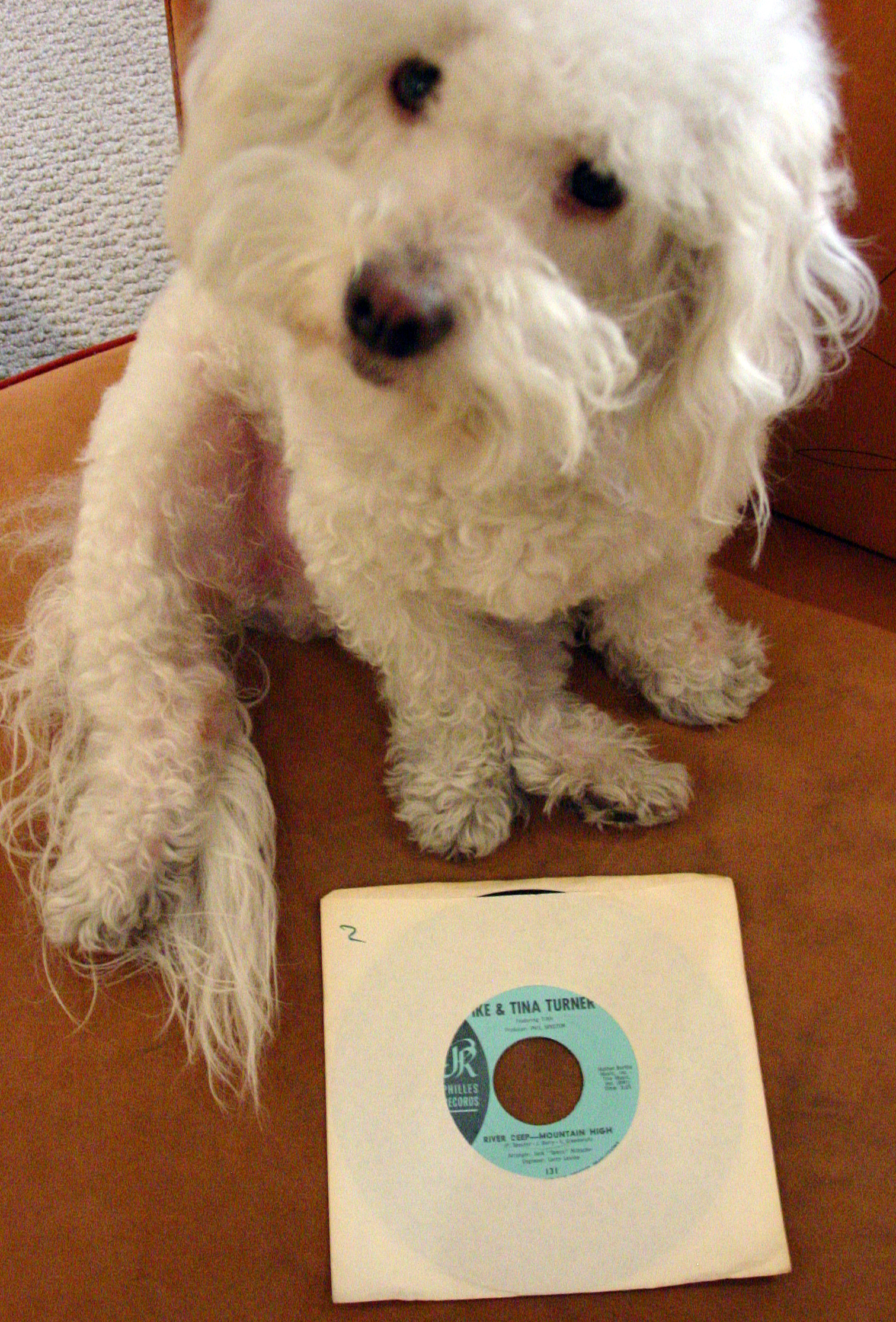
By 1966, the recording duo Ike & Tina Turner and the record producer Phil Spector could use a turnaround in their luck.
Ike & Tina Turner’s first hit song was 1960’s “A Fool in Love.” Two more top forty pop and four more r&b top ten hits followed over the next couple of years.
Phil Spector’s first hit as a producer was The Teddy Bears’ “To Know Him Is to Love Him,” a #1 pop single in 1958. Over the next seven years Phil Spector produced twenty-five top 40 pop hits, including such classics as The Ronettes’ “Be My Baby,” The Righteous Brothers’ “You’ve Lost That Lovin’ Feeling” and “Unchained Melody,” The Crystals’ “He’s a Rebel” and “Da Doo Ron Ron,” and Curtis Lee’s “Pretty Little Angel Eyes.”
Fast forward to late 1965. Ike & Tina Turner’s last top 40 pop hit was “Poor Fool,” which peaked at #38 in early 1962. It went top ten on the r&b chart, as did its follow-up, “Tra La La La,” but successive singles failed to do as well.
Despite scoring four top ten singles on Spector’s Philles Records, The Righteous Brothers sued the producer/record company head to get off the label, saying their contract was unenforceable. It was announced in early 1966 that the duo signed with another label. Their first single for that label, Verve, was a #1 hit – “(You’re My) Soul and Inspiration.” Spector lost his star attraction, and the other acts in his stable had lost luster. The Ronettes’ most recent top 40 hit was 1964’s “Walking in the Rain.” The Crystals’ most recent top 40 hit was 1963’s “Then He Kissed Me.”
In 1965 the Ike & Tina Turner Revue performed The Galaxy in Los Angeles. In the audience was Phil Spector. He loved their act and booked them to appear on The Big TNT Show, a televised concert for which he was the associate producer and musical director. Also appearing on the program were The Byrds, Ray Charles, Bo Diddley, The Lovin’ Spoonful, Donovan, Joan Baez, Petula Clark, and Roger Miller.
Spector was taken by Tina’s performance. “I said, God, if I could make a number-one record with her she could go on Ed Sullivan, she could go to Las Vegas; she could break the color barrier.” At the time, Ike & Tina were singed to Loma Records, a division of Warner Brothers Records. None of their releases hit the pop charts. Spector negotiated a release from their Loma contract. Spector wanted Tina, not Ike, so he paid Loma $20,000 to buy out the duo’s contract, on the condition that Ike stay away from the studio while Tina recorded. Ike accepted this offer, with the stipulation that the resulting record still be credited to Ike & Tina Turner.
To come up with a suitable song, Spector turned to the husband and wife songwriting team of Jeff Barry and Ellie Greenwich, who, with Spector, wrote “Be My Baby” and “Da Doo Ron Ron” and also wrote “Leader of the Pack” (with Shadow Morton) and “Do Wah Diddy Diddy.” CORRECTION: former husband and wife songwriting team – Barry and Greenfield divorced in December 1965, just a few weeks before Spector asked them to write a song for Tina.
Though freshly-divorced, they both came to the table, each with a different unfinished song. The combination of the three songs resulted in “River Deep – Mountain High,” with the melody of the verses coming from Greenwich, the melody of the chorus coming from Spector, and most of the lyrics coming from Barry.
The first of five recording sessions for the single was in February 1966. Hanging out in the control room were a couple of folks you may have heard of – Mick Jagger and Brian Wilson. To achieve his vision Spector used 21 background vocalists and 21 musicians, including Glen Campbell, Leon Russell and Hal Blaine. The completed record cost around $22,000 to make. Said Bob Krasnow, the head of Loma Records, “In those days, you could make five albums for twenty thousand dollars. And this was just a single – one side of a single.”
After years with Ike Turner, Tina must have been relieved to be able to go into the studio without Ike and with Phil Spector, a man who treated women with respect – scratch that thought. In her autobiography, I, Tina, she recounts a recording session with Spector. “That intro – ‘When I was a little girl…’ – I must have sung that five hundred thousand times, and I don’t know if I ever got it just the way he wanted it. I would sing it, and he would say, ‘That’s very close, very close. We’ll try it again.’ I don’t remember him saying, ‘Got it.’ Pretty soon, I was drenched with sweat. I had to take off my shirt and stand there in my bra to sing, that’s how hard I was working on that song.”
A River Deep – Mountain High album, with a cover photo taken by a broke Hollywood actor named Dennis Hopper, wouldn’t be released until 1969. However, the “River Deep – Mountain High” single came out in the United States on May 14, 1966. It entered the Hot 100 at #98. A week later it was #94. One week after that #93. The next week it rose to #88.
And that was it. The record that was to be the triumphant return of Ike & Tina Turner and Phi Spector stayed on the chart for only four weeks. Looking back, Tina concluded “It was too black for the pop stations, and too pop for the black stations.” Ike agreed.
After the single’s failure, Spector became a semi-recluse. It would be three years before another Phil Spector’s production was on the Hot 100.
In the United Kingdom, however, it was a different story. “River Deep – Mountain High” peaked at #3 there. George Harrison called it “a perfect record from start to finish – you couldn’t improve on it.” Harrison would later have Spector co-produce his All Things Must Pass album, which included the classic “My Sweet Lord.”
In praising Tina, Mick Jagger said “’River Deep-Mountain High’ was an excellent record because she had the voice to get out in front of Phil Spector’s so-called wall of sound.” The Rolling Stones invited Ike & Tina to open for them on their tour that began in the autumn of 1966.
In 1999, “River Deep – Mountain High” was inducted in the Grammy Hall of Fame. Rolling Stone magazine put it at #33 on its list of the 500 Greatest Songs of All Time.
Tina Turner turns 75 today. Here are twenty career highlights, kicking off with the classic “River Deep – Mountain High.”
Read more about Tina Turner here.
Click here to like Tunes du Jour on Facebook!

As a songwriter, Jimmy Webb scored his first hit in 1967 at age twenty when The 5th Dimension took “Up, Up and Away” to the top ten. Later that year Glen Campbell had a hit with Webb’s composition “By the Time I Get to Phoenix.”
Webb then wrote a 22-minute cantata. His friend Bones Howe, with whom Webb worked on The 5th Dimension’s Up, Up and Away album, invited Webb to play the new piece for The Association, who Howe was then producing. Their reaction was less than enthusiastic. Per Howe, one group member said “Any two guys in this group could write a better piece of music than that.”
Sometime after, Webb received a telegram from actor Richard Harris, who he met at a fundraiser in Los Angeles. Harris was nominated for an Academy Award in 1963 for This Sporting Life and again in 1990 for The Field. He later went on to play Professor Dumbledore in the first two Harry Potter movies. The telegram read “Jimmy Webb, come to London and make a record. Love, Richard.”
Webb flew to London, bringing a satchel of songs he’d written. He played each for Harris, but nothing struck the actor. Webb recalled “I looked down with some dread because there was only one thing left.” That one thing was the last movement of the cantata he presented to The Association. He called it “MacArthur Park.”
Here are the lyrics to “MacArthur Park.” Raise your hand when they get confusing.
The opening lines are “Spring was never waiting for us, girl / it ran one step ahead, as we followed in the dance.”
I see some hands raised. The next line should help you understand: “Between the parted pages and were pressed in love’s hot fevered iron, like a striped pair of pants.” Now you got it! Harris, who is from the UK, where “pants” means underwear, uses an iron, a hot fevered iron, on his striped underwear. You may be asking: Does he iron his solid-colored underwear? Does he have solid-colored underwear? Boxers or briefs? Relax – there are still six and a half minutes left in the song, so maybe you’ll find out.
Moving on, we learn that MacArthur Park, which Harris calls MacArthur’s Park for the duration of the song, is melting. In the dark. Its icing is flowing down. Who hasn’t been there?
We now arrive at the classic lines about a cake left out in the rain, which appears to be causing Harris to have a breakdown. “I don’t think that I can take it ‘cause it took so long to bake it and I’ll never have that recipe again. Oh no!” Calm down. It’s just a cake. Bake another one. I know – this song was recorded in the pre-Internet age when finding a cake recipe required one to open a cook book, but come on! This cake can’t be that special if you chose to leave it out during inclement weather.
By the end of verse one we have learned several things: 1) Harris is singing to a girl; 2) Harris irons his striped underwear; 3) a park is melting; 4) if you bake a cake and wish to leave it outside, check The Weather Channel first; and 5) never write a song while you are on an acid trip.
As the song continues it gets more bizarre. The melody changes and Harris threatens us by singing “There will be another song for me, for I will sing it.” Luckily, this other song never became a hit. (And may I add, he is being rather presumptuous by calling his performance on this record “singing.”)
The song clocks in at nearly seven and a half minutes, and though it reached #2 on the US pop charts, most listeners had no idea why Harris was singing about a melting park, ironed underwear and a waterlogged dessert.
Songwriter Webb didn’t understand the confusion. He told Q Magazine that the song is “clearly about a love affair ending, and the person singing it is using the cake and the rain as a metaphor for that.” Clearly. Clear as mudcake.
The love affair was one from Webb’s own life. He and his girlfriend would meet for lunch at MacArthur Park, where there would sometimes be birthday parties, with cake. Their breakup devastated Webb, who wrote “Mac Arthur Park” and “By the Time I Get to Phoenix” based on their relationship. (Bonus trivia – the woman went on to marry Linda Ronstadt’s cousin.)
In 1993, humorist Dave Barry surveyed his readers to find the worst song. The clear winner for Worst Overall Song and Worst Lyrics was “Mac Arthur Park.” Culture critic Joe Queenan disagreed with the results “because ‘Ebony and Ivory’ exists, as do ‘You Don’t Bring Me Flowers,’ ‘Baby, I’m-a Want You,’ ‘Feelings,’ ‘Benny and the Jets,’ ‘Witchy Woman’ and ‘Sussudio,’” adding “On a planet where somebody thought it would be a good idea to write ‘Scenes from an Italian Restaurant,’ the best ‘MacArthur Park’ is ever going to earn in the sucky-song sweepstakes is a tie.”
Good or bad, the song is a classic. A 1968 Grammy winner for Best Arrangement Accompanying Vocalist, the song has been recorded by top artists in diverse genres, including Frank Sinatra, Tony Bennett, Sammy Davis Jr., Liza Minnelli, the Four Tops, Maynard Ferguson, Stan Kenton and Woody Herman. Waylon Jennings’ 1969 version won a Grammy. In 1978, Donna Summer’s rendition became her first #1 pop record and stands as the only US #1 pop song for Jimmy Webb, who also wrote “Wichita Lineman,” “Galveston,” “Worst That Could Happen” and “All I Know.”
It has been rumored that Webb and Harris had a falling out due to the song’s success. Harris promised Webb his Rolls Royce if the song went top ten. When the record did, Harris offered Webb a different Rolls Royce. It is because of this that people named Richard are often called Dick. Allegedly, the pair stopped speaking.

Today Jimmy Webb turns 68 years old. Hopefully he’s somewhere celebrating with a nice piece of wet cake. We kick off our weekly dance party with Donna Summer’s version of “MacArthur Park,” which she, like Harris, insists on calling “MacArthur’s Park” for the duration of the song.
Like Tunes du Jour on Facebook. Click here.