Tunes Du Jour Presents 1984

It’s hard to overstate how culturally dominant pop music was in 1984—or how much the year reshaped the landscape. Many of the songs on this playlist weren’t just hits; they were defining moments, launching or solidifying the careers of artists whose names still carry weight today. The sheer number of songs from 1984 that are still instantly recognizable points to a moment when creativity, commerce, and cultural change aligned. The presence of “Thriller”—Michael Jackson’s seventh single from the album of the same name—reminds us that the music business had never seen anything quite like this before. And yet, he wasn’t the only artist making history.

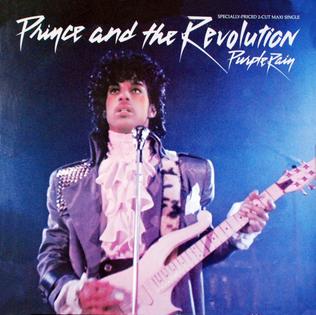
Prince’s “Purple Rain” marked not just a commercial breakthrough, but a creative one. It’s a song, an album, and a film—each enhancing the other’s mythology. Similarly, “Like a Virgin” signaled Madonna’s arrival as more than a pop star; she became a cultural force. Tina Turner, with “What’s Love Got to Do with It,” pulled off one of the most celebrated comebacks in music history. And Cyndi Lauper’s “Girls Just Want to Have Fun” brought an infectious blend of new wave and punky playfulness to the mainstream, reshaping ideas about femininity and pop performance.

Meanwhile, the rock world was hardly on pause. “Jump” became Van Halen’s biggest hit, thanks to its synth hook and anthemic chorus, while Bruce Springsteen’s “Dancing in the Dark” pushed his career into stadium territory. Across the Atlantic, U2’s “Pride (In the Name of Love)” began their transformation from college radio favorites to global headliners. The Replacements’ “I Will Dare,” from Let It Be, captured the heart of American indie rock—irreverent, emotionally raw, and just tuneful enough to hint at wider possibilities. And among the post-punk and alternative set, songs like “The Killing Moon” by Echo & the Bunnymen and “Heaven Knows I’m Miserable Now” by The Smiths gave moody introspection a lasting soundtrack.

What also stands out in 1984 is the range of genres that made a mainstream impact. Shannon’s “Let the Music Play” helped lay groundwork for freestyle, and Chaka Khan’s “I Feel for You” was a pivotal crossover moment, bringing together R&B, pop, and hip-hop. Run-D.M.C.’s “Rock Box” did something similar, blending rap and rock before it was fashionable. The Pointer Sisters’ “Automatic” was one of several hits that proved they could thrive in an electronic pop era without losing their vocal identity. Even novelty songs like “Ghostbusters” or the cheerful “Wake Me Up Before You Go-Go” helped shape the sound of the time.

Beyond chart success, 1984’s songs carried messages—sometimes playful, sometimes political. “Free Nelson Mandela” by The Special A.K.A. was a global anthem of protest. Depeche Mode’s “Blasphemous Rumours” examined faith and fate with a dark electronic edge. And “Somebody’s Watching Me,” a paranoid slice of synth-pop, foreshadowed a media culture on the verge of explosion. Whether on the dancefloor, in dorm rooms, or through the television set, 1984’s music didn’t just reflect its era—it helped define it.

Follow Tunes Du Jour on Facebook

Follow me on Bluesky

Follow me on Instagram
Throwback Thursday: 1984

Madonna! Prince! Bruce! Michael! Chaka! Cyndi! Rockwell! Boy! The best of 1984’s pop stars/hits made a mark that remain part of our consciousness nearly forty years later. The influence of upstarts who didn’t crack the Hot 100 – The Smiths, The Replacements, Run-D.M.C. – has been acknowledged in the years since. For those who wish to relive those days, for those who wish they were living then, and for those who wish to associate 1984 with something other than a misunderstood piece of classic literature or the most recent Wonder Woman movie, this playlist is for you. Happy Throwback Thursday!

Follow Tunes du Jour on Facebook.

Follow Tunes du Jour on Twitter.

Follow me on Instagram.

Throwback Thursday – The Hits of 1984

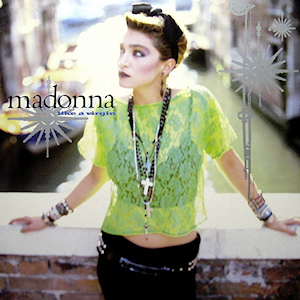
Madonna debuted “Like a Virgin” with a performance on the MTV Video Music Awards in September 1984, weeks before the record was released. Watching her on television rolling around the floor in a wedding dress with a Boy Toy belt buckle, the song’s writers, Tom Kelly and Billy Steinberg, thought “We’re doomed now. This is an embarrassment. This is never going to succeed.”

“Like a Virgin” spent six weeks at #1 on the Billboard Hot 100, her first single to top that chart.

Kelly and Steinberg didn’t meet Madonna until around five years later. At a party they saw her, and asked Steve Bray, who wrote Madonna’s hit “Into the Groove,” to introduce them.

Bray did so. “Madonna, I want you to meet Billy Steinberg and Tom Kelly. They wrote ‘Like a Virgin.’”

Steinberg said “Oh Madonna, I’ve wanted to meet you for so long.”

Madonna replied “Well, now you did,” and walked away.

“Like a Virgin” kicks off this week’s Throwback Thursday playlist, spotlighting the hits of 1984.


Click here to like Tunes du Jour on Facebook!
Follow me on Twitter: @TunesDuJour

It’s Berry Gordy’s Birthday And I Need To Dance!

It’s interesting that Berry Gordy, the head of Motown Records who in 1970 told his top male vocalist Marvin Gaye that the new song Gaye had written, “What’s Going On,” was “the worst thing I ever heard in my life” and that he shouldn’t do protest songs, would five years later have Motown be the first major label to release a pro-gay anthem.

Bunny Jones, a heterosexual Christian woman, owned several beauty salons in Harlem. Most of her employees were gay. Seeing how they needed to suppress their natural selves and being aware of the issues they faced, she wrote song lyrics about a man who says he’s “happy, carefree and gay,” the way God made him.

Set to music written by Chris Spierer, also straight, Jones looked for a male vocalist to record her song. After catching a performance of Hair at the Westbury Music Fair, she approached one of the show’s actors, Charles “Valentino” Harris, and told him of the song.

In 1975, at age 22, Valentino recorded his only record, a single entitled “I Was Born This Way.” Jones released it on a label she started, named Gaiee. On her own she sold 15,000 copies of the song. This got the attention of Berry Gordy, whose Motown Records picked up the single for distribution.

Valentino’s record got some club play, particularly in the UK where it was a #1 disco hit.

Two years later Motown approached a gospel singer named Carl Bean and asked him if he would record a new version of “I Was Born This Way.” Unbeknownst to Motown, Bean was gay. In early 1978, Bean’s version of the tune reached #15 on the Billboard Disco chart.

The song has since become something of a classic. Two years after Bean’s success with “I Was Born This Way,” Motown released Diana Ross’ “I’m Coming Out.” It would hold the #1 position on the Disco chart for five weeks and have much crossover success at pop and r&b radio as well.

Today Berry Gordy celebrates his 85th birthday. Friday is dance day at Tunes du Jour. Here are twenty of Motown’s best disco/dance tracks from the 1970s thru 1990.

Click here to like Tunes du Jour on Facebook!

Winston + Chic 2014-09-19 13.37

It’s Halloween And I Need To Dance!

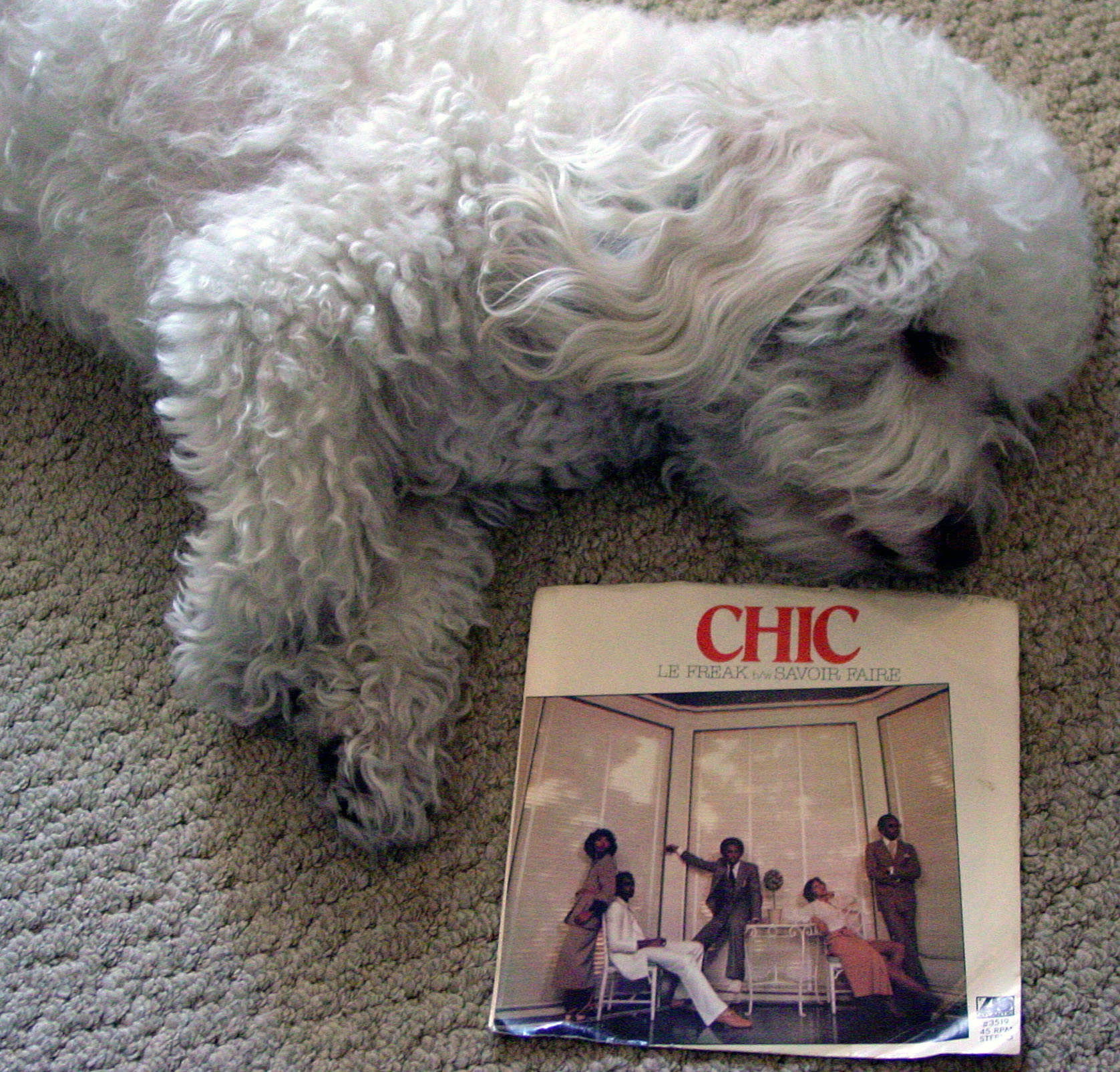
On the night of December 31, 1977, Grace Jones rang in the new year with a performance at New York City’s Studio 54. She invited Nile Rodgers and Bernard Edwards of the band Chic, whose hits such as “Dance, Dance, Dance (Yowsah, Yowsah, Yowsah)” were often played at the club, to catch her show. The guys went to the stage door, where the doorman told them to “Fuck off!” They went to the front entrance and told the doorman there they were personal guests of Jones. The doorman told them they weren’t on the list and refused them admission. Though all dressed up, they went back to the apartment where Nile was then staying. Several bottles of champagne and a little cocaine later, the two musicians started jamming on a song they improvised, inspired by the first doorman. “Awww, fuck off – fuck Studio 54 – fuck off.”

Bernard was impressed with the riff they created, though both knew they wouldn’t get radio airplay for a song that went “fuck off.” (How times have changed!) They changed “fuck” to “freak,” though “freak off” sounded lame. Then Bernard suggested changing “off” to “out.” Nile responded “Like…when you’re out on the dance floor losing it, you know you’re freaking out,” to which Bernard replied “Yeah, plus they have that new dance called ‘the Freak.’”

“Le Freak” debuted on the Billboard Hot 100 in the fall of 1978. In December it hit #1, though it got knocked from the top a week later by Barbra Streisand and Neil Diamond’s “You Don’t Bring Me Flowers.” One week later “Le Freak” went back to #1, but one week after that it got knocked out by Bee Gees’ “Too Much Heaven.” Two weeks later “Le Freak” returned to #1, staying on top for four more weeks. It went on to sell approximately twelve million units worldwide, becoming the best-selling record ever for Atlantic Records.

In 1979 “Le Freak” was included on a compilation album entitled A Night at Studio 54.

Winston + Chic 2014-09-19 13.37
All sorts of freaks and monsters will be out today/tonight for Halloween. This week’s dance party is inspired by the holiday.