Tunes Du Jour Presents Covers Of The Rolling Stones

One of the best ways to understand a song’s true strength is to hear it played by someone else. When a song can be lifted from its original context, performed by a different artist in a new style, and still resonate, you know the writers built it on a solid foundation. Looking at the sheer breadth of artists who have successfully interpreted the songs of Mick Jagger and Keith Richards, it becomes clear that their songwriting partnership created something remarkably durable. While their own recordings as The Rolling Stones are iconic, it’s the cover versions that reveal the fundamental power of the compositions themselves.

The playlist immediately highlights how deeply their writing is rooted in the American soul and R&B they revered. It’s one thing to be influenced by a genre; it’s another to write songs that the masters of that genre can inhabit as their own. When you hear Aretha Franklin transform “Jumpin’ Jack Flash” into a gospel-fueled force of nature, or Ike & Tina Turner inject “Honky Tonk Women” with their signature high-octane energy, you realize the songs contain an authentic rhythmic and emotional core. This goes even deeper with Solomon Burke’s take on “I Got the Blues” or Bettye LaVette’s searing, world-weary version of “Salt of the Earth.” These aren’t just covers; they are reclamations, demonstrating that the blueprints Jagger and Richards created were so solid that they could hold the weight of the most powerful voices in soul music.

What’s also remarkable is the structural flexibility of their work. A great Jagger/Richards song often has a distinct personality, yet its core components—melody, lyrical theme, and chordal movement—are adaptable enough to thrive in entirely new environments. The post-punk angularity of Devo’s “(I Can’t Get No) Satisfaction” strips away the blues swagger to expose the lyric’s timeless complaint of modern alienation. The Sundays reimagine the country-tinged “Wild Horses” as a piece of shimmering, ethereal dream pop, proving the song’s beautiful melody is its true anchor. Even more extreme, the Ramones boil “Out of Time” down to its raw essentials, recasting the shuffling pop song as a driving, three-chord punk declaration, while Ituana finds a relaxed, bossa nova groove in the epic “You Can’t Always Get What You Want.” The songs don’t just survive these transformations; they reveal different facets of their character.

Ultimately, this collection of performances underscores that the Jagger/Richards catalog is more than a collection of iconic riffs and rock and roll attitude. These are fundamentally well-crafted songs. They can be country laments in the hands of Johnny Cash (“No Expectations”) or Steve Earle (“Dead Flowers”). They can be theatrical pop statements for David Bowie (“Let’s Spend The Night Together”) or Bryan Ferry (“Sympathy for the Devil”). They can even be played for laughs by “Weird Al” and The Folksmen precisely because the source material is so instantly recognizable. The Rolling Stones’ versions will always be definitive, but these interpretations from other artists give us a clearer view of the writers’ craft, proving the songs stand on their own, ready for anyone to find a piece of their own story within them.

Follow Tunes Du Jour on Facebook

Follow me on Bluesky

Follow me on Instagram
Throwback Thursday – 1963

The girl group sound was hugely popular on the US pop charts in the early 1960s. The Shirelles, The Crystals, The Chiffons, The Angels, Martha and the Vandellas, The Marvelettes, The Exciters, The Orlons, The Cookies, The Murmaids, The Dixie Cups, The Supremes, The Toys, The Shangri-Las, The Jaynetts and others filled the radio with tales of teenage romance, heartbreak and occasionally social commentary. Solo acts such as Lesley Gore and Darlene Love also exemplified the girl group sound.

Described in the Library of Congress’ National Recording Registry as “the quintessence of the ‘girl group’ aesthetic of the early 1960s,” the Ronettes’ “Be My Baby” reached #2 in 1963. The record was produced by Phil Spector, who produced at least 15 top forty girl group songs between 1962 and 1964.

Lead vocals on “Be My Baby” were performed by Ronnie Spector. In fact, the other Ronettes aren’t even on the record. Backup singers included the girlfriend of Phil Spector’s promotion man. That man was Sonny Bono; his girlfriend was Cher. Sonny & Cher would have their first hit as a duo two years later.

This week’s Throwback Thursday playlist spotlights the hits of 1963. Here are twenty of that year’s best, kicking off with the record New Music Express named the second best song of the 1960s (their #1 was The Beatles’ “A Day in the Life”), the Ronettes’ “Be My Baby.”


Click here to like Tunes du Jour on Facebook!
Follow me on Twitter: @TunesDuJour
Follow me on Instagram: @GlennSchwartz

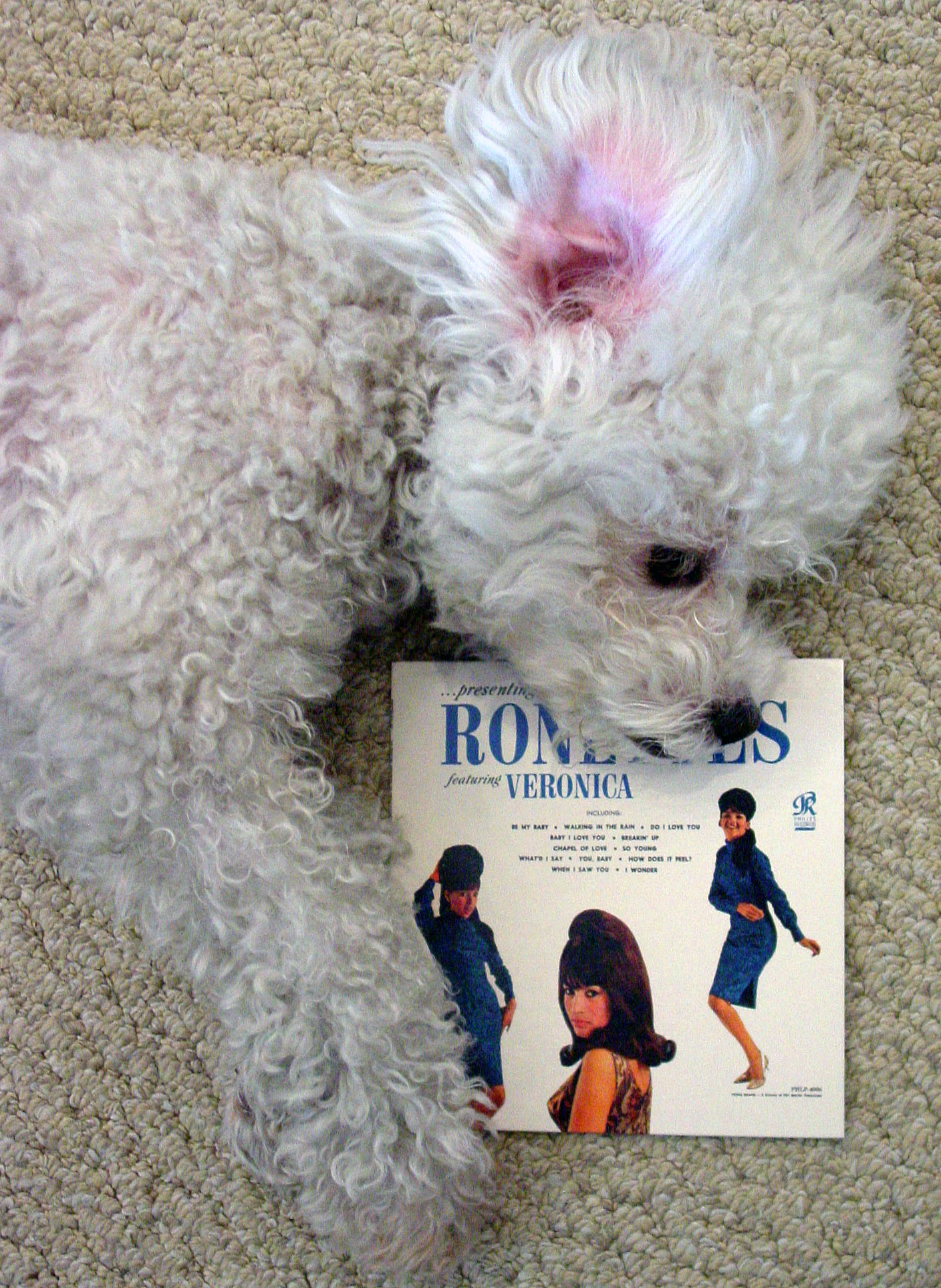
Ringo + Ronnie 2014-08-10 12.19

The Ronettes – “Be My Baby”

Ringo + Ronnie 2014-08-10 12.19

Ronnie Spector turns 71 years old today. Along with her sister Estelle and cousin Nedra, Ronnie, then Veronica “Ronnie” Bennett, formed The Ronettes, one of the classic girl groups of the sixties.

The trio was signed to Colpix Records, but none of their singles performed well. Then they met Phil Spector, who signed them to his label, Philles.

The first track Spector recorded with the trio was “Why Don’t They Let Us Fall in Love?,” which, though the girls liked it, Spector held from release.

With Jeff Barry and Ellie Greenwich, Phil Spector wrote “Be My Baby,” with the intention of having Ronnie Bennett, the woman he wanted to be his baby, record it.

The resulting record had a classic Spector wall of sound production and Phil recorded more than 40 takes. It took Ronnie three days to get the lead vocal down.

The other Ronettes don’t sing on “Be My Baby.” Background vocals were provided by Darlene Love, Nino Tempo, Sonny Bono, who did promotion for Phil Spector, and Bono’s girlfriend, Cher.

In 1963, The Ronettes’ “Be My Baby” rose to #2 on Billboard’s Hot 100. Since that time it has made many lists of the greatest recordings. Among its biggest fans is Brian Wilson of The Beach Boys, who named it is favorite single of all-time, saying “This is a special one for me. What a great sound, the Wall of Sound. Boy, first heard this on the car radio and I had to pull off the road, I couldn’t believe it. The choruses blew me away; the strings are the melody of love. It has the promise to make the world better.”

Ronnie Bennett married Phil Spector in 1968. They divorced in 1974.

Today’s playlist consists of twenty tracks embodying the classic girl groups sound, with an emphasis on The Ronettes.