Elton John’s Derivative Rock

British-born Reginald Kenneth Dwight, better known by his stage name, Elton John, hit #1 on the singles and album charts in the U.S. prior to doing so in his home country.

His first #1 album stateside was Honky Château, which topped the chart in 1972, thanks to hit singles “Rocket Man” (#6) and “Honky Cat” (#8).

The first single off his follow-up album was inspired by a song Elton discovered while touring Australia the year Château was released. A local band named Daddy Cool had a million-selling smash in that country called “Eagle Rock,” which remained at #1 on their singles chart for ten weeks. The song told of a popular American dance from the 1920s.

Bernie Taupin, Elton’s lyricist in those days, wrote of a fictional American dance from the early days of rock and roll. Taking Bill Haley & His Comets’ “See You Later Alligator” as inspiration for this dance, Taupin called it the “Crocodile Rock.” Another Haley classic is referenced in the song, as Elton sings “while the other kids were rockin’ ‘round the clock.”

Other early rock-and-roll tunes inspired the writers (Elton composed the music) as well. Buddy Kaye, writer of “Speedy Gonzales,” a 1962 hit for homophobic shitbag Pat Boone, accused Elton of copying that tune for “Crocodile Rock”’s “la la la la la” refrain. Elton’s response to Kaye’s claim was that “Crocodile Rock” was “a really blatant homage to ‘Speedy Gonzales’ and all the great ’50s and ’60s records that we used to love.” So there!

“Crocodile Rock,” which, by the way, contains eighty “la’s,” was released as a single in the U.S. in November of 1972, the first single released by MCA Records. It became the first of eight #1 singles for Elton John. In the U.K. the single peaked at #3. The long-player from which it was taken, Don’t Shoot Me I’m Only the Piano Player, became the second of seven #1 Elton John albums in the U.S. and his first #1 album in the U.K.

(Elton’s first solo single to top the charts in the U.K. was 1990’s “Sacrifice.” He previously topped the U.K. chart with “Don’t Go Breaking My Heart,” a duet with Kiki Dee, in 1976.)

Of Elton’s first U.S. #1, Bernie Taupin said “I don’t want people to remember me for ‘Crocodile Rock.’ … But there are things like ‘Crocodile Rock’ which was fun at the time, but it was pop fluff. It was like, ‘Okay, that was fun for now, throw it away, and here’s the next one’” and called the song “a strange dichotomy because I don’t mind having created it, but it’s not something I would listen to.”

Elton’s retort to critics who called the song derivative was “it’s derivative in every sense of the word.”

Today Elton John turns 68 years old. Here are twenty tracks from when he and his rock were young.

Click here to like Tunes du Jour on Facebook!
Follow me on Twitter: @TunesDuJour
Ringo + Chubby

Let’s Twist!

Ringo + Chubby
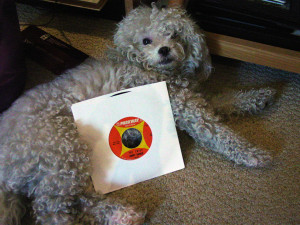
On January 13, 1962, Chubby Checker returned to #1 with “The Twist,” a record he previously took to #1 in September of 1960, making it the only record to hit #1 in two separate chart runs.

The song was originally recorded and released in 1959 by its writer, Hank Ballard, and his band, The Midnighters, as the b-side to their single “Teardrops on Your Letter.” A Baltimore DJ named Buddy Deane played “The Twist” on his television dance party program and got a good response. He told Dick Clark, host of American Bandstand about the tune.

Depending on what account you read, Ballard was unavailable to appear on American Bandstand or Clark was wary of Ballard, who previously hit with such lascivious songs as “Work with Me, Annie” and “Sexy Ways.” Either way, Clark had Chubby Checker (born Earnest Evans; his stage name was a take-off on popular singer Fats Domino) record “The Twist.”

Checker’s version is an extremely faithful cover of the Ballard recording. It is difficult to tell them apart; even Ballard thought the Checker recording was his!

In its 1960 release, Chubby Checker’s record launched a national dance craze. On the second release of the Chubby Checker version, “The Twist” became a worldwide phenomenon. Other twist hits included “Slow Twistin’,” “Dear Lady Twist,” “Twist, Twist Señora,” “Twistin’ the Night Away,” “Percolator (Twist),” “Soul Twist,” “Twist and Shout,” “Hey, Let’s Twist,” “Twistin’ Matilda (and the Channel),” “Twist-Her,” “Bristol Twistin’ Annie,” “Twistin’ Postman” and The Chipmunks’ “The Alvin Twist” – and that was just in 1962!

Chubby Checker’s “The Twist” spent one week at #1 in 1960 and two more weeks at #1 in 1962 before it was knocked from the top by…”The Peppermint Twist,” by Joey Dee & the Starlighters.

Here are twenty twistin’ favorites.

Click here to like Tunes du Jour on Facebook!

Ten Facts About Little Richard

1) Mojo magazine’s list of “The 100 Records that Changed the World” placed Little Richard’s “Tutti-Frutti” at #1.
2) Pat Boone, who made a career of recording new tracks by African-American acts and sanitizing them for white audiences, covered Little Richard’s “Tutti-Frutti” in 1956 and had a bigger hit with it than Richard did. To avoid a repeat of this, Richard and his producer, Bumps Blackwell, rehearsed the follow-up single, “Long Tall Sally,” until Richard could sing it as fast as possible, with the thinking that Boone wouldn’t be able to sing it as fast. Little Richard’s version became his first top ten pop hit and the biggest-selling single in the history of Specialty Records. Unfortunately, Pat Boone also enjoyed a top ten hit with his version.
3) Richard wrote a song about a female impersonator from his hometown who was called Queen Sonya. He changed Sonya to Lucille, which became the song’s title. It became Richard’s longest-charting hit in 1957.
4) While on tour in 1957 Richard decided to give up rock & roll and enter the ministry. He left the tour ten days early. The original flight on which he had been scheduled to return home crashed into the Pacific Ocean.
5) In 1962 Richard returned to performing secular music while touring Europe. Sam Cooke was his opening act.
6) Later in 1962 Little Richard’s opening act was The Beatles. Richard taught Paul McCartney how to sing like he does.
7) In 1963 The Rolling Stones opened for Richard. Said Mick Jagger: “I couldn’t believe the power of Little Richard onstage. He was amazing.”
8) Members of Little Richard’s band at times include Jimi Hendrix and Billy Preston. This line-up can be heard on the track “I Don’t Know What You’ve Got (But It’s Got Me),” the last single released by Vee-Jay Records.
9) Rolling Stone magazine’s list of The Greatest Artists of All Time has Little Richard at #8.
10) Today is his 81st birthday.

Enjoy this playlist inspired by one of rock and roll’s originators, Little Richard.