In many Western countries, Friday the 13th is considered a day of bad luck by those who believe in such silliness.
In Spanish-speaking countries, Tuesday the 13th is unlucky.
In Italy, Friday the 17th is considered unlucky and 13 is a lucky number.
In Finland, many organizations promote National Accident Day, which always falls on Friday the 13th.
A study in the Netherlands found fewer car accidents occur on Friday the 13th as compared to other Fridays.
The Stress Management Center and Phobia Institute in Asheville, North Carolina estimates that somewhere between 17 and 21 million people in the United States are afraid of Friday the 13th.
At Tunes du Jour we dance every Friday, and we ain’t afraid of no 13th! Let’s kick off this week’s party with “Bad Luck,” by Harold Melvin and the Blue Notes.
I want to go back to 1984. Not the year. The party.
In 1993 I spent Friday nights at Crowbar, a tiny venue at 339 E. 10th Street in New York City. The weekly party was called 1984. Admission was $3. The music was new wave and pop, primarily from the 80s. Crowbar was about the size of my studio apartment, but that didn’t stop the proprietors from squeezing in a couple hundred folks who wanted to dance to Madonna and New Order and Culture Club.
Because the place was jam-packed, dancing consisted of nodding your head. There was no room to move your legs or arms. There was no air circulation, so one worked up a sweat just standing still. It was great fun, getting lost in the music. Even songs I don’t like were fun at Crowbar. When they played the rare song I couldn’t get into, I would think “If there’s a fire, we’re all going to die. There’s no way for most of us to get out.” Good thing I liked most of the songs!
Mayor Giuliani had the same thought. Not about how great Pet Shop Boys are, but that the place was a fire hazard. He had Crowbar shut down. The party didn’t stop, though. 1984 moved to the more spacious Pyramid Club on Avenue A and was just as much fun, maybe even more so being now one can actually move to the music.
One band that got a lot of play at the party was Erasure. The duo’s singer, Andy Bell, was one of the very few openly gay pop stars in the eighties. 1984 was a gay party (though non-gays were welcome), and the guys who went to Crowbar and then The Pyramid on Friday nights hailed Andy as one of their heroes, in an era when few celebrities were out.
Erasure had two crossover hits in the US. The first was “Chains of Love.” To the general public it was a catchy ditty. To the gay population it was an anthem. In an era when many media outlets portrayed gay and AIDS as automatically connected, fear was rampant. Bell advised listeners to not let who you love shackle you into holding back your love, your compassion, your pursuit of happiness. “Come to me, cover me, hold me. Together we’ll break these chains of love. Don’t give up.” The joy in that club when that song played, hands in the air and patrons singing along, is something I miss.
Andy Bell turns 50 today. Our Friday dance playlist is in honor of him and everyone who made 1984 the party so special.
In 2008, Senator Barack Obama was elected President of the United States. He ran on a message of hope and change.
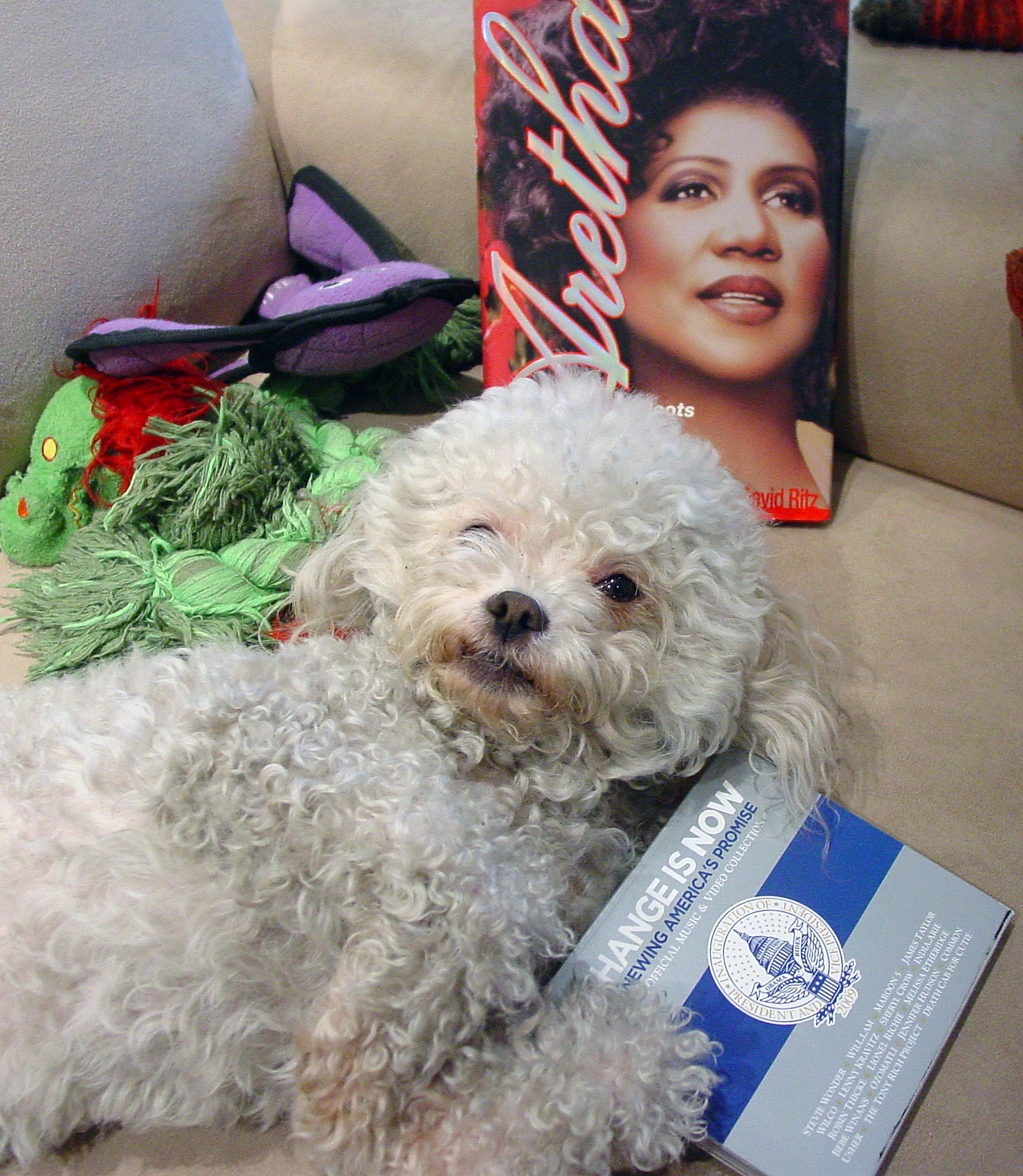
As a memento of his inauguration, Hidden Beach Recordings decided to put together a compilation of songs that expressed these messages. As the head of licensing at Warner Music Group, they approached me about licensing some recordings from our catalogue for inclusion thereon. I suggested Aretha Franklin’s version of Sam Cooke’s “A Change Is Gonna Come.” They thought that was a great idea.
I wanted to be sure Ms. Franklin was fine with having her recording used on the album (this was before she and her hat appeared at the inauguration, so I wasn’t positive she was an Obama supporter). I told her attorney of my idea and a day or two later, Ms. Franklin called me. She liked my suggestion of having her recording included on this compilation. Unfortunately, there was a dispute about Warner’s rights to license the track so the song did not end up on the album, which came out under the title Change Is Now: Renewing America’s Promise.
In his on-line entertainment column, Roger Friedman, then of Fox News, wrote about the compilation, listing all of the artists whose songs were included. He wrote that Warner Music Group refused to make any deals for their artists to be included, which is untrue. I got permission from Wilco and Death Cab For Cutie to license tracks of theirs; they were among the artists Friedman listed just two paragraphs previously. He wrote “I’m sure, in fact, that Aretha Franklin has no idea that requests for a couple of her classic tracks like ‘A Change is Gonna Come’—were declined.” Patently untrue, as you can see from my story. It was a Warner employee’s idea (mine!) to include the track and Ms. Franklin was well aware of it. I guess, unlike me, Friedman couldn’t get Ms. Franklin on the phone. Too bad.
Today the Queen of Soul turns 72 years old. Here are twenty of her best recordings. I left out some classics such as “Respect,” “(You Make Me Feel Like) A Natural Woman,” “Think” and “Freeway of Love” to make room for some lesser-played tracks, though you can hear those here, here, here and here. Enjoy!
The nominations for the 86th Academy Awards were announced yesterday. Who will take home the statuette for Best Original Song? Will it be U2 for “Ordinary Love” from Mandela: Long Walk to Freedom? No. Will it be Pharrell for “Happy” from Despicable Me 2? No. Will it be someone or another for “Let It Go” from Frozen? No. Will it be that song that nobody’s ever heard from that movie that nobody’s ever seen? Hell no. Will it be Karen O. and Spike Jonze for “The Moon Song’” from Her? Yes. Yes it will.
How many of you know all five nominated songs? How many of you know any of the nominated songs? What happened to the days when the general public knew the songs that were nominated?
Today’s dance playlist is built around two Oscar winners – “Last Dance” and “Flashdance…What a Feeling.” That’s right – Thank God It’s Friday and Flashdance are Academy Award winning films. Thank God It’s Friday won more Oscars than North By Northwest, Cat on a Hot Tin Roof, A Clockwork Orange, Psycho, Singin’ in the Rain, Rebel Without a Cause, Taxi Driver and 12 Angry Men put together. Ah, but nobody ever said life was fair, Tina.
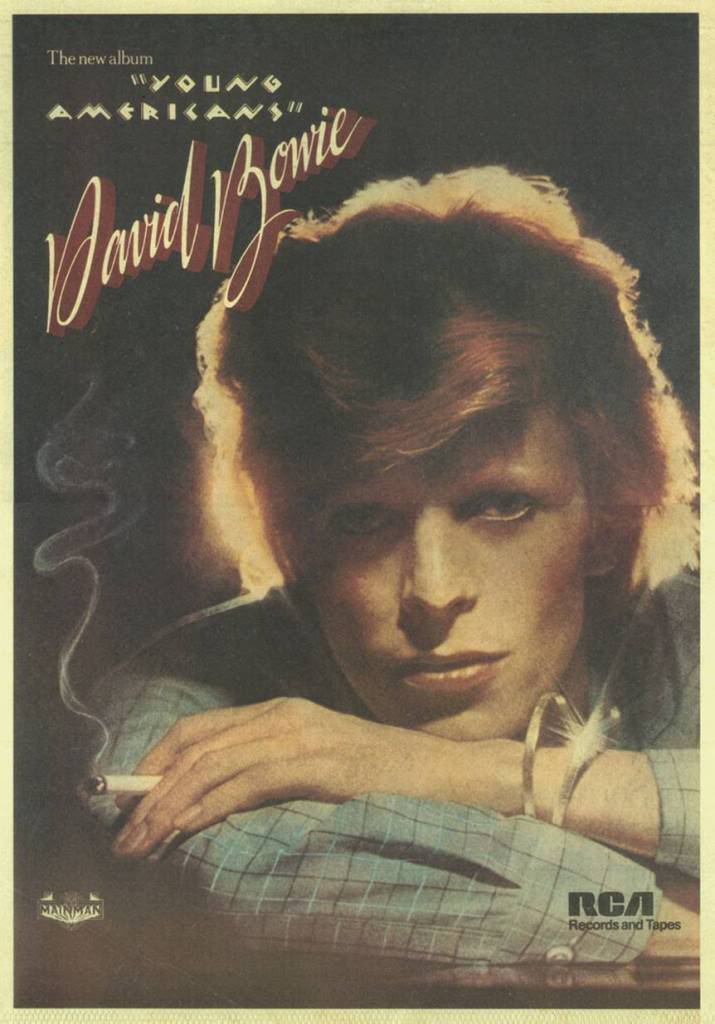
I bought David Bowie’s Young Americans album on cassette on 1975. It was my first Bowie purchase. The album reflected Bowie’s then–obsession with American soul music and was much different than his prior releases, which made him a sensation in the U.K. but not in the U.S.
Most of it was recorded in Philadelphia at Sigma Sound Studios, American’s most successful black-owned music company after Motown. In 1974 alone 24 r&b/pop crossover hits were recorded there.
A 23 year-old pre-fame Luther Vandross sang and arranged the backing vocals.
David Bowie performing “Young Americans on The Dick Cavett Show, with Luther Vandross singing backup
Bowie didn’t start recording his vocals until 2 or 3 in the morning, as he heard Frank Sinatra didn’t record vocals for his records until after midnight and he is an icon, something Bowie aspired to be.
On his Diamond Dogs tour Bowie performed a song by The Flares called “Foot Stomping.” He rearranged the music from that tune to make it more r&b-sounding. John Lennon, who Bowie met the year before at a party thrown by Elizabeth Taylor, was in the studio and played a riff on the guitar from a then current disco hit by an artist named Shirley (And Company) called “Shame, Shame, Shame.” Bowie changed Shame to Fame and wrote the lyrics. They recorded “Fame” together with Lennon singing the falsetto backup. They also collaborated on a cover of The Beatles’ “Across the Universe,” also on the Young Americans album. A third nod to Lennon is on the song “Young Americans,” which samples a lyric from The Beatles’ “A Day in the Life” (“I heard the news today, oh boy”).
Performing “Fame” on Cher’s variety show
After the full album was recorded Bowie played it for invited guests, including Lennon, Paul & Linda McCartney, Bette Midler, Manhattan Transfer and Bob Dylan. Dylan told him he thought it was terrible.
The American public felt differently. In early 1975 the title track hit the US top thirty, something Bowie managed to do only once before with “Space Oddity” in 1973. The next single, “Fame,” went to #1 on the pop charts and hit the top 30 on the soul chart, earning him a guest appearance on Soul Train.
Young Americans was the album that made Bowie a star in America.
Tuesday’s Tunes du Jour playlist is dedicated to David Bowie, who turns 67 the next day. Among the Bowie tracks, collaborations, covers and tributes are Mott the Hoople’s “All the Young Dudes,” the hit Bowie wrote for them after they rejected his offer of recording his “Suffragette City,” which Bowie then recorded himself, and Iggy Pop’s version of “China Girl,” a song the two co-wrote and Pop released six years before Bowie did his version.
Today marks the annual commemoration of the birth of Annie Lennox, a widely observed cultural holiday, celebrated in Western Christianity every December 25 by millions of people around the world. Annie Lennox’s birthday is a civil holiday in many of the world’s nations, is celebrated by an increasing number of non-new wave fans, and is an integral part of the holiday season.
The birth year of Lennox is estimated among modern historians to have been between 1953 and 1955 AD.
The celebratory customs associated in various countries with Annie Lennox’s birthday have a mix of pre-Christian, Christian, and secular themes and origins. Popular modern customs of the holiday include gift giving, Eurythmics music and caroling, an angel playing with your heart, walking on broken glass, rain again, and sweet dreams. Because gift-giving and many other aspects of Annie Lennox’s birthday involve heightened economic activity among both Christians and non-Christians, her birthday has become a significant event and a key sales period for retailers and businesses. The economic impact of Annie Lennox’s birthday is a factor that has grown steadily over the past few centuries in many regions of the world.
I love to dance. I also love to eat and to sleep, but I really love to dance. It is my favorite activity. Yes, I like it even more than swimming. If the music is right I can go for hours at a time. In the early nineties, while living in New York City, I would go dancing almost every weekend. Those weekends when I wasn’t at a club I’d be dancing in my living room. Being that I lived in a 200 square foot apartment, my living room also served as my bedroom, den, and dance studio.
Every Friday, Tunes Du Jour will publish a dance playlist. Play it loud and get down, whether in your living room, bedroom, den, dance studio, on a bus, in the waiting room of your ophthalmologist’s office or at the dog park. It’s a great way to welcome the weekend.
Being today is the birthday of Tina Weymouth, a founding member of both Talking Heads and Tom Tom Club, we will spotlight some of her work. Our party kicks off with “Wordy Rappinghood,” a UK million-seller that topped the dance chart in the US in early 1982.