Tunes Du Jour Presents 1961

The year 1961 didn’t roar in with a musical revolution—but in hindsight, that’s part of its charm. Instead, it offered a series of small but significant steps toward what would become a much louder, wilder, and more politically charged musical landscape. If the ’50s laid the foundation for rock and R&B, then ’61 felt like a transitional hallway: not quite out of the doo-wop era, but inching toward soul, girl groups, and the unmistakable rise of youth-driven pop. Listen closely, and you can hear a generation beginning to test its voice.

The playlist for this year paints a picture of variety and crossover. Ben E. King’s “Stand by Me” combines gospel roots with a pop sensibility, creating a timeless anthem of emotional resilience. Meanwhile, The Marcels inject a doo-wop jolt into “Blue Moon,” turning a Rodgers and Hart chestnut into something utterly of the moment. And “Shop Around” by The Miracles helps define the early Motown sound—polished, melodic, and unmistakably urban—hinting at the empire Berry Gordy was quietly building in Detroit.

Pop and R&B weren’t the only sounds of 1961. The jazz world was still vibrant, and John Coltrane’s take on “My Favorite Things” stretched the familiar into something exploratory and modal, giving the Broadway tune a hypnotic new dimension. Similarly, Art Blakey’s “A Night in Tunisia” offered a fiery reminder that hard bop was far from finished. This year wasn’t just about three-minute singles on AM radio; it also made room for longer-form musical statements that spoke to listeners seeking complexity.

And then there were the voices—so many distinct, unforgettable voices. Roy Orbison’s near-operatic Crying and Patsy Cline’s aching “Crazy” each showed that vulnerability could be commercially viable. The same went for Etta James, whose rendition of “At Last” remains one of the most iconic vocal performances ever recorded. Elsewhere, the lighter side of pop was thriving with Neil Sedaka’s “Calendar Girl” and Bobby Vee’s “Take Good Care of My Baby,” songs built for teenagers who were beginning to see themselves as a cultural force.

Taken together, the music of 1961 reflects a moment in flux: the last glimmers of the 1950s still lingered, but the seeds of what would define the 1960s were clearly being planted. Whether it was Ray Charles fusing gospel and R&B on “Hit the Road Jack,” or the early stirrings of girl-group grandeur from The Marvelettes and The Shirelles, this was a year where nothing yet dominated—but everything seemed possible.

Follow Tunes Du Jour on Facebook

Follow me on Bluesky

Follow me on Instagram
Throwback Thursday: 1961

The years between 1958 and 1963 are often thought of as a sleepy time for rock and roll, a quiet time between the genre’s initial burst onto the charts and the onslaught of the British Invasion. However, lots of great records were charting during those years. Check out this playlist of thirty hits from 1961 for proof.

Follow Tunes du Jour on Facebook.

Follow Tunes du Jour on Twitter.

Follow me on Instagram.

Throwback Thursday – 1961

From 1958 to 1960, Ben E. King was the lead singer of The Drifters, scoring hits with “There Goes My Baby,” “Save the Last Dance for Me,” “This Magic Moment” and “I Count the Tears.” He suggested to the group’s manager, George Treadwell, that they record the spiritual tune “Stand by Me Father,” but Treadwell turned him down. King also asked Treadwell for a greater share of the group’s royalties. Again, Treadwell turned him down. King said goodbye.

King left the group after recording just thirteen songs with them. He soon made the top ten as a solo act with 1961’s “Spanish Harlem.”

Around that time, King was working on a song based on “Stand by Me Father.” He had some lyrics and a melody. He finished the lyrics with his producer, Jerry Leiber. Leiber’s songwriting/production partner, Mike Stoller, added some chords behind the melody, as well as a bass line.

Per Leiber, it’s that last addition that makes Ben E. King’s “Stand By Me” a classic. “The lyrics are good, King’s vocal is great. But Mike’s bass line pushed the song into the land of immortality. Believe me – it’s the bass line.”

“Stand By Me” kicks off this week’s Throwback Thursday playlist, spotlighting hits from 1961.


Click here to like Tunes du Jour on Facebook!
Follow me on Twitter: @TunesDuJour

Ringo + Righteous

Who Is Barry Mann?

Ringo + Righteous
During yesterday’s Grammy Awards, the songwriting team of Barry Mann and Cynthia Weil received the Trustees Award, whatever that is. The honor was introduced by Tom Jones and Jessie J, who performed the most godawful rendition of “You’ve Lost That Lovin’ Feelin’” that has ever been foisted upon an unsuspecting world. Lost that loving feeling? More like lost their hearing, based on the way Jones and J yelled and screamed at each other. Do they not understand the concept of microphones? No need to shout, people.

To unwrong this heinous assault on the ears of the show’s viewers, Tunes du Jour presents to you a collection of twenty tunes co-written by Mann, most with his wife of 54 years, Weil. Along with the husband-wife songwriting team of Carole King and Gerry Goffin, Barry Mann and Cynthia Weil helped shape the sound of American pop music beginning in the early 1960s. Coincidentally, both Mann and King celebrate their birthdays today. For more on King, click here.

Click here to like Tunes Du Jour on Facebook!
Follow me on Twitter: @TunesDuJour

Ringo + Chubby

Let’s Twist!

Ringo + Chubby
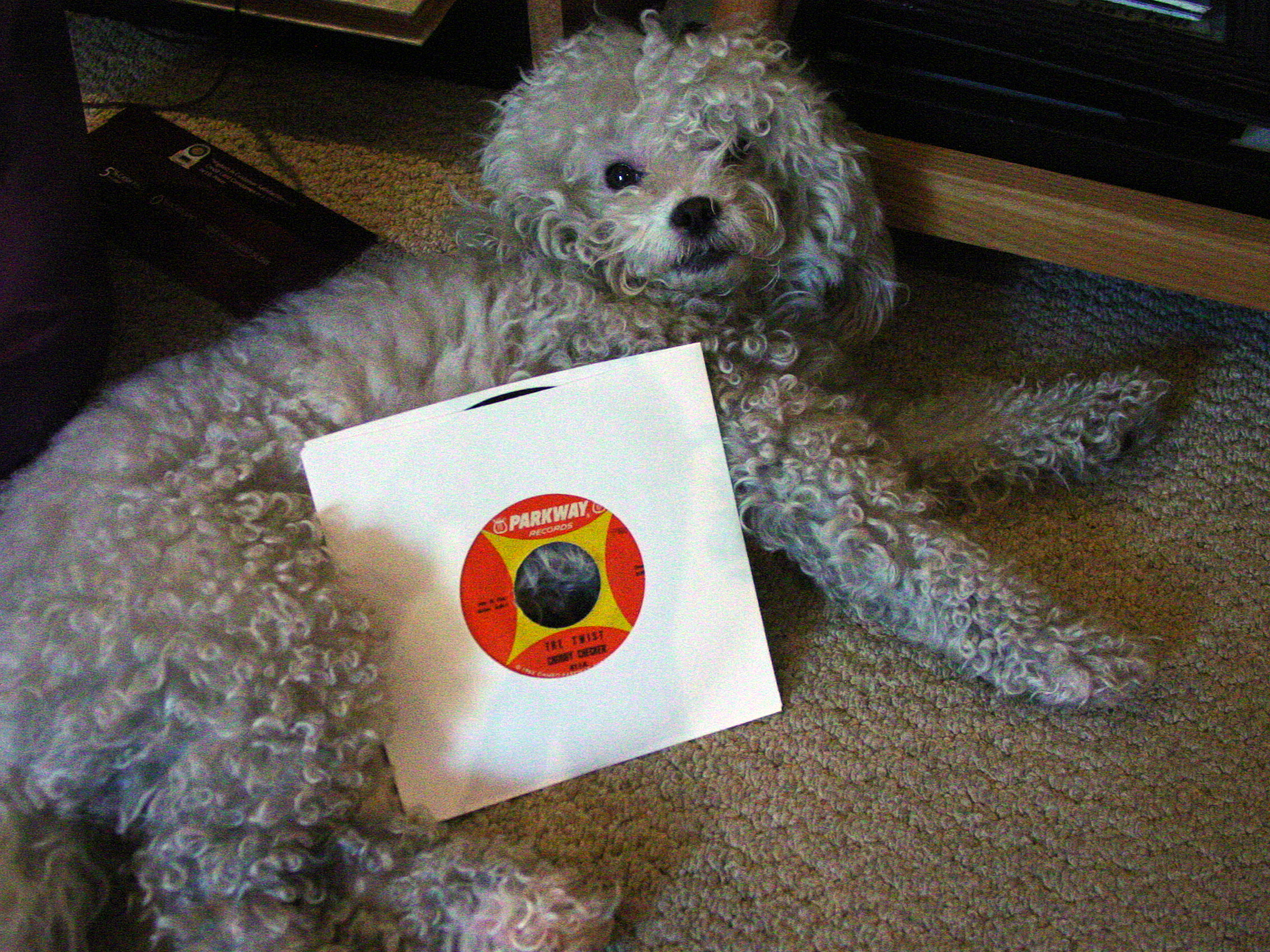
On January 13, 1962, Chubby Checker returned to #1 with “The Twist,” a record he previously took to #1 in September of 1960, making it the only record to hit #1 in two separate chart runs.

The song was originally recorded and released in 1959 by its writer, Hank Ballard, and his band, The Midnighters, as the b-side to their single “Teardrops on Your Letter.” A Baltimore DJ named Buddy Deane played “The Twist” on his television dance party program and got a good response. He told Dick Clark, host of American Bandstand about the tune.

Depending on what account you read, Ballard was unavailable to appear on American Bandstand or Clark was wary of Ballard, who previously hit with such lascivious songs as “Work with Me, Annie” and “Sexy Ways.” Either way, Clark had Chubby Checker (born Earnest Evans; his stage name was a take-off on popular singer Fats Domino) record “The Twist.”

Checker’s version is an extremely faithful cover of the Ballard recording. It is difficult to tell them apart; even Ballard thought the Checker recording was his!

In its 1960 release, Chubby Checker’s record launched a national dance craze. On the second release of the Chubby Checker version, “The Twist” became a worldwide phenomenon. Other twist hits included “Slow Twistin’,” “Dear Lady Twist,” “Twist, Twist Señora,” “Twistin’ the Night Away,” “Percolator (Twist),” “Soul Twist,” “Twist and Shout,” “Hey, Let’s Twist,” “Twistin’ Matilda (and the Channel),” “Twist-Her,” “Bristol Twistin’ Annie,” “Twistin’ Postman” and The Chipmunks’ “The Alvin Twist” – and that was just in 1962!

Chubby Checker’s “The Twist” spent one week at #1 in 1960 and two more weeks at #1 in 1962 before it was knocked from the top by…”The Peppermint Twist,” by Joey Dee & the Starlighters.

Here are twenty twistin’ favorites.

Click here to like Tunes du Jour on Facebook!

Ten Facts About Little Richard

1) Mojo magazine’s list of “The 100 Records that Changed the World” placed Little Richard’s “Tutti-Frutti” at #1.
2) Pat Boone, who made a career of recording new tracks by African-American acts and sanitizing them for white audiences, covered Little Richard’s “Tutti-Frutti” in 1956 and had a bigger hit with it than Richard did. To avoid a repeat of this, Richard and his producer, Bumps Blackwell, rehearsed the follow-up single, “Long Tall Sally,” until Richard could sing it as fast as possible, with the thinking that Boone wouldn’t be able to sing it as fast. Little Richard’s version became his first top ten pop hit and the biggest-selling single in the history of Specialty Records. Unfortunately, Pat Boone also enjoyed a top ten hit with his version.
3) Richard wrote a song about a female impersonator from his hometown who was called Queen Sonya. He changed Sonya to Lucille, which became the song’s title. It became Richard’s longest-charting hit in 1957.
4) While on tour in 1957 Richard decided to give up rock & roll and enter the ministry. He left the tour ten days early. The original flight on which he had been scheduled to return home crashed into the Pacific Ocean.
5) In 1962 Richard returned to performing secular music while touring Europe. Sam Cooke was his opening act.
6) Later in 1962 Little Richard’s opening act was The Beatles. Richard taught Paul McCartney how to sing like he does.
7) In 1963 The Rolling Stones opened for Richard. Said Mick Jagger: “I couldn’t believe the power of Little Richard onstage. He was amazing.”
8) Members of Little Richard’s band at times include Jimi Hendrix and Billy Preston. This line-up can be heard on the track “I Don’t Know What You’ve Got (But It’s Got Me),” the last single released by Vee-Jay Records.
9) Rolling Stone magazine’s list of The Greatest Artists of All Time has Little Richard at #8.
10) Today is his 81st birthday.

Enjoy this playlist inspired by one of rock and roll’s originators, Little Richard.