Tunes Du Jour Presents The Bruce Springsteen Songbook

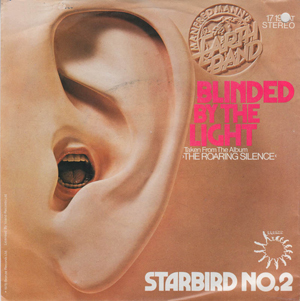
Bruce Springsteen’s name immediately conjures images of epic live performances and anthemic rock, but beneath the stadium lights and E Street Band’s prowess lies the bedrock of truly exceptional songwriting. While his own interpretations are iconic, a fascinating way to understand the depth and versatility of his craft is to listen to his songs as performed by other artists. This collection of interpretations isn’t just a testament to his popularity; it’s a deep dive into the resilient structure and universal appeal of his compositions. From Manfred Mann’s Earth Band giving “Blinded By The Light” a prog-rock makeover to Patti Smith taking his musical sketch for “Because the Night” and transforming it with her own powerful lyrics, these early releases demonstrated how his musical ideas could flourish in different hands.

What becomes clear through these varied renditions is the enduring power of Springsteen’s narratives. His ability to distill complex human experiences – the struggles of working life, the ache of forgotten dreams, the defiance of the underdog – resonates across genres and generations. Lucinda Williams’ sparse, melancholic “Factory” strips the song to its empathetic core, highlighting the quiet dignity in its depiction of labor. Johnny Cash’s gravelly voice lends a somber weight to the poignant tale of brotherhood and duty in “Highway Patrolman,” while Billy Bragg’s acoustic “Mansion on the Hill” underscores the song’s sharp social commentary on class division. Even a frequently misunderstood anthem like “Born in the U.S.A.” finds its original critical intent amplified in the raw, acoustic performance by Jason Isbell and Amanda Shires, revealing the layered complexities always present in the lyrics.

Beyond the lyrical prowess, this playlist also illuminates the structural and melodic robustness of Springsteen’s music. His compositions possess an inherent strength that allows them to be re-imagined without losing their essence. Take Hot Chip’s electronic reinterpretation of “Dancing In The Dark,” which transforms its mainstream rock energy into an indie-dance anthem, proving how adaptable the song’s core rhythm and melody truly are. Similarly, the minimalist beauty of Kevin Breit and Harry Manx’s “I’m On Fire” distills the song’s longing into a haunting, intimate whisper, while Crooked Fingers’ “The River” captures the stark emotional landscape of its narrative with a raw, almost trembling fragility. Even a track like Donna Summer’s “Protection,” originally given to her by Springsteen, showcases how his knack for catchy hooks and dynamic arrangements could easily translate into a different pop sensibility, illustrating a versatile craft beneath the surface.

This extensive array of interpretations also showcases the broad emotional spectrum Springsteen explores in his writing. His songs aren’t confined to a single mood; they capture the full range of human feeling, from youthful exuberance to weary resignation, from hopeful yearning to quiet despair. The Hollies’ rendition of “4th of July, Asbury Park (Sandy)” evokes a wistful, nostalgic glow, while Southside Johnny & The Asbury Jukes’ raucous “Hearts of Stone” pulsates with a more defiant rock and soul energy. Natalie Cole injects a playful, sassy spirit into “Pink Cadillac,” revealing the sheer fun and swagger that can inhabit his lyrics. And when Bettye LaVette takes on “Streets of Philadelphia,” she strips it down to its raw, aching vulnerability, reminding us of the profound empathy and social conscience that often underlies his work. These varied voices unlock different emotional doors, each revealing another facet of the original composition’s emotional potential.

Ultimately, a journey through these numerous cover versions offers a compelling argument for Bruce Springsteen’s enduring legacy as a songwriter. Stripped of his iconic delivery or re-clothed in entirely new musical garments, his compositions consistently stand tall. They speak to universal truths, craft unforgettable characters, and resonate with melodies that are both immediate and deeply rooted. This diverse collection of interpretations isn’t just a tribute; it’s an educational deep dive into the core strength of his writing, demonstrating that long before they became rock anthems or stadium singalongs, they were simply great songs – versatile, profound, and built to last, capable of inspiring countless artists to make them their own.

Follow Tunes Du Jour on Facebook

Follow me on Bluesky

Follow me on Instagram
Tunes Du Jour Presents 1966

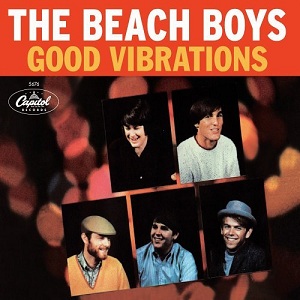
By 1966, rock and pop music had reached a critical turning point. The early, relatively simple sounds of rock and roll were giving way to a more experimental, ambitious approach, yet the airwaves were still filled with instantly memorable melodies. The year saw the release of songs that would go on to define entire careers—The Beach Boys’ “Good Vibrations” took pop production to new heights, The Four Tops’ “Reach Out (I’ll Be There)” solidified Motown’s dominance, and The Rolling Stones’ “Paint It Black” pushed rock into darker, more dramatic territory. Meanwhile, The Monkees burst onto the scene with “I’m a Believer,” adding a dose of manufactured but undeniably catchy charm to the mix.

Psychedelia was creeping into mainstream music, foreshadowing the sonic explorations that would fully take hold in the coming years. The Byrds’ “Eight Miles High” and The 13th Floor Elevators’ “You’re Gonna Miss Me” hinted at a new, mind-expanding direction for rock, while The Beatles’ “Paperback Writer” and its B-side, “Rain,” found the band toying with the limits of studio technology. The Who’s “My Generation,” released in late 1965 but peaking on the US charts in ’66, captured the rebellious energy of youth culture, while ? and the Mysterians’ “96 Tears” gave garage rock one of its most enduring anthems.

Soul music was also in full bloom, delivering some of its most powerful and enduring records. Percy Sledge’s “When a Man Loves a Woman” became an instant classic, dripping with raw emotion. Jimmy Ruffin’s “What Becomes of the Brokenhearted” and The Supremes’ “You Can’t Hurry Love” showcased Motown’s knack for blending heartache and joy in equal measure. Meanwhile, James Brown’s “It’s a Man’s Man’s Man’s World” was a testament to his singular ability to infuse deep soul with commentary. Over in the R&B realm, Ike & Tina Turner’s “River Deep – Mountain High”—though not a hit in the U.S. at the time—demonstrated producer Phil Spector’s bombastic “Wall of Sound” approach at its most overwhelming.

The year also had its share of songs that were simply too infectious to ignore. The Lovin’ Spoonful’s “Summer in the City” painted a sweltering urban landscape with its mix of laid-back verses and explosive choruses. Nancy Sinatra’s “These Boots Are Made for Walkin’” turned a simple, stomping beat into a statement of defiant cool. The Walker Brothers’ “The Sun Ain’t Gonna Shine Anymore” and The Left Banke’s “Walk Away Renée” delivered lush, baroque pop melancholy, while Eddie Floyd’s “Knock on Wood” became one of the defining records of Stax-style Southern soul.

Perhaps what’s most striking about 1966 in retrospect is just how many of these songs have endured. Whether through original recordings, countless covers, or their presence in film and television, these records still resonate. From the garage rock sneer of The Bobby Fuller Four’s “I Fought the Law” to the hypnotic stomp of The Troggs’ “Wild Thing,” the music of 1966 wasn’t just a snapshot of its time—it was the foundation for what was to come.

Follow Tunes Du Jour on Facebook

Follow me on Bluesky

Follow me on Instagram
Tunes Du Jour Celebrates World Kindness Day

Today is World Kindness Day. While every day would be a great day to practice basic human decency, some people are nasty assbags with no regard for others. If you’re one of those walking masterpieces of jackholery, here’s a wild idea: try being kind for ONE WHOLE DAY and see what it does. For example, let’s say you’re the personal assistant to someone who lives in a building with other residents. When you’re walking out of the building’s front door just in front of a neighbor who is holding his 17-year-old blind dog and leading his other pupper on a leash, maybe – and I’m just spitballing here – don’t let the door slam in their face, you self-absorbed piece of human garbage. And if said neighbor thoughtfully moves your precious Tesla charging cable to prevent damage (gasp – the audacity of helping!), perhaps, don’t show up at his door and berate him for protecting your property. Wild concept: Show some gratitude for his thoughtfulness. Consider saying “thank you,” you self-important, unreasonable, entitled, high-handed weenie.

FFS people, be kind! Rewind!

(Any resemblance to persons unfortunately living is purely intentional.)

Follow Tunes Du Jour on Facebook

Follow Tunes Du Jour on Twitter

Follow me on Instagram

Your (Almost) Daily Playlist: 4-19-24

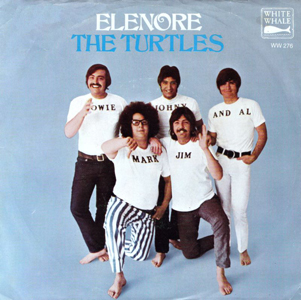
Elenore
Gee, I think you’re swell
And you really do me well 
You’re my pride and joy, et cetera…

After the huge success of their “Happy Together,” The Turtles’ record label asked them for another love song in a similar vein. Jokingly, they turned in “Elenore.” It became their eighth US top 40 hit, reaching number 6 on the Billboard Hot 100.

The Turtles’ Mark Volman was born on this date in 1947. A few songs from his band are included on today’s playlist.

Follow Tunes du Jour on Facebook

Follow Tunes du Jour on Twitter

Follow me on Instagram

Your (Almost) Daily Playlist: 10-21-23

“This is a song I wrote for my first album. It was the only song I ever wrote that was a Top 10 hit. It wasn’t for me, it was for a group called Manfred Mann’s Earth Band. They were a great band, but they changed the lyrics. And it pissed me off. Because I have a big ego. And I wanted to hear my words coming out of the radio. But they had a hit, so I was happy about that. But what they did was, they took out one of my lines and they put in one of their own. And their line became one of the most misunderstood lines of all time. In my version, the line went: ‘Cut loose like a deuce, another runner in the night.’ A deuce is a 1932 Ford Coupe, a very hot car back in the day. But they changed it to: ‘Blinded by the light, revved up like a deuce, you know the runner in the night.’ Now that makes no sense. But that’s OK, because it rhymed. But then people started to mishear that line. And they misheard it as: ‘Blinded by the light, wrapped up like a douche, another rumor in the night.’ A douche is not a car. It’s a feminine hygiene product. And it doesn’t even rhyme! So I don’t know how they got that. But that’s what people heard. And that’s what they’ve been singing for 40 years.” – Bruce Springsteen

Manfred Mann was born Manfred Lubowitz on this date in 1940. A few of his hits are on today’s playlist.

Follow Tunes du Jour on Facebook

Follow Tunes du Jour on Twitter

Follow me on Instagram

Your (Almost) Daily Playlist: 9-24-23

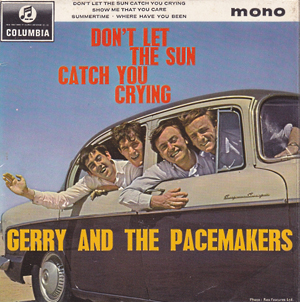
I say let the sun catch you crying. You have control over your own life. As long as you’re not impinging on someone else’s rights or happiness, do it. Cry.

The late Gerard Marsden of Gerry and The Pacemakers was born on this date in 1942. A couple of his group’s tunes are on this week’s playlist.

Follow Tunes du Jour on Facebook

Follow Tunes du Jour on Twitter

Follow me on Instagram