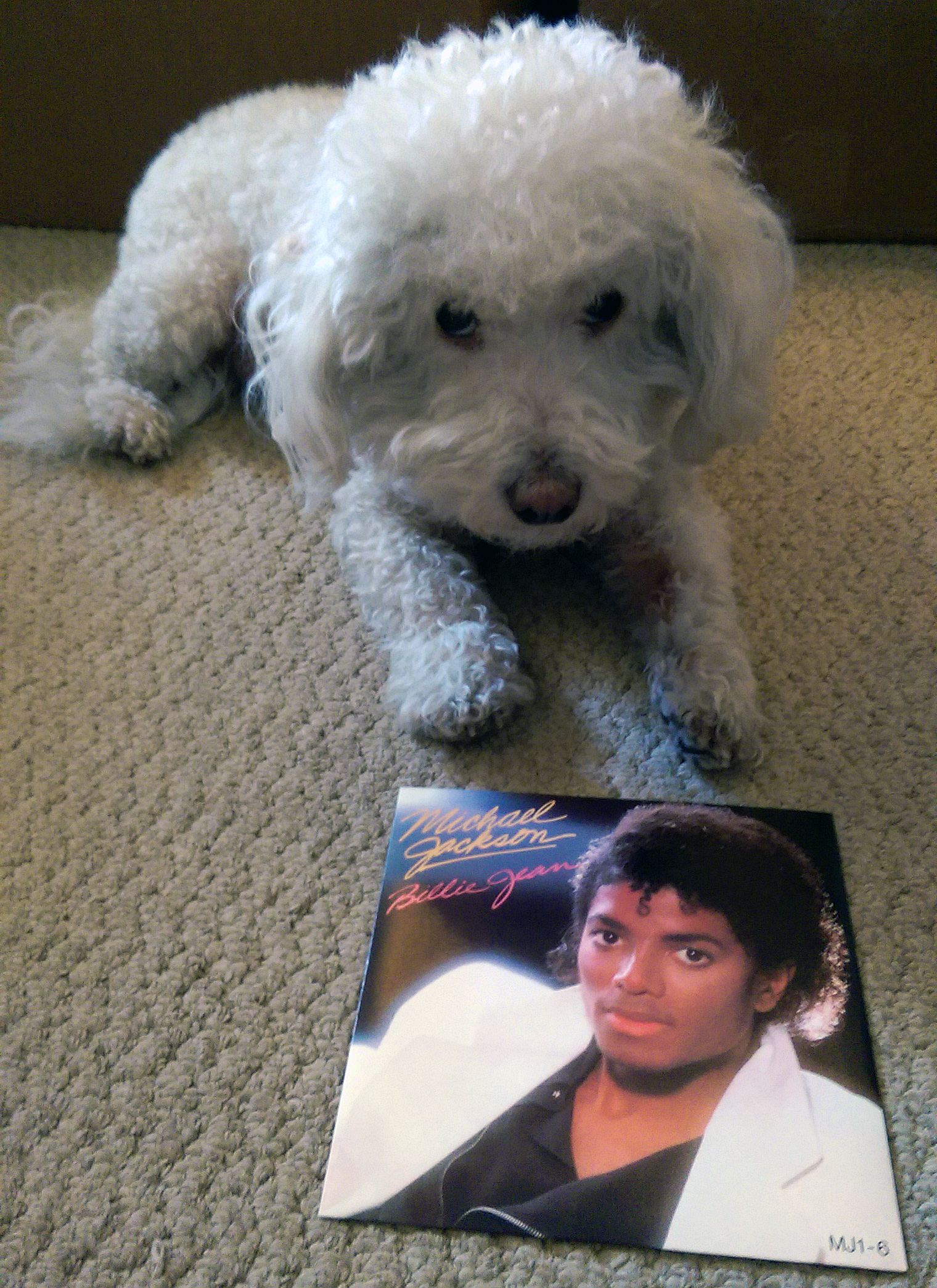
Winston + MJ

Throwback Thursday – 1983

Winston + MJ
MTV debuted on August 1, 1981. Back then it was a music video network. It positioned itself as a rock station. Most of the videos shown were of songs made by Caucasian performers, though rock-leaning black acts such as Joan Armatrading and the Bus Boys got some play.

Then came “Billie Jean.” The second single from Michael Jackson’s Thriller, “Billie Jean” was accompanied by a stylish video featuring a mesmerizing performance from Jackson. However, it wasn’t a rock song. It didn’t fit the format of rock radio stations, and it didn’t fit the format of MTV either.

But there is a big difference between radio and music television. There were plenty of radio stations and many different formats. You may not hear “Billie Jean” on the rock stations, but you could hear it on r&b stations and pop stations and dance-leaning stations. However, there was only one music television – MTV.

In his autobiography, Howling at the Moon, Walter Yetnikoff, head of CBS Records, for whom Jackson recorded (and where I worked in my first music business job), wrote “I screamed bloody murder when MTV refused to air [Jackson’s] videos. They argued that their format, white rock, excluded Michael’s music. I argued they were racist assholes – and I’d trumpet it to the world if they didn’t relent. I’ve never been more forceful or obnoxious. I’ve also never been as effective, threatening to pull all our videos. With added pressure from [Thriller producer] Quincy Jones, they caved in, and in doing so the MTV color line came crashing down.”

Jackson’s video for “Billie Jean” aired on MTV, followed just weeks later by his video for “Beat It,” a song whose guitar solo from Eddie Van Halen helped make it a hit on rock radio. These two videos made Jackson, already a superstar, a worldwide phenomenon with a humongous fan base that transcended race, age and location in a way never seen before. These two videos made MTV, a year and a half old and fairly popular in white suburban areas, a cultural institution. These two videos made the music video, then not something done for many singles, particularly those performed by artists of color, an art form and a necessary marketing tool.

Some people tuned in to MTV to see the Michael Jackson videos, and while watching the channel, discovered other acts. Some people tuned in to MTV to watch “white rock” videos, and while watching the channel, discovered Michael Jackson.

MTV went to showcase more “non-rock” videos. In 1988, they launched their hugely popular program Yo! MTV Raps, something that would have been completely unexpected just five years earlier, pre-“Billie Jean.”

While MTV deserves credit for making “Billie Jean” and Thriller successful, the person most responsible is Jackson himself. He wrote the song. He sang the song. He danced the song. Quincy Jones did not want “Billie Jean” to appear on Thriller. He didn’t like the title. He didn’t like the bassline. He felt the song’s introduction was too long. Jackson argued “But that’s the jelly!…That’s what makes me want to dance.” Jones wasn’t ready for this jelly, but Jackson stood his ground.

In May of 1983, NBC aired a tribute to Motown Records. Motown: Yesterday, Today, Forever featuring many legends who recorded for the storied label performing their classics. We saw Diana Ross, the Temptations, Marvin Gaye, Smokey Robinson and the Miracles, Stevie Wonder, the Four Tops, Martha Reeves, Lionel Richie and the Commodores, Mary Wells, Junior Walker and then some. It was a terrific show, but the talk of the town following its airing was the performance of a song not from the Motown catalogue – Michael Jackson’s “Billie Jean.” The iconic performance, during which Jackson brought the famous moonwalk to the world at large, pushed him that much more ahead of any other performer working in music back then.

Following “Beat It,” CBS Records released four more singles from Thriller. All seven of the singles released (the album had only nine songs!) went top ten, breaking the record of most top ten hits from a single-artist album that was set a few years earlier by…Michael Jackson, whose Off the Wall gave us four. Before Thriller, four singles for one album was considered a lot. Thriller raised the bar for blockbuster albums, and subsequent releases such as Bruce Springsteen’s Born in the U.S.A., Prince’s Purple Rain, Def Leppard’s Hysteria and Janet Jackson’s Control each produced more than four hits.

“Billie Jean” changed everything.

On this week’s Throwback Thursday playlist, Tunes du Jour spotlights 1983, kicking off with Michael Jackson’s classic “Billie Jean.”


Click here to like Tunes du Jour on Facebook!
Follow me on Twitter: @TunesDuJour
Throwback Thursday – 1972

Willie Mitchell, the producer of Al Green’s string of hits in the first half of the 1970s, recalled the one time he and the singer had a fight. It was over a song the two men had written with Al Jackson, Jr. While producing that track, Mitchell told Green to sing it much more softly than he had sung his other material. Green thought that direction was wrong and the song would never become a hit.

That recording was “Let’s Stay Together,” and it became Green’s first #1 on the pop chart. It also spent nine weeks at #1 on the r&b chart.

Following the success of “Let’s Stay Together,” Mitchell said Green never again argued with him.

This week’s Throwback Thursday playlist focuses on the year 1972, kicking off with the song that Rolling Stone magazine named the 60th greatest of all time, Al Green’s “Let’s Stay Together.”


Click here to like Tunes du Jour on Facebook!
Follow me on Twitter: @TunesDuJour

Throwback Thursday – 1961

From 1958 to 1960, Ben E. King was the lead singer of The Drifters, scoring hits with “There Goes My Baby,” “Save the Last Dance for Me,” “This Magic Moment” and “I Count the Tears.” He suggested to the group’s manager, George Treadwell, that they record the spiritual tune “Stand by Me Father,” but Treadwell turned him down. King also asked Treadwell for a greater share of the group’s royalties. Again, Treadwell turned him down. King said goodbye.

King left the group after recording just thirteen songs with them. He soon made the top ten as a solo act with 1961’s “Spanish Harlem.”

Around that time, King was working on a song based on “Stand by Me Father.” He had some lyrics and a melody. He finished the lyrics with his producer, Jerry Leiber. Leiber’s songwriting/production partner, Mike Stoller, added some chords behind the melody, as well as a bass line.

Per Leiber, it’s that last addition that makes Ben E. King’s “Stand By Me” a classic. “The lyrics are good, King’s vocal is great. But Mike’s bass line pushed the song into the land of immortality. Believe me – it’s the bass line.”

“Stand By Me” kicks off this week’s Throwback Thursday playlist, spotlighting hits from 1961.


Click here to like Tunes du Jour on Facebook!
Follow me on Twitter: @TunesDuJour
Winston + Nirvana

Throwback Thursday – 1992

Prior to Nirvana, alternative music was consigned to specialty sections of record stores, and major labels considered it to be, at the very most, a tax write-off. After the band’s second album, 1991’s Nevermind, nothing was ever quite the same, for better and for worse. Nirvana popularized punk, post-punk, and indie rock, unintentionally bringing them into the American mainstream like no other band to date.
AllMusic

It’s the Song that Broke Punk, the incantation about self-despising entertainment that turned a dead-end Aberdeen kid into a supernova, the very last rock song everyone could rally around.
Pitchfork

Winston + Nirvana
The song that changed everything, “Nirvana’s “Smells Like Teen Spirit,” was released as a single in September 1991. It reached #6 on Billboard’s Hot 100 in January of the following year, and kicks off this week’s Throwback Thursday playlist focusing on 1992.


Click here to like Tunes du Jour on Facebook!
Follow me on Twitter: @TunesDuJour
Winston + Soft Cell

Throwback Thursday – 1982

As a songwriter, Gloria Jones charted with Gladys Knight & the Pips’ “If I Were Your Woman,” the Four Tops’ “Just Seven Numbers (Can Straighten Out My Life),” and Marvin Gaye and Diana Ross’ “My Mistake (Was to Love You).” As a producer, Gloria Jones hit the top ten on the disco chart with Gonzalez’s “Haven’t Stopped Dancing Yet.” But as a lead singer, Jones failed to make the pop, r&b or dance charts.

In 1973, while on a trip to the United States, British DJ Richard Searling purchased a copy of a Gloria Jones single from 1965. The A-side was a song called “My Bad Boy’s Comin’ Home,” but it was the B-side that really got Searling’s attention.

Northern soul music (uptempo American soul music in a sixties Motown vein yet without commercial success) had a large cult following in the northern England at that time, and Searling played the Gloria Jones b-side during his sets.

Northern soul fan David Ball loved the song. When he and his musical partner, Mark Almond, who together comprised the duo Soft Cell, were looking for a song to cover, they went with the Jones song, thinking it would be interesting for a synth band to cover a soul tune. Their record label asked them to add guitar, bass and drums to the track, but the duo refused. Despite this, the label put out the singer. Almond told Rolling Stone magazine “We thought if we were really lucky, we’d scrape into the top 75 in Britain. We didn’t think anything would happen over here [in the US].”

Soft Cell’s recording of “Tainted Love” became a smash worldwide. In the US, it spent 43 weeks on Billboard’s Hot 100, a record at that time. Said Gloria Jones of the Soft Cell recording “Their version was far better than mine.”

Winston + Soft Cell
This week, Tunes du Jour celebrates Throwback Thursday with twenty great tunes from 1982, kicking off with Soft Cell’s version of “Tainted Love,” but first, check out Gloria Jones’ original:


Click here to like Tunes du Jour on Facebook!
Follow me on Twitter: @TunesDuJour
Throwback Thursday – 1971

At the end of the 1960s, Marvin Gaye was a huge star, having had more than two dozen top 40 hits before 1970. However, the singer was having a crisis of conscience, wanting to sing about the ills of the world he saw around him as opposed to perform nothing but love songs.

Inspired by the horrific stories told to him by his brother of what he witnessed serving three years in Viet Nam, Gaye, who hadn’t a hand in writing most of his hits up to this point, added lyrics to an unreleased song written by Obie Benson of the Four Tops and Al Cleveland.

He presented the song to Motown head Berry Gordy, who supposedly called it “the worst thing I ever heard in my life.” Gaye’s response? “Basically, I said ‘Put it out or I’ll never record for you again.’ That was my ace in the hole, and I had to play it.”

“What’s Going On” became the fastest-selling single in the history of Motown Records. Rolling Stone magazine has since placed it at #4 on their ranking of the greatest songs of all-time.

This week’s Throwback Thursday playlist consists of twenty hits from 1971, kicking off with Marvin Gaye’s “What’s Going On.”


Click here to like Tunes du Jour on Facebook!
Follow me on Twitter: @TunesDuJour

Throwback Thursday – 1960

“I’ve always been very content when I wrote all those songs. By this I’m saying that a lot of people think you have to live through something before you can write it, and that’s true in some cases, but I remember the times that I was unhappy or discontent, and I couldn’t eat, I couldn’t sleep, I couldn’t communicate, and I certainly couldn’t write a song, no way. All the songs I wrote that were successful were written when I was in a contented state of mind.”
– Roy Orbison, NME, 1980

From its title, you’d never know that the guy who wrote “Only the Lonely (Know How I Feel),” was content. Orbison wrote the lyrics to this song while sitting in his car outside his house. Being there by himself inspired the sentiment expressed in the song’s title.

As he had yet to have any hits as a performer, Orbison offered “Only the Lonely” to the Everly Brothers, who by that time (1960) had many hits, including “Claudette,” written by Orbison. Don Everly told Orbison he should record “Only the Lonely” himself.

“Only the Lonely,” written with Joe Melson, became Orbison’s first top 40 single as a performer, reaching #2 on the pop charts in the summer of 1960. He’d go on to have 22 more top 40 singles.

On this Throwback Thursday, Tunes du Jour presents twenty great tracks from 1960, kicking off with Roy Orbison’s “Only the Lonely (Know How I Feel),” one of three hits about loneliness to impact the charts that year.


Click here to like Tunes du Jour on Facebook!
Follow me on Twitter: @TunesDuJour
Throwback Thursday – 1991

“It was a 5-minute song with no chorus and a mandolin as the lead instrument. So for us to hold that as the bar we have to jump over every time we write a song would be ridiculous.”

In the summer of 1990, R.E.M. demoed a song in the studio with the working title of “Sugar Cane.” The band’s guitarist, Peter Buck, had recently purchased a mandolin and while learning how to play it, came up with the song’s main riff and chorus.

Lyrics about obsession and unrequited love were added, including an expression from the southern part of the United States that means “being at the end of one’s rope.” That expression became the song’s new title. The band’s singer, Michael Stipe, recorded his vocals in one take.

Though in the liner notes the R.E.M.’s career retrospective, Part Lies, Part Heart, Part Truth, Part Garbage 1982-2011, Stipe wrote “I don’t think any of us had any idea it would ever be … anything,” the group wanted it to be the first single released from their album Out of Time. Their record label, Warner Bros., didn’t think that was a good idea, as it was, in the words of one of the company’s executives, an “unconventional track.” After much discussion, Warner relented.

That record, with the title “Losing My Religion,” went to #4 on Billboard’s Hot 100 and became a smash worldwide. The album from which it was taken, Out of Time, sold over 18 million copies, far more than any of their previous releases.

Out of Time won the Grammy Award for Best Alternative Music Album and was nominated for Album of the Year. “Losing My Religion” won Best Pop Performance by a Duo or Group with Vocal and Best Short Form Music Video and was nominated for Record of the Year and Song of the Year, which it lost to “Unforgettable,” which was written in 1951.

When asked at the time if he was worried that the song’s success might alienate older fans, Peter Buck told Rolling Stone, “The people that changed their minds because of ‘Losing My Religion’ can just kiss my ass.”

“Losing My Religion” made Rolling Stone’s list of the 500 Greatest Songs of All Time, VH1’s list of the 100 Greatest Songs of the 90s, Blender’s list of The 500 Greatest Songs Since You Were Born, and The Rock and Roll Hall of Fame’s list of 500 Songs that Shaped Rock and Roll. On their annual music critics poll, the Village Voice had “Losing My Religion” as the #2 single of 1991, just behind Nirvana’s “Smells Like Teen Spirit.”

For this Throwback Thursday, Tunes du Jour presents twenty of the best tracks from 1991. (I didn’t include “Smells Like Teen Spirit” because I base this not on year of release, but on the year a song peaked in popularity. “Smells Like Teen Spirit” hit the top ten on the Hot 100 in 1992.)


Click here to like Tunes du Jour on Facebook!
Follow me on Twitter: @TunesDuJour
Blondie + Ringo

Throwback Thursday – 1979

Blondie + Ringo
Blondie’s hit single “Heart of Glass” was written by band members Debbie Harry and Chris Stein and had the working title of “The Disco Song.” Drummer Clem Burke said his part was inspired by the Bee Gees’ “Stayin’ Alive.”

Said Harry “When we did ‘Heart of Glass’ it wasn’t too cool in our social set to play disco. But we did it because we wanted to be uncool,” with the band’s keyboardist Jimmy Destri adding “We used to do ‘Heart of Glass’ to upset people.”

The song was included on Blondie’s Parallel Lines LP “as a novelty item to put more diversity into the album,” per Stein. The novelty song became the group’s first charted single and first #1, in 1979. Its success prompted John Lennon to send Ringo Starr a postcard advising to write songs like “Heart of Glass.”

Today’s Throwback Thursday playlist spotlights twenty of the best tracks from 1979, kicking off with Blondie’s upsetting disco novelty.


Click here to like Tunes du Jour on Facebook!
Follow me on Twitter: @TunesDuJour

Ringo + Elvis

Throwback Thursday – 1969

In 1968, songwriter Mark James, whose hit compositions include “Hooked on a Feeling” and “Always on My Mind,” was married to his first wife, but he still had feelings for his childhood sweetheart, who also was married. Said James, “My wife suspected I had those feelings, so it was a confusing time for me. I felt as though all three of us were all caught in this trap that we couldn’t walk out of.”

He recorded and released a song he wrote based on his situation, but it flopped.

A year later, producer Chips Moman brought the song to Elvis Presley. Elvis loved it and was confident he could make it a hit.

Elvis was acknowledged as the King of Rock and Roll. During the ten years from 1956 through 1965 he scored 33 top ten singles, including 17 #1s. Then he hit a relative dry spell, with no top tens in 1966, 1967 or 1968.

The King recorded Mark James’ song. It became Elvis’ first #1 single since “Good Luck Charm” in 1962. The song, “Suspicious Minds,” was Presley’s final #1 in the US. Between 1956 and 1969, Elvis spent 79 weeks at #1, more than any other act.

In 2004, Rolling Stone magazine ranked “Suspicious Minds” at no. 91 on their list of the 500 Greatest Songs of All Time.

Ringo + Elvis
This week, Tunes du Jour’s Throwback Thursday playlist spotlights twenty of the best singles of 1969, kicking off with Elvis Presley’s “Suspicious Minds.”


Click here to like Tunes du Jour on Facebook!
Follow me on Twitter: @TunesDuJour