Let’s Sing About Sex

Today is the 57th birthday of English singer-songwriter Billy Bragg. My favorite song of his is “Sexuality,” a #2 US Modern Rock hit from 1991. Co-written with The Smiths’ Johnny Marr, “Sexuality” is, as described by Wayne Studer in his book Rock on the Wild Side, “a bouncy, ringing celebration of healthy, open-minded live-and-let-live attitudes about the human body and human relationships.” Singing “your laws do not apply to me” and “I demand equality,” this is a protest song that remains relevant 20+ years later.

In celebration of “Sexuality,” today’s playlist consists of twenty songs with the word sex or some variant thereof in the title. Get down!

Click here to like Tunes du Jour on Facebook!

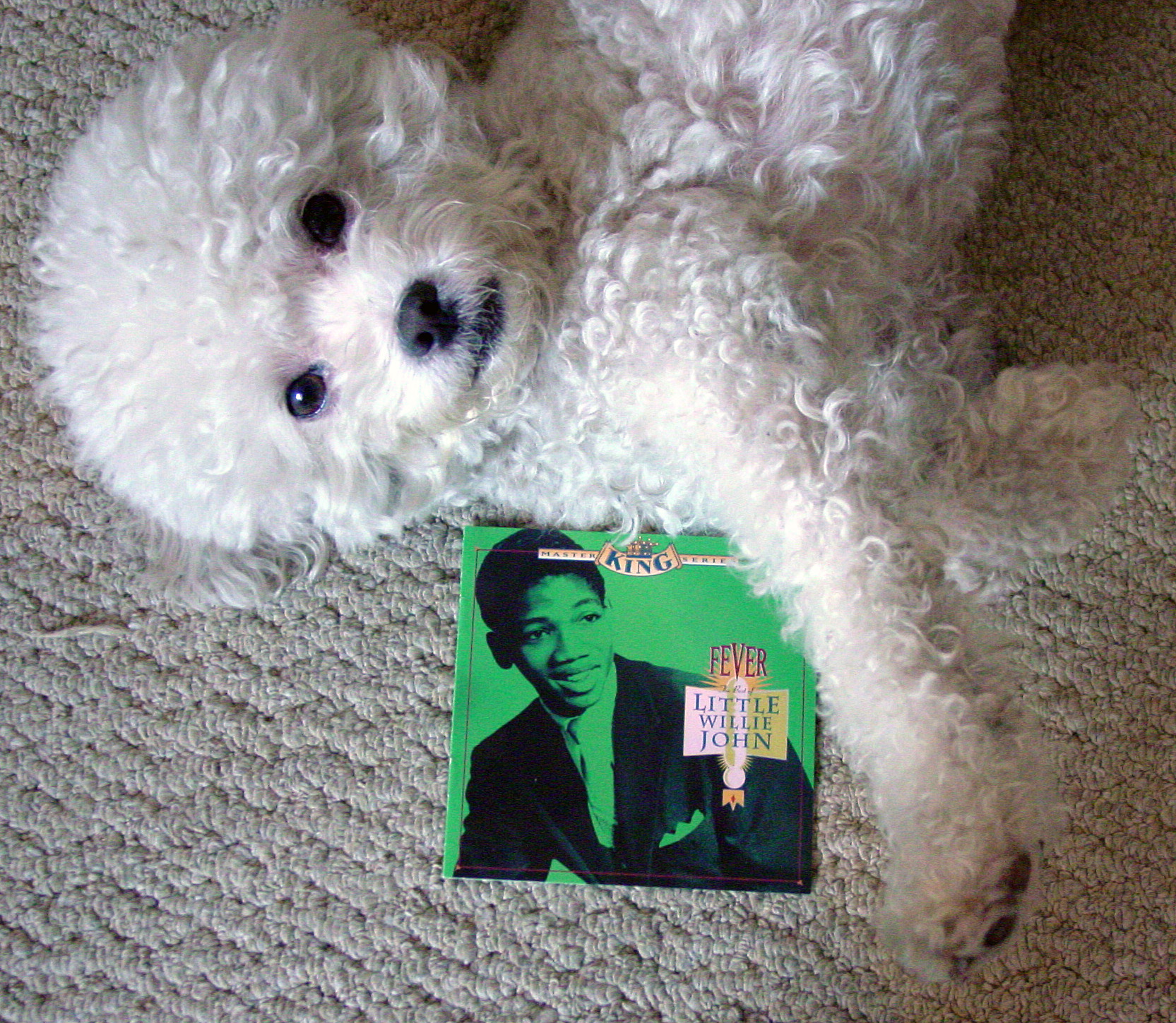
Ringo + Little Willie John

Who Is Little Willie John?

“If any one person invented soul singing it was Little Willie John.”
– Peter Shapiro, The Rough Guide to Soul and R&B

Ringo + Little Willie John

William Edward John was born on this day in 1937. As a child he sang with his family in a gospel quintet. At age 13 he hooked up with Johnny Otis’ band and for the next few years he performed with various bands, his misbehaving resulting in his getting kicked out.

In 1955, at age 17, he was signed by King Records. Said label head Henry Glover “I heard Little Willie John at 5 o’clock and I was so impressed with him that at 8 o’clock I had musicians in the studio and I recorded him.”

Though he had considerable insecurity about his height, his records were released under the name Little Willie John. His first single, “All Around the World,” was a top five r&b hit in 1955.

The following year John released the original version of “Fever.” While it became a bigger pop hit for Peggy Lee in 1958, John’s version hit #24 on the pop chart and spent five weeks at #1 on r&b chart. Following its success John went on tour as a headliner. His opening act was the up-and-coming James Brown & His Famous Flames.

For a few years the hits kept coming, but in the early sixties, as his records became more pop-oriented and drenched in strings, sales declined. The lack of sales coupled with John’s alcoholism led to his being dropped by King in 1963.

In August 1964, John was arrested for attacking a man with a broken bottle. Two months later, at a house party, Little Willie got into a fight with a 200 lb. six-foot-tall ex-convict named Kevin Roundtree. Roundtree punched John in the face. John got up from the floor and stabbed Roundtree, killing him. Following a trial and appeals, John was sentenced to eight to twenty years for manslaughter. He entered prison in the summer of 1966.

While in prison John fell ill and was confined to a wheelchair. On May 26, 1958, while in jail, he died of a heart attack at age 30.

His singing influenced James Brown and Prince, among others. His recordings have been covered by The Beatles, Fleetwood Mac, Madonna, Jack White and the Allman Brothers. He was referenced by Robbie Robertson on his 1987 song “”Somewhere Down the Crazy River.”

In 1966 Little Willie John was inducted into the Rock and Roll Hall of Fame.

Now that you know a little about the man, check out today’s playlist.

Click here to like Tunes du Jour on Facebook!

elva

Meet Mrs. Miller!

In 2008 Rolling Stone published their list of the 100 Greatest Singers of All-Time. At #1 was Aretha Franklin. No argument here. She has a voice and she knows how to use it effectively. Her range, her passion, her vocal variety, her phrasing, her confidence and her power are what other artists should aspire to replicate. When you hear Aretha Franklin, you know it’s her, even if you’ve never heard that particular recording before.

The rest of the top ten included Ray Charles, Elvis Presley, Sam Cooke, John Lennon, Marvin Gaye, Otis Redding, Stevie Wonder, James Brown and Bob Dylan. I’ve heard people argue against that last one. They’re wrong. Dylan may not possess a stereotypically beautiful voice, but he is a great singer. Nobody else sounds like him. When you hear Bob Dylan, you know it’s him, even if you’ve never heard that particular recording before.

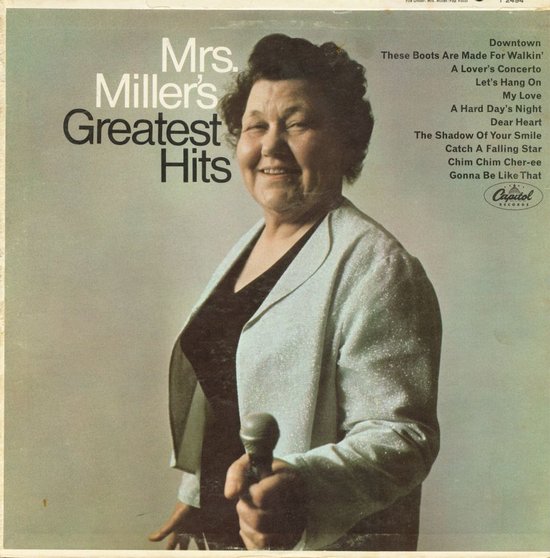
Missing from this 100 Greatest list is Mrs. Miller. Born Elva Connes in 1907, she became Mrs. Miller in 1934 when she married a Mr. Miller. In 1966, Capitol Records released her major label debut, Mrs. Miller’s Greatest Hits. Like Aretha, Mrs. displayed passion, power and confidence in her material. When you hear Mrs. Miller, you know it’s her, even if you’ve never heard that particular recording before, which chances are you haven’t.

elva
All the qualities that make Mrs. Miller unique can be heard on her first charting single, a cover of Petula Clark’s “Downtown,” which reached #82 on Billboard’s Hot 100. Her vibrato, her soaring soprano, the way she sings “always” in the song’s first line, the way she sings ahead of the beat on the line “no finer place for sure” in the first go-round of the chorus, the way she sings ahead of the beat on the first line of the second verse, the way she sings ahead of the beat on the bridge after the third verse, when she laughs while singing “waiting for you tonight” in the second go-round of the chorus. And then there’s her whistling solo. In a word, wow!

As was often the case with The Beatles, Elvis Presley and Creedence Clearwater Revival, the b-side of the “Downtown” single, Mrs.’ version of The Toys’ “A Lover’s Concerto,” also made Billboard’s Hot 100, peaking at #95. Again we’re transfixed by her vibrato, her hitting notes that had never been written and the way she sings ahead of the beat on the final verse. And then there’s her scatting like Ella Fitzgerald. Well, maybe not like Ella Fitzgerald. In a word, wow!

Her voice leant itself equally well to rock and roll, pop, country, and show tunes. She probably would have mastered rap as well. On her cover of Chuck Berry’s “Memphis,” she ditches her usual soprano to speak the words in a lower register. Her whistling solo is in its usual range, however.

Mrs. Miller’s Greatest Hits sold 250,000 copies in its first three weeks of release. She made television appearances on The Tonight Show with Johnny Carson and Ed Sullivan. She sang at The Hollywood Bowl. She performed alongside Bob Hope for US troops in Vietnam. That she is all but forgotten today is a shonda.

Rolling Stone’s list of The 100 Greatest Singers Of All-Time is terrific, but someone should be bumped (cough cough Mariah Carey cough cough) to make room for Mrs. Miller. Her distinctive sound, her enthusiasm and her ability to transform any song into a Mrs. Miller song make her one of the greats. The fact that she didn’t have her first chart single until age 58 inspires me.

If Mrs. Miller were still alive she’d be celebrating her 107th birthday today. She isn’t so she won’t be, but Tunes du Jour celebrates her craft with ten of her finest.

Click here to like Tunes du Jour on Facebook!

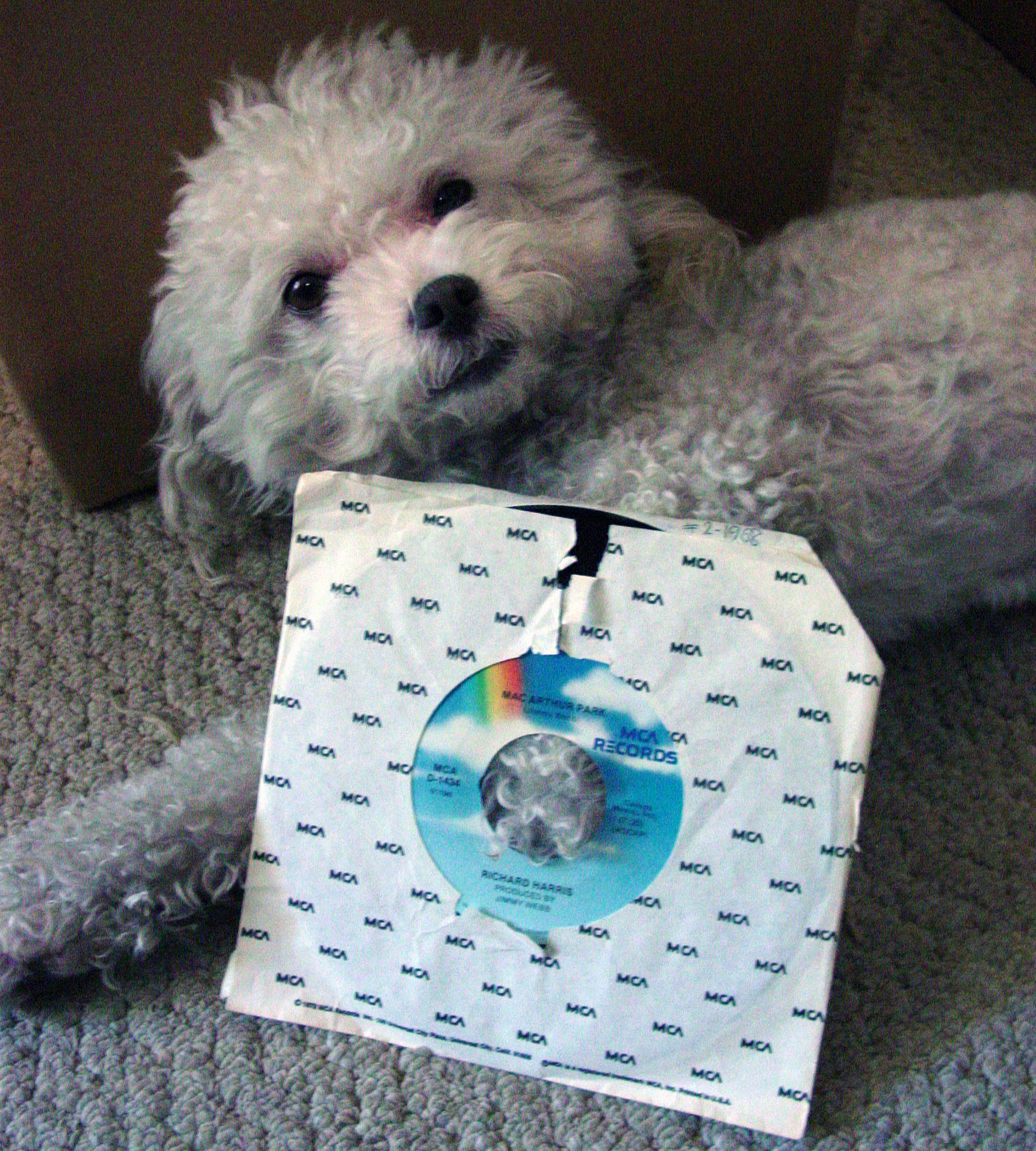
Ringo + Harris 2014-08-15 12.17

It’s Friday And I Need To Dance!

As a songwriter, Jimmy Webb scored his first hit in 1967 at age twenty when The 5th Dimension took “Up, Up and Away” to the top ten. Later that year Glen Campbell had a hit with Webb’s composition “By the Time I Get to Phoenix.”

Webb then wrote a 22-minute cantata. His friend Bones Howe, with whom Webb worked on The 5th Dimension’s Up, Up and Away album, invited Webb to play the new piece for The Association, who Howe was then producing. Their reaction was less than enthusiastic. Per Howe, one group member said “Any two guys in this group could write a better piece of music than that.”

Sometime after, Webb received a telegram from actor Richard Harris, who he met at a fundraiser in Los Angeles. Harris was nominated for an Academy Award in 1963 for This Sporting Life and again in 1990 for The Field. He later went on to play Professor Dumbledore in the first two Harry Potter movies. The telegram read “Jimmy Webb, come to London and make a record. Love, Richard.”

Webb flew to London, bringing a satchel of songs he’d written. He played each for Harris, but nothing struck the actor. Webb recalled “I looked down with some dread because there was only one thing left.” That one thing was the last movement of the cantata he presented to The Association. He called it “MacArthur Park.”

Here are the lyrics to “MacArthur Park.” Raise your hand when they get confusing.

The opening lines are “Spring was never waiting for us, girl / it ran one step ahead, as we followed in the dance.”

I see some hands raised. The next line should help you understand: “Between the parted pages and were pressed in love’s hot fevered iron, like a striped pair of pants.” Now you got it! Harris, who is from the UK, where “pants” means underwear, uses an iron, a hot fevered iron, on his striped underwear. You may be asking: Does he iron his solid-colored underwear? Does he have solid-colored underwear? Boxers or briefs? Relax – there are still six and a half minutes left in the song, so maybe you’ll find out.

Moving on, we learn that MacArthur Park, which Harris calls MacArthur’s Park for the duration of the song, is melting. In the dark. Its icing is flowing down. Who hasn’t been there?

We now arrive at the classic lines about a cake left out in the rain, which appears to be causing Harris to have a breakdown. “I don’t think that I can take it ‘cause it took so long to bake it and I’ll never have that recipe again. Oh no!” Calm down. It’s just a cake. Bake another one. I know – this song was recorded in the pre-Internet age when finding a cake recipe required one to open a cook book, but come on! This cake can’t be that special if you chose to leave it out during inclement weather.

By the end of verse one we have learned several things: 1) Harris is singing to a girl; 2) Harris irons his striped underwear; 3) a park is melting; 4) if you bake a cake and wish to leave it outside, check The Weather Channel first; and 5) never write a song while you are on an acid trip.

As the song continues it gets more bizarre. The melody changes and Harris threatens us by singing “There will be another song for me, for I will sing it.” Luckily, this other song never became a hit. (And may I add, he is being rather presumptuous by calling his performance on this record “singing.”)

The song clocks in at nearly seven and a half minutes, and though it reached #2 on the US pop charts, most listeners had no idea why Harris was singing about a melting park, ironed underwear and a waterlogged dessert.

Songwriter Webb didn’t understand the confusion. He told Q Magazine that the song is “clearly about a love affair ending, and the person singing it is using the cake and the rain as a metaphor for that.” Clearly. Clear as mudcake.

The love affair was one from Webb’s own life. He and his girlfriend would meet for lunch at MacArthur Park, where there would sometimes be birthday parties, with cake. Their breakup devastated Webb, who wrote “Mac Arthur Park” and “By the Time I Get to Phoenix” based on their relationship. (Bonus trivia – the woman went on to marry Linda Ronstadt’s cousin.)

In 1993, humorist Dave Barry surveyed his readers to find the worst song. The clear winner for Worst Overall Song and Worst Lyrics was “Mac Arthur Park.” Culture critic Joe Queenan disagreed with the results “because ‘Ebony and Ivory’ exists, as do ‘You Don’t Bring Me Flowers,’ ‘Baby, I’m-a Want You,’ ‘Feelings,’ ‘Benny and the Jets,’ ‘Witchy Woman’ and ‘Sussudio,’” adding “On a planet where somebody thought it would be a good idea to write ‘Scenes from an Italian Restaurant,’ the best ‘MacArthur Park’ is ever going to earn in the sucky-song sweepstakes is a tie.”

Good or bad, the song is a classic. A 1968 Grammy winner for Best Arrangement Accompanying Vocalist, the song has been recorded by top artists in diverse genres, including Frank Sinatra, Tony Bennett, Sammy Davis Jr., Liza Minnelli, the Four Tops, Maynard Ferguson, Stan Kenton and Woody Herman. Waylon Jennings’ 1969 version won a Grammy. In 1978, Donna Summer’s rendition became her first #1 pop record and stands as the only US #1 pop song for Jimmy Webb, who also wrote “Wichita Lineman,” “Galveston,” “Worst That Could Happen” and “All I Know.”

It has been rumored that Webb and Harris had a falling out due to the song’s success. Harris promised Webb his Rolls Royce if the song went top ten. When the record did, Harris offered Webb a different Rolls Royce. It is because of this that people named Richard are often called Dick. Allegedly, the pair stopped speaking.
Ringo + Harris 2014-08-15 12.17
Today Jimmy Webb turns 68 years old. Hopefully he’s somewhere celebrating with a nice piece of wet cake. We kick off our weekly dance party with Donna Summer’s version of “MacArthur Park,” which she, like Harris, insists on calling “MacArthur’s Park” for the duration of the song.

Like Tunes du Jour on Facebook. Click here.
doggies + James Brown 2014-07-04 10.41

It’s Friday The Fourth Of July And I Need To Dance!

On July 4, 1982, I went with my then-friend Robin to see Diana Ross in concert at Giants Stadium. I hadn’t been to the stadium before, but I figured on a typical day it was about a half hour drive from my home in New Jersey. As this was a holiday, I assumed there would be a lot of traffic, so I allowed for extra travel time. I didn’t want to be late.

We got to Giants Stadium five hours before show time. We parked right by the stadium entrance, went in, and found our seats. It was a beautiful sunny day, so we tanned as we waited for others to join us.

After a few hours other people showed up. The stadium was mostly full when the first opening act took to the stage. The band’s lead singer introduced them. “We’re Frankie Beverly and Maze for all you white people who don’t know who we are because you don’t listen to black music.” He sure knew how to charm an audience and win over new fans! I was momentarily ashamed that I spent my money to see and hear the white music of Diana Ross.

After Maze, Miles Davis performed. Would it have killed him to finish writing the songs before he came out? And hello, the audience is over here, not behind the curtain.

While Davis was playing, the couple sitting next to my then-friend Robin and me snorted cocaine. I’d never seen anyone do that before. They left after Davis finished, skipping the Diana Ross show altogether. That’s all I needed to see to keep me from ever doing coke. I don’t ever want to get to a point where I lose control over my thoughts and whereabouts and miss Miss Ross.

Finally, the main event. Diana Ross. Live. She performed all her big solo hits, except “Love Hangover,” and 30+ years later that still irks me. She did a medley of Supremes hits. She changed her clothes a few times. It was great!

doggies + James Brown 2014-07-04 10.41
Friday is dance day at Tunes du Jour, and while I could open today’s playlist with “Love Hangover” (Why, Miss Ross, why didn’t you preform that song???), I’m going to go with a more traditional 4th of July choice, James Brown’s “Living in America,” one of the very few Brown hits that the man neither wrote nor produced. Happy holiday!

Winston + Chuck 2014-06-30 11.25

A Change Is Gonna Come If You Make It So

A company I worked for – I won’t say which one – has an amazing catalogue of rhythm & blues music, arguably the best r&b catalogue of any record label. Despite possessing this goldmine, most of our catalogue releases were from white rock bands. I asked a member of senior management why we didn’t do more with our black artists, and the answer I got was “We don’t know how to sell that music.”

Is that not a stupid response? If you don’t know how to do that, hire someone who has that expertise, or learn how to do it. Why ignore a large swath of your potential market, especially when you already own the assets?

Years ago I was put in charge of licensing at a record label. I knew the music and I knew the components of licensing deals; however, I wasn’t a very good negotiator. I found the process intimidating. I could have left it at that – “I don’t know how to negotiate.” My company would have made money nonetheless, though not at its full potential. For that matter, I wouldn’t be working at full potential.

I took a course in negotiations. Six weeks, $300. Money well spent. I put what I learned in the class into action. Practice makes perfect, and I became an excellent negotiator. In my four years at that company our licensing revenue increased 400%. My skills also led to my next job as the Vice President of Licensing at another company.

Is a lack of some skill or knowledge holding you back? Fix that. Read a book, attend a seminar, take an on-line course or find a mentor. Saying “I don’t know how” won’t lead to success; learning how will.

Winston + Chuck 2014-06-30 11.25
Today is the last day of Black Music Month. It would be ludicrous to think a 40-song playlist would cover black music in any comprehensive way. Enjoy it for what it is – nearly three hours of fantastic music. Listen to it while you research how to learn a new skill.

Ringo + Curtis 004

Keeping The Music Of Curtis Mayfield Alive

Ringo + Curtis 004
In my role as the Vice President of Licensing at Warner Music Group I oversaw the licensing of “samples.” A sample is when a newer song uses a portion of an existing recording. A prominent example is Puff Daddy’s sample of The Police’s “Every Breath You Take” in his “I’ll Be Missing You.”

One of the most popular catalogues for sample licensing is that of Curtis Mayfield. Elements of his records have been used by many well-known and respected rap acts, including Kanye West and Beastie Boys. I’d run the requests by Curtis’ son Kirk, who was always a pleasure to work with.

Many complain of hip hop’s dependence on samples, and while often times samples are used in a lazy and uninspired way, there are many examples where the samples complement the new song perfectly. It can also be argued that samples keep the music of great acts of the past alive and introduce this music to younger generations. Where else might a teenager hear Curtis Mayfield or James Brown other than via a new Kanye jam?

Today, the third day of Black Music Month, we celebrate the birthday of the late, great Curtis Mayfield with some of the classics he had a hand in – as a solo artist, as a member of The Impressions, as a writer/producer, or via a sample. Click here for the playlist.

Ringo + C + C

It’s Friday And I Need To Dance!

Ringo + C + C

Every Friday Tunes du Jour presents a dance playlist to get you into the weekend spirit. Today we kick off with C + C Music Factory’s “Things That Make You Go Hmmm…” in memory of David Cole, who with Robert Clivillés were the C + C of the Music Factory. Besides their own group’s hits, Cole and Clivillés produced/remixed tracks for Aretha Franklin, James Brown, Chaka Khan, Lisa Lisa and Cult Jam, Mariah Carey, Cover Girls, Seduction, Martha Wash and, um, Jim Carrey. Cole died on January 24, 1995 of complications of spinal meningitis brought on by AIDS. He was 32.

An Atheist Jew’s Guide To Christmas Music, Part 4

In the grocery store yesterday I heard the most joyless version of “Joy to the World.” I heard a dull version of “White Christmas” that made me glad it was 77 degrees outside. I heard a rendition “Santa Claus Is Coming to Town” so lifeless it would make Kris Kringle say “Fuck this – I’m staying home.”

My fourth and final Christmas playlist for 2013 includes more festive fare. Mostly it consists of Christmas songs that have not been overplayed. Some of the holiday classics are represented – “The Little Drummer Boy” as performed by Iggy Pop and RuPaul’s twist on “I Saw Mommy Kissing Santa Claus” in which mommy is not the parent doing the kissing.

Enjoy!

But Then Again, No

Sometimes an awkward lyric shows up and mars an otherwise perfectly reasonable song. I don’t mean songs such as Paul McCartney’s “Spies Like Us” or Stevie Wonder’s “I Just Called to Say I Love You” or Paul McCartney and Stevie Wonder’s “Ebony and Ivory.” Those songs are just plain bad.

Wings’ “Live and Let Die” is one of my favorite of Sir Paul’s post-Beatles songs, but I refuse to sing along with the phrase “this ever changing world in which we live in.” Poor grammar makes me want to give in and cry.

John Mellencamp’s “R.O.C.K. in the U.S.A.” pays tribute to many rock and soul greats of the 1960s. It’s a crackin’ little number but I always cringe when he sings “let’s don’t forget James Brown.” “Let’s not” uses just as many syllables, is grammatically-correct, and doesn’t detract from the message of not forgetting James Brown.

There are times when lyrics are bad not because of their grammar, but because they sound like place holders that remained in the song because the lyricist couldn’t come up with anything with which to replace them. Take Elton John’s classic hit “Your Song.” “If I was a sculptor, but then again, no.” Why is that in the song? You’re not a sculptor. You weren’t a sculptor. What would happen if you were a sculptor? Instead of giving the object of your affection the gift of song, would you make a bust of their face, a la Lionel Richie’s “Hello” video?

One of my favorite bad lyrics is in the Diana Ross and the Supremes hit “I’m Livin’ in Shame,” in which Diana sings “Came the telegram – Ma passed away while making homemade jam.” Telegram messages were charged by the letter, so including the details of what Ma was doing when she died is a bad choice lyrically and financially. What lyrics were discarded in favor of that? “Came the telegram – Ma passed away while carving up the ham?” “Came the telegram – Ma passed away with her finger in a dam?” “Came the telegram – Ma passed away serving in Viet Nam?” “Came the telegram – Ma passed away from an attack by a ram?” “Came the telegram – Ma passed away from choking on a yam?” That last one is good, but then again, no.

“I Started a Joke” by the Bee Gees is an okay song that would be better if Johnny Marr played guitar on it. Then it may sound like a Smiths song. Not a Smiths single. Maybe an album track. I’m not sure what the over-the-top lyrics are about. It seems Robin Gibb is not a gifted comedian and his joke made everyone cry and then he cried and everyone started laughing and then he died but kept singing this song. That’s all well and good. The line that made me include it in this blog entry is “I fell out of bed hurting my head from things that I said.” I think you hurt your head when you fell out of bed and banged said head on a jar of homemade jam.

Let’s don’t forget Robin and Maurice Gibb on their birthday.