Ringo + Toni 002

Feliz Cinco De Mayo!

Ringo + Toni 002
Hoy es Cinco de Mayo, y yo was thinking about Spanish-language songs that crossed over onto the US pop charts. That got me thinking about hit songs that were re-recorded in Spanish by their original hitmakers in an attempt to cross over the other direction. It’s a savvy business move, no? Why limit your audience, especially once the music business became more global?

Here is your Cinco de Mayo playlist:

Winston + Marvin 003

“I Heard It Through The Grapevine”

Winston + Marvin 003

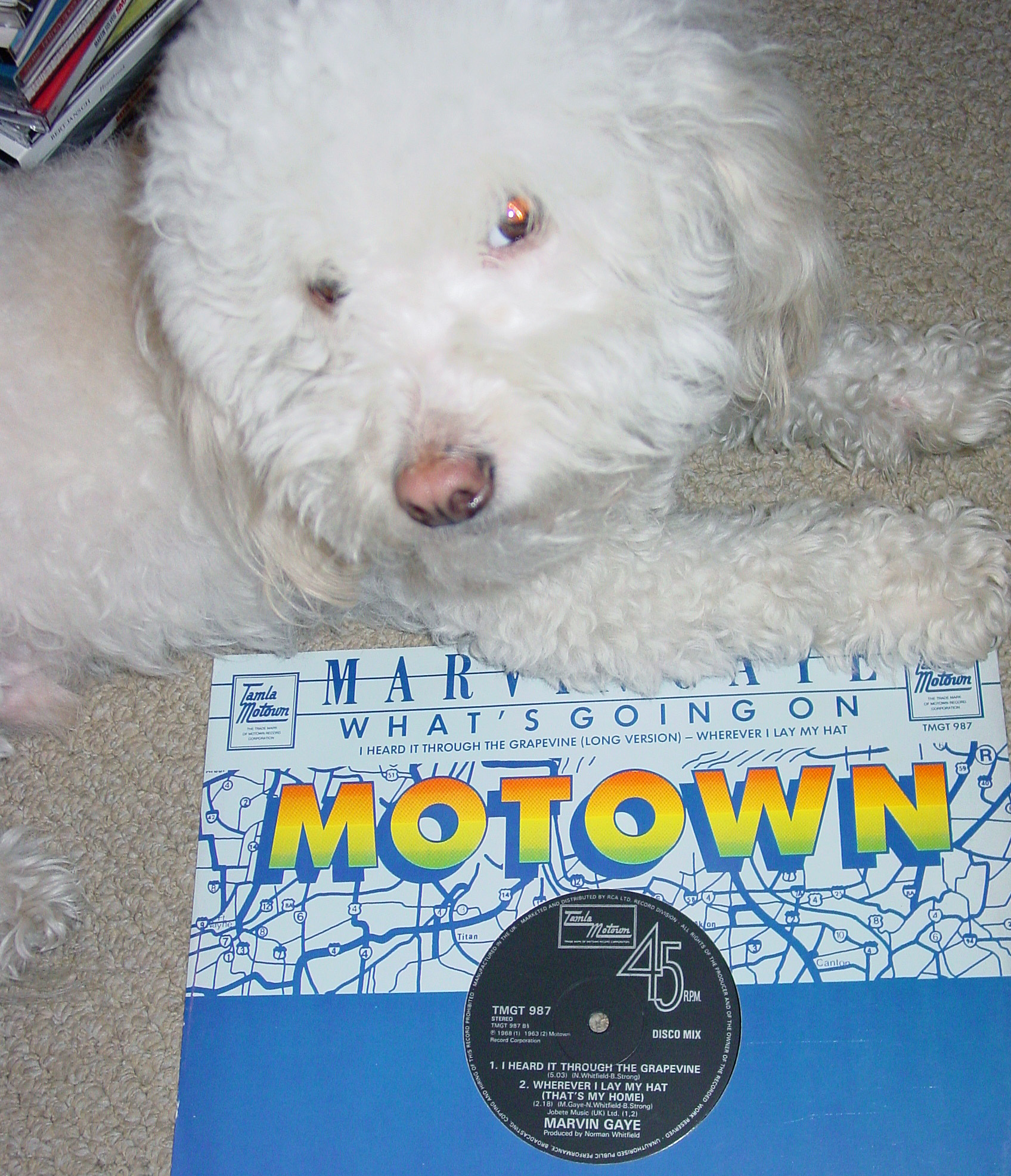
By 1966, Barrett Strong, the singer on Motown Records’ first hit single, “Money (That’s What I Want),” had the core of a song based on expression that emanated from the Civil War era. Slaves in the United States passed along information via a “human grapevine.” In Strong’s time he often heard people passing along gossip, saying they “heard it through the grapevine.” With that line as the chorus and a bass line, he brought the song to Norman Whitfield, who added lyrics about someone who hears gossip that their lover is unfaithful and will leave him/her for another lover.

Whitfield produced a version of their new song, “I Heard It Through the Grapevine,” with Smokey Robinsons and the Miracles, but Motown chief Berry Gordy, Jr. rejected it.

In 1967, Whitfield entered the studio with Marvin Gaye. At the time Gaye was married to Berry Gordy’s sister Anna. Gaye heard that Anna was being unfaithful to him. The lyrics surely resonated with him (though in (un)fairness, he was cheating on Anna). To wring more emotion out of Gaye, Whitfield had him perform the song in a higher key than he normally used. This did not sit well with Gaye, who is quoted in his biography as saying “Norman and I came within a fraction of an inch of fighting. He thought I as a prick because I wasn’t about to be intimidated by him. We clashed. He made me sing in keys much higher than I was used to. He had me reaching for notes that caused my throat veins to bulge.”

All may have been for naught, as Berry Gordy rejected the Gaye recording as well.

In June of 1967, Aretha Franklin went to #1 with her version of Otis Redding’s “Respect.” With that record as his model, Whitfield again brought “I Heard It Through the Grapevine” into the studio later that year, this time with Gladys Knight and the Pips. This version was faster than the versions he produced for the Miracles and Gaye, with the intention to “out-funk” Aretha.

Gordy reluctantly approved the Pips version for release. It rose to #2 on the pop chart and went to #1 on the r&b chart, where it remained for six weeks. It became Motown’s biggest-selling single to that point.

The Gaye version ended up on his 1968 album In the Groove. The first single from that album, “Chained,” hit #32 on the pop chart. “Grapevine” got the attention of some radio disc jockeys, who gave it airplay. Said Gordy, “The DJs played it so much off the album that we had to release it as a single.”

Marvin Gaye’s version of “I Heard It Through the Grapevine” was released as a single in fall of 1968. In mid-December it went to #1 on both the pop and r&b chart, and stayed on top of each for seven weeks, becoming Motown’s biggest hit to date. The week this went to #1 on the pop chart, Motown had the top three hits (#2 was “Love Child” by Diana Ross & the Supremes and #3 was “For Once in My Life” by Stevie Wonder.) The company held onto the top three for four consecutive weeks. “I Heard It through the Grapevine” bookended the r&b #1 slot in ’68 – the Pips’ version was #1 on January 1 and Gaye’s was #1 on Dec. 31.

By the time his “Grapevine” was released Marvin Gaye already had 23 top 40 pop hits. This was his first #1.

Gaye’s version made Rolling Stone’s list of the Greatest Songs of All Time and was inducted into the Grammy Hall of Fame.

“I Heard It Through The Grapevine” was the first collaboration between Barrett Strong and Norman Whitfield. The duo went on to compose “Papa Was a Rollin’ Stone” and “Just My Imagination (Running Away with Me)” for The Temptations.

Marvin Gaye died at age 44 on April 1, 1984, shot to death by his father the day before his birthday. The gun used was a Christmas present from Marvin.

Winston + Chaka 002

Chaka Khan’s Jazz

Winston + Chaka 002
Having already displayed her vocal chops with soul, funk, ballads and disco, Chaka Khan experiments with jazz on “And the Melody Still Lingers On,” her interpretation of Dizzy Gillespie’s “Night in Tunisia.” Featuring Herbie Hancock and Gillespie himself, as well as a Charlie Parker sample, Chaka and producer Arif Mardin add lyrics that pay tribute to the classic original composition. When it arrived in 1942 “it was new and very strange” but subsequently “paved the way for generations from Coltrane to Stevie.” “The past you can’t ignore, the torch is lit, we’ll keep the flame,” vows Chaka, at once saluting the past while being very much in the present. The performance also foretold her future – one of Khan’s 22 Grammy nominations would be for Best Jazz Vocal Performance in 1983. Seventy-two years after the debut of “Night in Tunisia” and thirty-three years after Chaka’s version, its melody still lingers on.

Tunes du Jour listens to Chaka’s jazzier sides today, her 61st birthday.

Ringo + Quincy 001

It’s Quincy Jones’ Birthday And I Need To Dance!

Ringo + Quincy 001
Twenty Things You Should Know About Quincy Jones:
1) He’s had a record 79 Grammy Award nominations. He’s won 27.
2) He arranged the Frank Sinatra/Count Basie version of “Fly Me to the Moon,” which astronaut Neil Armstrong played when he first landed on the moon.
3) Jones produced the soundtrack of the motion picture The Wiz. He later said he hated working on it, as he didn’t like most of the songs nor did he like the film’s script. However, on the set on The Wiz he got to know the singer who played the scarecrow, Michael Jackson. Jackson asked him to recommend a producer for his next album. Jones threw out a few names and also offered to produce it himself. Jackson took him up on his offer, though his record label thought it was a bad idea. The album, 1979’s Off the Wall, went on to sell 20 million copies and won Jackson his first Grammy Award.
4) While widely known as the producer of Michael Jackson’s Thriller, Bad and Off the Wall albums, Jones is also the producer of the hit records “We Are the World” by USA for Africa; “It’s My Party,” “You Don’t Own Me” and “Judy’s Turn to Cry” by Leslie Gore; “Angel” by Aretha Franklin; “I’ll By Good to You,” “Stomp” and “Strawberry Letter 23” by The Brothers Johnson; “One Mint Julep” by Ray Charles; and “Love is in Control (Finger on the Trigger)” by Donna Summer, among others. He also worked with Bono, Stevie Wonder, Miles Davis, Little Richard, Paul Simon, Duke Ellington, Ella Fitzgerald, Herbie Hancock, Billie Holiday, B.B. King, Louis Armstrong, Dizzie Gillespie, Sarah Vaughan, Diana Ross, Dinah Washington, Peggy Lee, Chaka Khan, Tony Bennett, George Benson, Luther Vandross, Sammy Davis Jr., Johnny Mathis, James Ingram and Patti Austin, plus plenty more.
5) “Quincy Jones is one of the most versatile and potent figures of popular culture….When you listen to his impressive and monumental body of work, it’s easy to understand how and why he’s touched such a broad audience of music lovers. He’s done it all.” – Michael Jackson
6) Time magazine named him one of the most influential jazz musicians of the 20th century.
7) In the early 1960s he became the Vice President of Mercury Records, the first African-American at a major record company to reach that executive level.
8) His middle name is Delight.
9) Along with Bob Russell, he became the first African-American to be nominated for an Oscar for Best Original Song for “The Eyes of Love” from Banning.
10) With seven Oscar nominations, he is tied with sound designer Willie Burton as the African-American with the most Oscar nominations.
11) Jones produced the film The Color Purple, his first foray into film production. He asked Steven Spielberg to direct it, which he did. It was nominated for eleven Academy Awards.
12) Among his 33 movie scores are the ones for The Color Purple, In the Heat of the Night, In Cold Blood, and Bob & Carol & Ted & Alice.
13) He has a daughter with actress Nastassja Kinski as well as six other children.
14) He’s the father of actress Rashida Jones. She’s pretty.
15) In 1988 he formed Quincy Jones Entertainment, who produced the television program The Fresh Prince of Bel-Air.
16) He never learned how to drive.
17) Among the charities Jones supports are American Foundation for AIDS Research (AmfAR), Global Down Syndrome Foundation, Gay and Lesbian Alliance Against Defamation (GLAAD), MusiCares, Elton John AIDS Foundation, Rape Foundation, UNICEF, NAACP, Nelson Mandela Centre of Memory, and Barbara Davis Center for Childhood Diabetes.
18) In 1974 Jones suffered a brain aneurysm. He was given a 1 in 100 chance of surviving. Family and friends, including Richard Pryor, Marvin Gaye and Sidney Poitier, planned a memorial service for him, which he got to attend.
19) Today he turns 81 years old.
20) “The thing is to find your lightning – and ride your lightning.” – Quincy Jones

As Friday is dance day at Tunes Du Jour, we’ll kick off today’s playlist with Q’s #3 club hit of 1981, “Ai No Corrida.”

Kings 003

King Holiday

Kings 003

Dr. Martin Luther King, Jr.’s birthday was first celebrated as a national holiday in the United States on January 20, 1986. To commemorate this, a group of popular urban music acts of that time collaborated on a single entitled “King Holiday.” The song was written by Kurtis Blow, Grandmaster Melle Mel, Phillip Jones and Bill Adler. Appearing with Blow and Melle Mel on the record are Run-D.M.C., Whitney Houston, Lisa Lisa, Full Force, James “JT” Taylor (of Kool & the Gang), Teena Marie, Whodini, Fat Boys, El DeBarge, Stephanie Mills, New Edition, Stacy Lattisaw and Menudo.

A bill to turn King’s birthday into a national holiday was first introduced to the House of Representatives in 1979, but it didn’t receive enough votes to pass. The following year Stevie Wonder released “Happy Birthday,” a song calling for the holiday, and organized a rally in Washington DC for the cause. Soon, a petition was circulated calling for the same. Six million signatures were collected. Though President Reagan was initially against the holiday, he later signed the bill authorizing it.

Senator John McCain of Arizona was against the holiday, as was that state’s governor, Evan Meacham. New Hampshire didn’t acknowledge Martin Luther King Day until 1999. South Carolina made King Day a paid holiday for state employees in 2000. Prior to then, employees could choose between observing King’s birthday or one of three Confederate holidays.

Today Tunes du Jour celebrates the birthday and the legacy of Dr. Martin Luther King, Jr.

But Then Again, No

Sometimes an awkward lyric shows up and mars an otherwise perfectly reasonable song. I don’t mean songs such as Paul McCartney’s “Spies Like Us” or Stevie Wonder’s “I Just Called to Say I Love You” or Paul McCartney and Stevie Wonder’s “Ebony and Ivory.” Those songs are just plain bad.

Wings’ “Live and Let Die” is one of my favorite of Sir Paul’s post-Beatles songs, but I refuse to sing along with the phrase “this ever changing world in which we live in.” Poor grammar makes me want to give in and cry.

John Mellencamp’s “R.O.C.K. in the U.S.A.” pays tribute to many rock and soul greats of the 1960s. It’s a crackin’ little number but I always cringe when he sings “let’s don’t forget James Brown.” “Let’s not” uses just as many syllables, is grammatically-correct, and doesn’t detract from the message of not forgetting James Brown.

There are times when lyrics are bad not because of their grammar, but because they sound like place holders that remained in the song because the lyricist couldn’t come up with anything with which to replace them. Take Elton John’s classic hit “Your Song.” “If I was a sculptor, but then again, no.” Why is that in the song? You’re not a sculptor. You weren’t a sculptor. What would happen if you were a sculptor? Instead of giving the object of your affection the gift of song, would you make a bust of their face, a la Lionel Richie’s “Hello” video?

One of my favorite bad lyrics is in the Diana Ross and the Supremes hit “I’m Livin’ in Shame,” in which Diana sings “Came the telegram – Ma passed away while making homemade jam.” Telegram messages were charged by the letter, so including the details of what Ma was doing when she died is a bad choice lyrically and financially. What lyrics were discarded in favor of that? “Came the telegram – Ma passed away while carving up the ham?” “Came the telegram – Ma passed away with her finger in a dam?” “Came the telegram – Ma passed away serving in Viet Nam?” “Came the telegram – Ma passed away from an attack by a ram?” “Came the telegram – Ma passed away from choking on a yam?” That last one is good, but then again, no.

“I Started a Joke” by the Bee Gees is an okay song that would be better if Johnny Marr played guitar on it. Then it may sound like a Smiths song. Not a Smiths single. Maybe an album track. I’m not sure what the over-the-top lyrics are about. It seems Robin Gibb is not a gifted comedian and his joke made everyone cry and then he cried and everyone started laughing and then he died but kept singing this song. That’s all well and good. The line that made me include it in this blog entry is “I fell out of bed hurting my head from things that I said.” I think you hurt your head when you fell out of bed and banged said head on a jar of homemade jam.

Let’s don’t forget Robin and Maurice Gibb on their birthday.

An Atheist Jew’s Guide To Christmas Music, Part 3

You may have heard that last week on Fox Megyn Kelly said the real title of the song “Santa Claus Is Coming to Town” is “Santa Claus Is Coming to Town and He’s White and Just Because It Makes You Feel Uncomfortable Doesn’t Mean It Has To Change.” She also said “Here Comes Santa Claus” is actually “Here Comes Santa Claus and He’s White and Just Because It Makes You Feel Uncomfortable Doesn’t Mean It Has To Change.” She was fine with “White Christmas.”

Kelly, who is white and just because that makes you feel uncomfortable doesn’t mean it has to change, will enjoy today’s playlist. It’s part 3 of An Atheist Jew’s Guide to Christmas Music. (Click to listen to parts 1 and 2.) She may take issue with an atheist Jew selecting Christmas songs, but she’ll be happy I’m white, just like Santa and Jesus and Frosty and Rudolph. Artists on today’s playlist include such great white folks as Pet Shop Boys, Erasure, James Brown, The Jackson 5, The Beach Boys, Stevie Wonder, Rufus Wainwright, The Supremes, Eagles, Whitney Houston, The Temptations, Paul Simon, Pearl Jam, Boy George, Elvis Presley and Joan Jett, among others. There are classic songs and some you may not have heard before. I doubt Kelly is familiar with Pansy Division’s “Homo Christmas” and she may not like what the band suggests one does with a candy cane, but just because that makes her feel uncomfortable doesn’t mean it has to change. Besides, Pansy Division is white, just like everyone is at Christmas time.

Enjoy! May your days be merry and bright and may all your Christmases be white with a capital W.