Brandeis ID

It’s Friday And I Need To Dance! – College Reunion Edition

Brandeis ID
On the Facebook page for my thirty-year college reunion, which is coming up this June, someone brought up the music that reminds them of our college days. Many posts followed, naming songs that remind us of shared experiences at Brandeis University in the first half of the 1980s.

That post inspired today’s playlist. Friday is dance day at Tunes du Jour, and today I present 50 songs we danced to in the Usdan Ballroom at Brandeis University between the fall of 1981 and the spring of 1985. It was a great time for popular music. These songs have stood the test of time.

Have a great weekend!

Click here to like Tunes du Jour on Facebook.
Follow me on Twitter: @TunesDuJour

Winston + Bobby Brown

The Song Retains The Name

Winston + Bobby Brown
Today is Bobby Brown’s 46th birthday. A former member of New Edition, Brown had his first solo hit in 1988 with “Don’t Be Cruel,” which reached #8 on the Hot 100. Though it shares its title with an Elvis Presley #1 hit from 1956, Brown’s “Don’t Be Cruel” is not a remake.

That brings us to today’s playlist, which I call The Song Retains the Name. It consists of different songs with the same title. I initially planned to include twenty such songs, but more kept springing to mind. Before I knew it, I passed 100 entries. There are plenty more, so I decided to open this up to my reader(s). If you have songs that share titles you’d like to add, feel free to do so.

(NOTES: I included The Jacksons’ “This Place Hotel” because when it was released in 1980 its title was “Heartbreak Hotel.” Thought he didn’t have to, Michael Jackson, the song’s writer, later changed its name to “This Place Hotel” to avoid confusion with the Elvis Presley song “Heartbreak Hotel.” Whitney Houston didn’t feel the need to make the same Hotel accommodation.

Also, though it is listed on Spotify as “The Best of My Love,” the Eagles track does not have a “The” on the 45 or the band’s On the Border album.)

Click here to follow Tunes du Jour on Facebook!
Follow me on Twitter: @TunesDuJour

A Soulful Christmas Playlist

TRIVIA QUESTION: Who was the first woman to hit the top ten on the Billboard Hot 100 with a song she wrote herself?

ANSWER: Carla Thomas. She was 16 years old when she wrote “Gee Whiz (Look at His Eyes),” which hit #10 in 1961. Today she turns 72.

In 1963, Thomas incorporated the title of her first hit into a seasonal offering, “Gee Whiz, It’s Christmas.”

“Gee Whiz, It’s Christmas” inspires today’s playlist – fifty great soul and r&b Christmas jams, with some fun extra treats thrown in.

Click here to like Tunes du Jour on Facebook!

Let’s Sing About Sex

Today is the 57th birthday of English singer-songwriter Billy Bragg. My favorite song of his is “Sexuality,” a #2 US Modern Rock hit from 1991. Co-written with The Smiths’ Johnny Marr, “Sexuality” is, as described by Wayne Studer in his book Rock on the Wild Side, “a bouncy, ringing celebration of healthy, open-minded live-and-let-live attitudes about the human body and human relationships.” Singing “your laws do not apply to me” and “I demand equality,” this is a protest song that remains relevant 20+ years later.

In celebration of “Sexuality,” today’s playlist consists of twenty songs with the word sex or some variant thereof in the title. Get down!

Click here to like Tunes du Jour on Facebook!

Ringo + Sheila E

It’s Sheila E’s Birthday And I Need To Dance!

Prince wrote the song “The Glamorous Life” for the Apollonia 6 album. According to Apollonia, he wrote the song about her. Per Nilsen, who has written a couple of book about Prince, quotes Apollonia as saying “He used to make all these stupid jokes, ‘You’re the kind of chick who would wear a mink coat in the summertime.’ To this day I don’t have my own mink coat!”

Prince ended up giving the song to Sheila E. for her debut solo album. Prior to meeting Prince Sheila worked with Marvin Gaye, Diana Ross, Lionel Richie, Herbie Hancock, George Duke, Billy Cobham, Jeffrey Osborne, Con Funk Shun, and her dad, Pete Escovedo.

In 1984 “The Glamorous Life” hit #7 on the pop chart, #9 on the r&b chart, and #1 on the dance chart.

Ringo + Sheila E
Today Sheila E. turns 57 years old. We kick off our weekly dance party with her first hit single.

Click here to like Tunes du Jour on Facebook!

It’s Berry Gordy’s Birthday And I Need To Dance!

It’s interesting that Berry Gordy, the head of Motown Records who in 1970 told his top male vocalist Marvin Gaye that the new song Gaye had written, “What’s Going On,” was “the worst thing I ever heard in my life” and that he shouldn’t do protest songs, would five years later have Motown be the first major label to release a pro-gay anthem.

Bunny Jones, a heterosexual Christian woman, owned several beauty salons in Harlem. Most of her employees were gay. Seeing how they needed to suppress their natural selves and being aware of the issues they faced, she wrote song lyrics about a man who says he’s “happy, carefree and gay,” the way God made him.

Set to music written by Chris Spierer, also straight, Jones looked for a male vocalist to record her song. After catching a performance of Hair at the Westbury Music Fair, she approached one of the show’s actors, Charles “Valentino” Harris, and told him of the song.

In 1975, at age 22, Valentino recorded his only record, a single entitled “I Was Born This Way.” Jones released it on a label she started, named Gaiee. On her own she sold 15,000 copies of the song. This got the attention of Berry Gordy, whose Motown Records picked up the single for distribution.

Valentino’s record got some club play, particularly in the UK where it was a #1 disco hit.

Two years later Motown approached a gospel singer named Carl Bean and asked him if he would record a new version of “I Was Born This Way.” Unbeknownst to Motown, Bean was gay. In early 1978, Bean’s version of the tune reached #15 on the Billboard Disco chart.

The song has since become something of a classic. Two years after Bean’s success with “I Was Born This Way,” Motown released Diana Ross’ “I’m Coming Out.” It would hold the #1 position on the Disco chart for five weeks and have much crossover success at pop and r&b radio as well.

Today Berry Gordy celebrates his 85th birthday. Friday is dance day at Tunes du Jour. Here are twenty of Motown’s best disco/dance tracks from the 1970s thru 1990.

Click here to like Tunes du Jour on Facebook!

elva

Meet Mrs. Miller!

In 2008 Rolling Stone published their list of the 100 Greatest Singers of All-Time. At #1 was Aretha Franklin. No argument here. She has a voice and she knows how to use it effectively. Her range, her passion, her vocal variety, her phrasing, her confidence and her power are what other artists should aspire to replicate. When you hear Aretha Franklin, you know it’s her, even if you’ve never heard that particular recording before.

The rest of the top ten included Ray Charles, Elvis Presley, Sam Cooke, John Lennon, Marvin Gaye, Otis Redding, Stevie Wonder, James Brown and Bob Dylan. I’ve heard people argue against that last one. They’re wrong. Dylan may not possess a stereotypically beautiful voice, but he is a great singer. Nobody else sounds like him. When you hear Bob Dylan, you know it’s him, even if you’ve never heard that particular recording before.

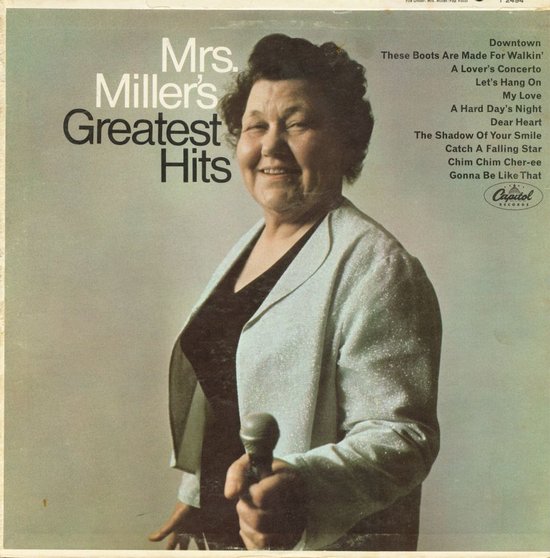
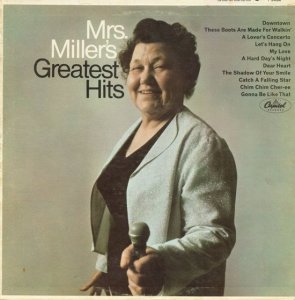
Missing from this 100 Greatest list is Mrs. Miller. Born Elva Connes in 1907, she became Mrs. Miller in 1934 when she married a Mr. Miller. In 1966, Capitol Records released her major label debut, Mrs. Miller’s Greatest Hits. Like Aretha, Mrs. displayed passion, power and confidence in her material. When you hear Mrs. Miller, you know it’s her, even if you’ve never heard that particular recording before, which chances are you haven’t.
elva
All the qualities that make Mrs. Miller unique can be heard on her first charting single, a cover of Petula Clark’s “Downtown,” which reached #82 on Billboard’s Hot 100. Her vibrato, her soaring soprano, the way she sings “always” in the song’s first line, the way she sings ahead of the beat on the line “no finer place for sure” in the first go-round of the chorus, the way she sings ahead of the beat on the first line of the second verse, the way she sings ahead of the beat on the bridge after the third verse, when she laughs while singing “waiting for you tonight” in the second go-round of the chorus. And then there’s her whistling solo. In a word, wow!

As was often the case with The Beatles, Elvis Presley and Creedence Clearwater Revival, the b-side of the “Downtown” single, Mrs.’ version of The Toys’ “A Lover’s Concerto,” also made Billboard’s Hot 100, peaking at #95. Again we’re transfixed by her vibrato, her hitting notes that had never been written and the way she sings ahead of the beat on the final verse. And then there’s her scatting like Ella Fitzgerald. Well, maybe not like Ella Fitzgerald. In a word, wow!

Her voice leant itself equally well to rock and roll, pop, country, and show tunes. She probably would have mastered rap as well. On her cover of Chuck Berry’s “Memphis,” she ditches her usual soprano to speak the words in a lower register. Her whistling solo is in its usual range, however.

Mrs. Miller’s Greatest Hits sold 250,000 copies in its first three weeks of release. She made television appearances on The Tonight Show with Johnny Carson and Ed Sullivan. She sang at The Hollywood Bowl. She performed alongside Bob Hope for US troops in Vietnam. That she is all but forgotten today is a shonda.

Rolling Stone’s list of The 100 Greatest Singers Of All-Time is terrific, but someone should be bumped (cough cough Mariah Carey cough cough) to make room for Mrs. Miller. Her distinctive sound, her enthusiasm and her ability to transform any song into a Mrs. Miller song make her one of the greats. The fact that she didn’t have her first chart single until age 58 inspires me.

If Mrs. Miller were still alive she’d be celebrating her 107th birthday today. She isn’t so she won’t be, but Tunes du Jour celebrates her craft with ten of her finest.

Click here to like Tunes du Jour on Facebook!
Winston + Bee Gees 2014-09-01 14.35

Ten Facts About Barry Gibb

Winston + Bee Gees 2014-09-01 14.35
Ten facts about Barry Gibb:
• As a member of the Bee Gees and as a producer and writer, Barry contributed to more than half of the songs on the soundtrack to the film Saturday Night Fever. That album went on to sell 40 million copies and was the all-time best-selling album until it was outsold by Michael Jackson’s Thriller.
• The Bee Gees are the only group to have six consecutive singles go to #1, all of which were also written and produced by them – “How Deep is Your Love,” “Stayin’ Alive,” “Night Fever,” “Too Much Heaven,” “Tragedy” and “Love You Inside Out.”
• For twenty-seven of the thirty-seven weeks from December 24, 1977 through September 2, 1978, the #1 singles in the US featured Barry Gibb as a writer. The songs were the Bee Gees’ “How Deep Is Your Love,” “Stayin’ Alive” and “Night Fever,” Andy Gibb’s “(Love Is) Thicker Than Water” and “Shadow Dancing,” Yvonne Elliman’s “If I Can’t Have You” and Frankie Valli’s “Grease.”
• Barry Gibb wrote “Grease” without his brothers. It was Frankie Valli’s only #1 single not co-written by Bob Gaudio or Bob Crewe. At the time Gibb approached Valli about recording the tune, Valli didn’t have a record deal. It was Valli’s last top 40 single.
• For three weeks beginning March 18, 1978, Barry was the lead singer, co-producer or co-writer of four of the US’ top five singles – “Night Fever,” “Stayin’ Alive,” “(Love Is) Thicker Than Water” and Samantha Sang’s “Emotion.”
• Barry and Robin Gibb wrote “Emotion” for the film Saturday Night Fever. It wasn’t used in the pic; however, it was used in the Joan Collins film The Stud the following year.
• Gibb was a co-producer and co-writer of the Kenny Rogers/Dolly Parton duet “Islands in the Stream.” The record was a #1 country and pop hit, the last song to top both of those charts for 17 years. Barry Gibb said the song was written for Marvin Gaye to record.
Dionne Warwick did not care for “Heartbreaker,” written by the Bee Gees, but she recorded it anyway, as she trusted the brothers’ judgment that it would be a hit. It sailed into the top ten in 1983, her first single to do so in four years.
• The Bee Gees-penned “Chain Reaction” was one of two #1 solo singles for Diana Ross in the UK, the other being “I’m Still Waiting.” Neither are amongst her 27 post-Supremes top 40 hits in the US.
• As a songwriter Gibb has had No. 1 songs in the 1960s, 1970s, 1980s, 1990s and 2000s.

Today Barry Gibb turns 68. Here are twenty songs he sang and/or wrote and/or produced.

Click here to like Tunes du Jour on Facebook!

Winston + Chuck 2014-06-30 11.25

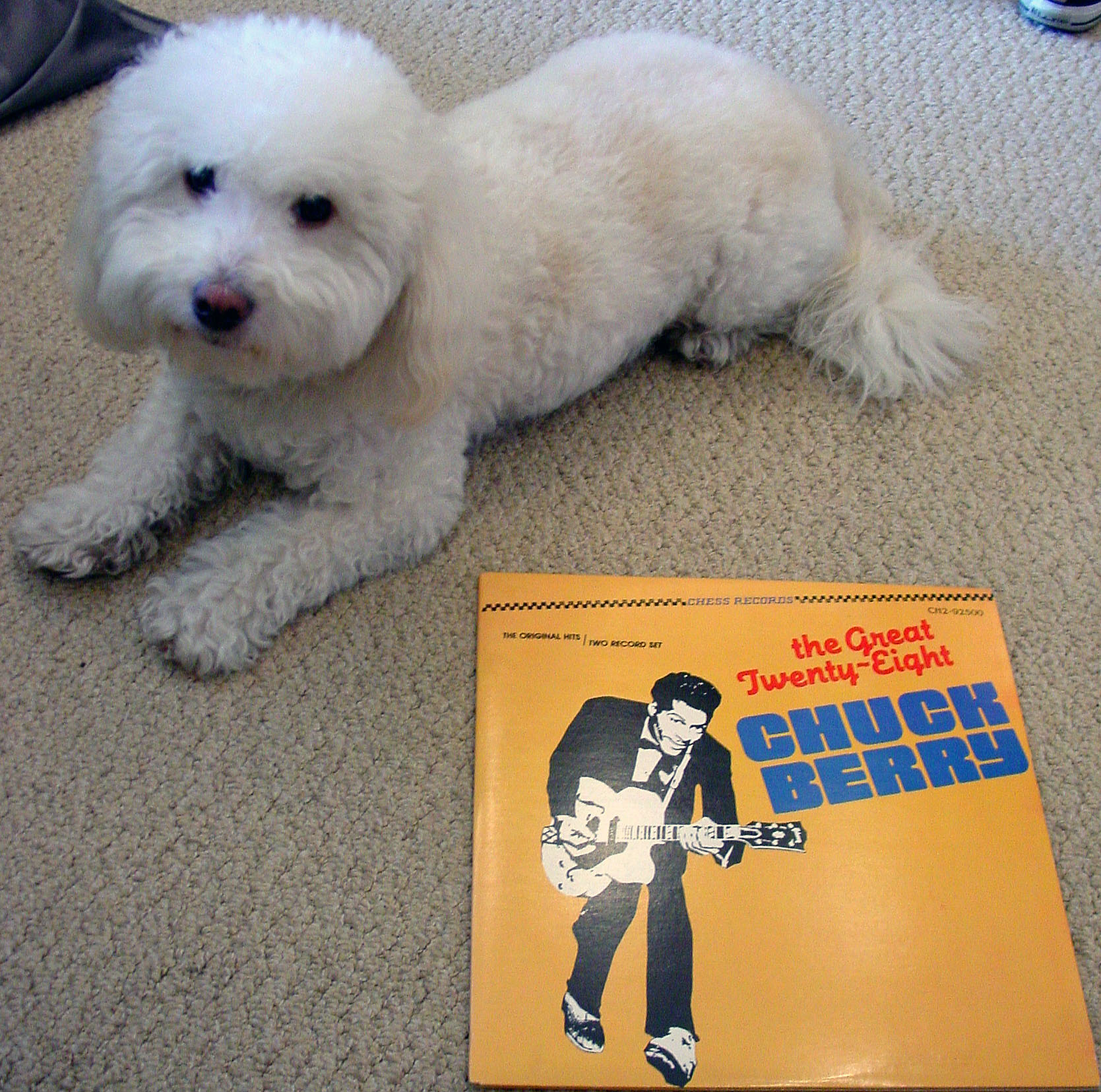
A Change Is Gonna Come If You Make It So

A company I worked for – I won’t say which one – has an amazing catalogue of rhythm & blues music, arguably the best r&b catalogue of any record label. Despite possessing this goldmine, most of our catalogue releases were from white rock bands. I asked a member of senior management why we didn’t do more with our black artists, and the answer I got was “We don’t know how to sell that music.”

Is that not a stupid response? If you don’t know how to do that, hire someone who has that expertise, or learn how to do it. Why ignore a large swath of your potential market, especially when you already own the assets?

Years ago I was put in charge of licensing at a record label. I knew the music and I knew the components of licensing deals; however, I wasn’t a very good negotiator. I found the process intimidating. I could have left it at that – “I don’t know how to negotiate.” My company would have made money nonetheless, though not at its full potential. For that matter, I wouldn’t be working at full potential.

I took a course in negotiations. Six weeks, $300. Money well spent. I put what I learned in the class into action. Practice makes perfect, and I became an excellent negotiator. In my four years at that company our licensing revenue increased 400%. My skills also led to my next job as the Vice President of Licensing at another company.

Is a lack of some skill or knowledge holding you back? Fix that. Read a book, attend a seminar, take an on-line course or find a mentor. Saying “I don’t know how” won’t lead to success; learning how will.

Winston + Chuck 2014-06-30 11.25
Today is the last day of Black Music Month. It would be ludicrous to think a 40-song playlist would cover black music in any comprehensive way. Enjoy it for what it is – nearly three hours of fantastic music. Listen to it while you research how to learn a new skill.

Winston + Marvin 003

“I Heard It Through The Grapevine”

Winston + Marvin 003

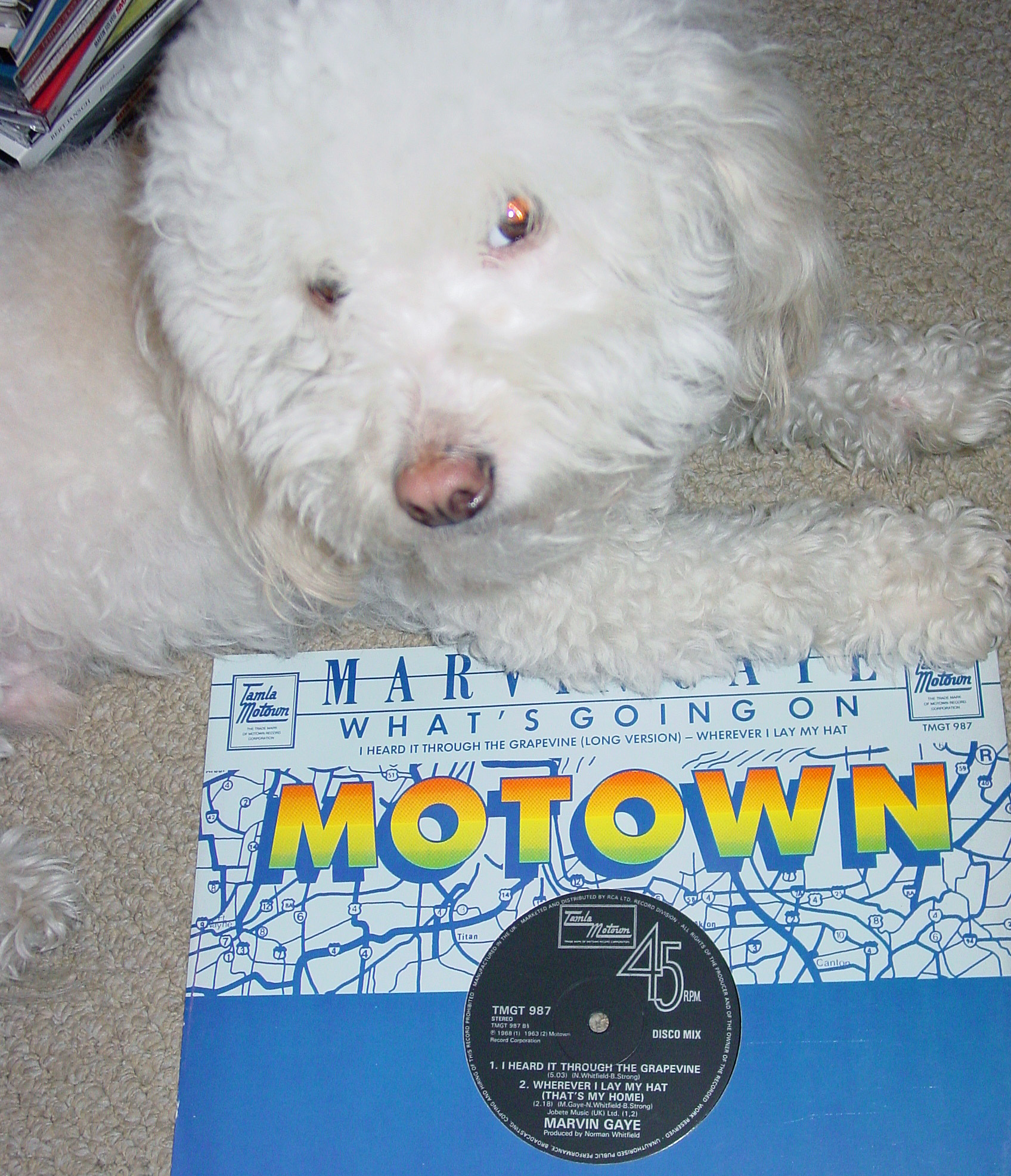
By 1966, Barrett Strong, the singer on Motown Records’ first hit single, “Money (That’s What I Want),” had the core of a song based on expression that emanated from the Civil War era. Slaves in the United States passed along information via a “human grapevine.” In Strong’s time he often heard people passing along gossip, saying they “heard it through the grapevine.” With that line as the chorus and a bass line, he brought the song to Norman Whitfield, who added lyrics about someone who hears gossip that their lover is unfaithful and will leave him/her for another lover.

Whitfield produced a version of their new song, “I Heard It Through the Grapevine,” with Smokey Robinsons and the Miracles, but Motown chief Berry Gordy, Jr. rejected it.

In 1967, Whitfield entered the studio with Marvin Gaye. At the time Gaye was married to Berry Gordy’s sister Anna. Gaye heard that Anna was being unfaithful to him. The lyrics surely resonated with him (though in (un)fairness, he was cheating on Anna). To wring more emotion out of Gaye, Whitfield had him perform the song in a higher key than he normally used. This did not sit well with Gaye, who is quoted in his biography as saying “Norman and I came within a fraction of an inch of fighting. He thought I as a prick because I wasn’t about to be intimidated by him. We clashed. He made me sing in keys much higher than I was used to. He had me reaching for notes that caused my throat veins to bulge.”

All may have been for naught, as Berry Gordy rejected the Gaye recording as well.

In June of 1967, Aretha Franklin went to #1 with her version of Otis Redding’s “Respect.” With that record as his model, Whitfield again brought “I Heard It Through the Grapevine” into the studio later that year, this time with Gladys Knight and the Pips. This version was faster than the versions he produced for the Miracles and Gaye, with the intention to “out-funk” Aretha.

Gordy reluctantly approved the Pips version for release. It rose to #2 on the pop chart and went to #1 on the r&b chart, where it remained for six weeks. It became Motown’s biggest-selling single to that point.

The Gaye version ended up on his 1968 album In the Groove. The first single from that album, “Chained,” hit #32 on the pop chart. “Grapevine” got the attention of some radio disc jockeys, who gave it airplay. Said Gordy, “The DJs played it so much off the album that we had to release it as a single.”

Marvin Gaye’s version of “I Heard It Through the Grapevine” was released as a single in fall of 1968. In mid-December it went to #1 on both the pop and r&b chart, and stayed on top of each for seven weeks, becoming Motown’s biggest hit to date. The week this went to #1 on the pop chart, Motown had the top three hits (#2 was “Love Child” by Diana Ross & the Supremes and #3 was “For Once in My Life” by Stevie Wonder.) The company held onto the top three for four consecutive weeks. “I Heard It through the Grapevine” bookended the r&b #1 slot in ’68 – the Pips’ version was #1 on January 1 and Gaye’s was #1 on Dec. 31.

By the time his “Grapevine” was released Marvin Gaye already had 23 top 40 pop hits. This was his first #1.

Gaye’s version made Rolling Stone’s list of the Greatest Songs of All Time and was inducted into the Grammy Hall of Fame.

“I Heard It Through The Grapevine” was the first collaboration between Barrett Strong and Norman Whitfield. The duo went on to compose “Papa Was a Rollin’ Stone” and “Just My Imagination (Running Away with Me)” for The Temptations.

Marvin Gaye died at age 44 on April 1, 1984, shot to death by his father the day before his birthday. The gun used was a Christmas present from Marvin.