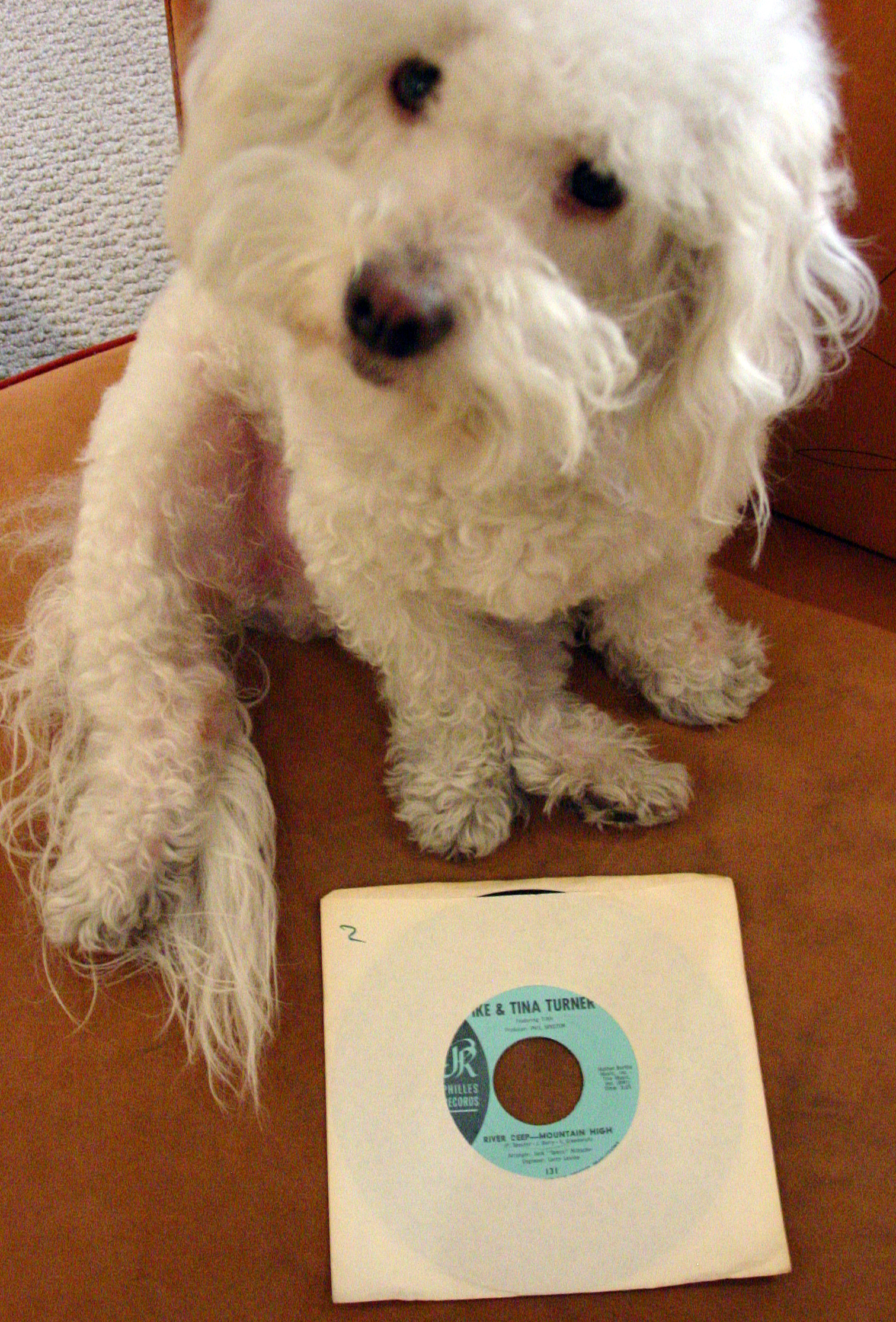
Winston + Turners

“River Deep – Mountain High” by Ike & Tina Turner

Winston + Turners
By 1966, the recording duo Ike & Tina Turner and the record producer Phil Spector could use a turnaround in their luck.

Ike & Tina Turner’s first hit song was 1960’s “A Fool in Love.” Two more top forty pop and four more r&b top ten hits followed over the next couple of years.

Phil Spector’s first hit as a producer was The Teddy Bears’ “To Know Him Is to Love Him,” a #1 pop single in 1958. Over the next seven years Phil Spector produced twenty-five top 40 pop hits, including such classics as The Ronettes’ “Be My Baby,” The Righteous Brothers’ “You’ve Lost That Lovin’ Feeling” and “Unchained Melody,” The Crystals’ “He’s a Rebel” and “Da Doo Ron Ron,” and Curtis Lee’s “Pretty Little Angel Eyes.”

Fast forward to late 1965. Ike & Tina Turner’s last top 40 pop hit was “Poor Fool,” which peaked at #38 in early 1962. It went top ten on the r&b chart, as did its follow-up, “Tra La La La,” but successive singles failed to do as well.

Despite scoring four top ten singles on Spector’s Philles Records, The Righteous Brothers sued the producer/record company head to get off the label, saying their contract was unenforceable. It was announced in early 1966 that the duo signed with another label. Their first single for that label, Verve, was a #1 hit – “(You’re My) Soul and Inspiration.” Spector lost his star attraction, and the other acts in his stable had lost luster. The Ronettes’ most recent top 40 hit was 1964’s “Walking in the Rain.” The Crystals’ most recent top 40 hit was 1963’s “Then He Kissed Me.”

In 1965 the Ike & Tina Turner Revue performed The Galaxy in Los Angeles. In the audience was Phil Spector. He loved their act and booked them to appear on The Big TNT Show, a televised concert for which he was the associate producer and musical director. Also appearing on the program were The Byrds, Ray Charles, Bo Diddley, The Lovin’ Spoonful, Donovan, Joan Baez, Petula Clark, and Roger Miller.

Spector was taken by Tina’s performance. “I said, God, if I could make a number-one record with her she could go on Ed Sullivan, she could go to Las Vegas; she could break the color barrier.” At the time, Ike & Tina were singed to Loma Records, a division of Warner Brothers Records. None of their releases hit the pop charts. Spector negotiated a release from their Loma contract. Spector wanted Tina, not Ike, so he paid Loma $20,000 to buy out the duo’s contract, on the condition that Ike stay away from the studio while Tina recorded. Ike accepted this offer, with the stipulation that the resulting record still be credited to Ike & Tina Turner.

To come up with a suitable song, Spector turned to the husband and wife songwriting team of Jeff Barry and Ellie Greenwich, who, with Spector, wrote “Be My Baby” and “Da Doo Ron Ron” and also wrote “Leader of the Pack” (with Shadow Morton) and “Do Wah Diddy Diddy.” CORRECTION: former husband and wife songwriting team – Barry and Greenfield divorced in December 1965, just a few weeks before Spector asked them to write a song for Tina.

Though freshly-divorced, they both came to the table, each with a different unfinished song. The combination of the three songs resulted in “River Deep – Mountain High,” with the melody of the verses coming from Greenwich, the melody of the chorus coming from Spector, and most of the lyrics coming from Barry.

The first of five recording sessions for the single was in February 1966. Hanging out in the control room were a couple of folks you may have heard of – Mick Jagger and Brian Wilson. To achieve his vision Spector used 21 background vocalists and 21 musicians, including Glen Campbell, Leon Russell and Hal Blaine. The completed record cost around $22,000 to make. Said Bob Krasnow, the head of Loma Records, “In those days, you could make five albums for twenty thousand dollars. And this was just a single – one side of a single.”

After years with Ike Turner, Tina must have been relieved to be able to go into the studio without Ike and with Phil Spector, a man who treated women with respect – scratch that thought. In her autobiography, I, Tina, she recounts a recording session with Spector. “That intro – ‘When I was a little girl…’ – I must have sung that five hundred thousand times, and I don’t know if I ever got it just the way he wanted it. I would sing it, and he would say, ‘That’s very close, very close. We’ll try it again.’ I don’t remember him saying, ‘Got it.’ Pretty soon, I was drenched with sweat. I had to take off my shirt and stand there in my bra to sing, that’s how hard I was working on that song.”

A River Deep – Mountain High album, with a cover photo taken by a broke Hollywood actor named Dennis Hopper, wouldn’t be released until 1969. However, the “River Deep – Mountain High” single came out in the United States on May 14, 1966. It entered the Hot 100 at #98. A week later it was #94. One week after that #93. The next week it rose to #88.

And that was it. The record that was to be the triumphant return of Ike & Tina Turner and Phi Spector stayed on the chart for only four weeks. Looking back, Tina concluded “It was too black for the pop stations, and too pop for the black stations.” Ike agreed.

After the single’s failure, Spector became a semi-recluse. It would be three years before another Phil Spector’s production was on the Hot 100.

In the United Kingdom, however, it was a different story. “River Deep – Mountain High” peaked at #3 there. George Harrison called it “a perfect record from start to finish – you couldn’t improve on it.” Harrison would later have Spector co-produce his All Things Must Pass album, which included the classic “My Sweet Lord.”

In praising Tina, Mick Jagger said “’River Deep-Mountain High’ was an excellent record because she had the voice to get out in front of Phil Spector’s so-called wall of sound.” The Rolling Stones invited Ike & Tina to open for them on their tour that began in the autumn of 1966.

In 1999, “River Deep – Mountain High” was inducted in the Grammy Hall of Fame. Rolling Stone magazine put it at #33 on its list of the 500 Greatest Songs of All Time.

Tina Turner turns 75 today. Here are twenty career highlights, kicking off with the classic “River Deep – Mountain High.”

Read more about Tina Turner here.

Click here to like Tunes du Jour on Facebook!
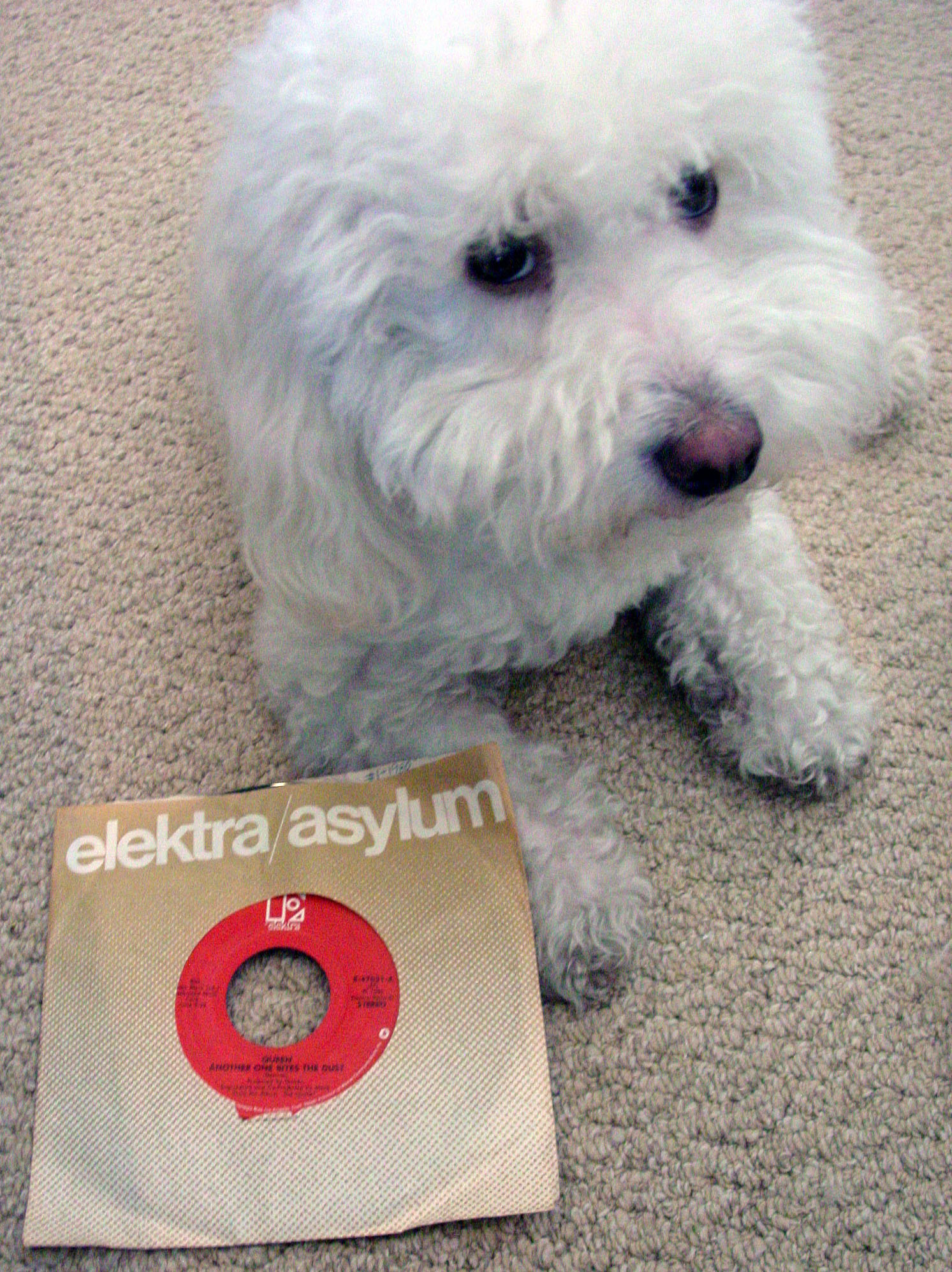
Winston + Queen 2014-09-05 11.07

It’s Freddie Mercury’s Birthday And I Need To Dance!

The band Queen released their eighth studio album, The Game, in 1980. The album’s first single, “Crazy Little Thing Called Love,” released eight months prior to the LP, went to #1 on the US pop charts. “Play the Game,” released as a single just a month before the album dropped, failed to make the US top 40.

Backstage after a Queen concert in Los Angeles, a fan of the group, Michael Jackson, suggested to Freddie Mercury that “Another One Bites the Dust” should be the next single. The band were initially reluctant to do so, but the track was getting airplay on black radio stations and demand was increasing, so their label, Elektra, put it out.

Inspired by the bass line of Chic’s “Good Times,” “Another One Bites the Dust” went to #1 on the US pop charts. It also hit #2 on the Soul chart and on the Dance chart, the group’s highest-placing songs on those formats.

A few years later Freddie Mercury and Michael Jackson recorded a few tracks together, including one written by Jackson and Randy Hansen entitled “State of Shock.” The pair never completed the track; explanations given or conjectured being they both got too busy with other commitments and couldn’t find time to reunite, Jackson objected to Mercury’s cocaine use, Mercury objected to Jackson bringing a llama into the recording studio, Queen’s record label fearing Mercury associating with Jackson would lead consumers to think he was gay (ahem). Whatever the reason, “State of Shock” was eventually released with Mick Jagger trading vocals with Jackson. It hit #3 in 1984.

Winston + Queen 2014-09-05 11.07
Today is Freddie Mercury’s birthday, so we’ll kick off our weekly dance party with “Another One Bites the Dust.”

Click here to like Tunes du Jour on Facebook!
Winston + Stones 2014-07-26 11.59

Mick Jagger Is 71!

Winston + Stones 2014-07-26 11.59

Today Mick Jagger turns 71 years old. He remains a dynamic live performer and one of the greatest frontmen ever.

Don’t use your age as an excuse to not do what you wish to. You’re not too old to write a novel or take tap-dancing lessons or wear Speedos at your local pool. Don’t worry about others might say; you have nobody to impress but yourself.

Paris001

Your Bastille Day Playlist

Paris001
In seventh grade we were given the option of taking Spanish or being expelled. I opted for the former. I did well in Spanish class. When I moved on to high school in ninth grade, we had a foreign language requirement, our options being Spanish, French or Swahili. I stayed with Spanish.

Through music I was able to pick up bits and pieces of other languages. I picked up some French phrases from Labelle and Talking Heads. I learned some Japanese from The Police and Robyn. The Rolling Stones and Dusty Springfield recorded Italian-language versions of a couple of their hits, and The Beatles recorded “I Want to Hold Your Hand” and “She Loves You” in German.

Limited as it was, this knowledge of foreign languages served me well when I moved into Sony Music’s International division. I could converse with our affiliates and licensees around the world. Sure, all I knew how to say to the folks in our French office was “Would you like to go to bed with me tonight?” and “What is it?,” but that’s all I needed to say. They appreciated the effort.

As today is Bastille Day and this blog has a French name, I created a playlist to help you with your French and your French kissing. Amusez-vous!

You can like this blog on Facebook! Click here.

Ringo + Kinks 2014-06-21 15.25

A Hint Of Mint: The Kinks’ “Lola”

The Kinks were part of the British Invasion of 1964. Alongside UK bands such as The Beatles, The Rolling Stones and The Dave Clark Five, The Kinks scored eight US Top 40 singles between 1964 and 1966, including the classics “You Really Got Me” (#7, 1964), “All Day and All of the Night” (#7, 1965) and “Tired of Waiting for You” (#6, 1965). After “Sunny Afternoon” peaked at #14 in 1966, the hits dried up. Their highest-charting single in 1967 was “Dead End Street,” which reached #73. They didn’t place any singles on the Hot 100 in 1968 or 1969. Their fortunes reversed in 1970.

Per the book The Kinks: The Official Biography, the band’s lead singer and chief songwriter Ray Davies came up with a song after a night out with the group’s manager, Robert Wace. Wace spent the evening dancing with a woman he met, and told Davies he was falling for her. When morning rolled around Ray noticed the woman had stubble on her face. In the song, Ray plays the part of Wace and the “woman” is given the name Lola.

Ringo + Kinks 2014-06-21 15.25
The song’s narrator recounts his meeting Lola in a club where everything is not what it seems. The champagne tastes like Coca-Cola (the BBC forced Davies to change the reference from Coca-Cola to cherry cola so as to not violate their policy against product placement) and the dancing happens under electric candlelight. Amidst these ambiguities he meets Lola, a woman who squeezes him so tight she nearly breaks his spine. A woman who “walked like a woman and talked like a man”. Our narrator is confused but continues to dance with Lola, who invites him to go home with her. He is falling for her, which frightens him, so he heads for the exit. Then he has second thoughts, turn back to Lola, and their eyes lock. He decides “that’s the way that I want it to stay and I always want it to be that way for my Lola.”

Accepting his destiny, he observes “Girls will be boys, and boys will be girls. It’s a mixed up, muddled up, shook up world, except for Lola.” Lola knows exactly who he/she is.

We then learn that our narrator was a virgin who first left his home a week prior, to which Lola responds “Little boy, gonna make you a man.”

Then we get one of my favorite lyrics ever. The narrator sings “I know what I am and I’m glad I’m a man, and so is Lola.” Lola is a man? Lola is glad the narrator is a man? The ambiguity of the character of Lola is reflected in the lyrics of “Lola.”

This is amazing songwriting. It is also amazing that this tale of a transvestite, not a popular song character today let alone in 1970, gave the Kinks their first huge hit in years and became an enduring staple of classic rock radio. The single went top ten in the United States and throughout Europe, hitting #1 in Ireland, Italy, the Netherlands, New Zealand and South Africa. The song made Rolling Stone magazine’s list of the 500 Greatest Songs of All Time.

Today Ray Davies turns 70 years old. Here is some of his best work.

Winston + Village People

“Go West” a/k/a It’s Gay Pride Weekend And We Need To Dance!

Winston + Village People
In 1979, the Village People released “Go West,” a celebratory disco romp whose message to listeners in the know was “go west, young man, to San Francisco, a utopia for gays.” The lyrics included “Together we will love the beach / Together we will learn and teach.” And “I love you, I know you love me. I want you happy and carefree / So that’s why I have no protest when you say you want to go west.”

San Francisco was a popular gay destination and in 1977, home to the nation’s first openly gay elected official, Harvey Milk.

In 1993, Pet Shop Boys released their cover of “Go West.” They kept all the Village People’s lyrics and they kept the dance beat, yet their version has a tinge of melancholy.

The duo’s Chris Lowe explained “When the Village People sang about a gay utopia it seemed for real, but looking back in hindsight it wasn’t the utopia they all thought it would be.”

Tunes du Jour readers – join me as we go back in time and look at the evolution of a gay dance classic.

Disco music was born in the early seventies in black, Hispanic and gay clubs. As explained in The Queer Encyclopedia of Music, Dance and Musical Theater, “Perhaps no other popular art form is more closely identified with gay culture than disco and dance music. Gay men in particular adopted the intense, loud, thumping 4/4 beat of the dance music predominantly at the bars and discos that were among the few places where they could openly express their sexual identities in the 1970s and 1980s. As the musical backdrop for generations of gay men who came of age is such venues, dance music became inextricably connected with the gay experience.”

Disco really hit the mainstream in 1977 with the release of the film Saturday Night Fever, based on a magazine article. The film’s soundtrack album became the biggest-selling album of all time in the United States, a record it held until Michael Jackson’s Thriller surpassed it.

As disco became a major commercial force, many rockers, including The Rolling Stones, Rod Stewart and Kiss, turned to the genre to score some of the biggest hits of their careers.

In June of 1978, the Village People entered the pop top 40 with their first crossover hit, “Macho Man.” Hard as it may be to believe, most people at that time had no idea they were gay, despite the costumes and despite song titles such as “Hot Cop,” “San Francisco,” “Sodom and Gomorrah,” “Key West” and “Fire Island.” Everyone in the whole family enjoyed their second hit, “Y.M.C.A.,” where one can “hang out with all the boys.”

In March of 1979 the group scored their third hit single in under a year – “In the Navy.” The U.S. Navy considered using it as a recruitment theme. Said a Navy spokesperson, “The words are very positive. They talk about adventure and technology. My kids love it.”

During the Seventies San Francisco remained a popular destination for gays. A report by Alfred Kinsey in the early 1970s found: “San Francisco is generally considered the best city in the U.S. for homosexuals. It was partly due to the city’s ‘tradition of tolerance.’ Another factor was the city’s size and geography, as it is smaller and less residentially dispersed than New York or Los Angeles, which made it “more conductive to a tightly knit homosexual community.”

In March of 1978 the San Francisco Board of Supervisors passed “the most stringent gay rights laws in the country.” Elsewhere in the U.S., the few existing gay rights laws were rapidly being repealed.

In June of 1978 San Francisco’s Gay Freedom Day Parade drew approximately 350,000 marchers.

On May 21, 1979, Dan White, the assassin who killed gay rights leader Harvey Milk as well as San Francisco’s mayor, was sentenced to only seven years and eight months in prison. The verdict led to massive riots in that city in which demonstrators burned a dozen police cars and more than 160 people, including 50 policemen, were injured. This happened just days after the Village People released their follow-up to “In the Navy,” “Go West.” Suddenly, San Francisco didn’t seem as peaceful and idyllic as it does in that song.

A few weeks later, a disc jockey from a Chicago rock radio station hosted an anti-disco demonstration at Comiskey Park between two baseball games in a double-header. Tens of thousands of people brought disco records to be set ablaze in center field while the crowd chanted “disco sucks.” I’d posit that this was in effect an anti-gay anti-black demonstration by white heterosexual rock fans.

Authors Andrew Edelstein and Kevin McDonough agree. In their book The Seventies they wrote “If you were a white, heterosexual teenage male who preferred to wear jeans and a t-shirt and sit passively at a stadium-size rock concert, then disco could be an especially threatening experience.”
After the Comiskey Park demonstration, disco quickly went back underground and was heard primarily in gay clubs. It soon came to be called house music and hi-nrg.

It should be noted that while rock fans tried to kill disco in the U.S., it stayed popular in the U.K., Europe, and elsewhere in the world.

The 1980s brought about the rise of the so-called Moral Majority in the United States. Not coincidentally, it also brought the scourge that came to be known as AIDS, which initially hit the gay population hardest. Homophobia contributed to a delayed response by the government.

Ten years into the AIDS epidemic there was still no sign of an effective treatment or cure.

In 1992 the British duo Pet Shop Boys were invited to perform at an AIDS fundraiser. Chris Lowe came up with the idea to do the Village People’s “Go West.” He played the record for his singing partner, Neil Tennant, who called it “ghastly” and “awful.” He got more into it when he thought about what he and his partner could bring to it, including the addition of “a big choir of butch men.”

A year later, the Boys released their studio recording of the song, complete with the big choir of butch men. In the context of the AIDS pandemic and the devastation it caused, particularly to the gay population, the song “Go West” takes on a different meaning than it did in 1979. As the website Shmoop puts it, “The sunny utopia the Village People had once sung of was literally full of sick and dying people; hospital beds in San Francisco were full of dying patients and there seemed to be no end in sight.”

The spread of AIDS led to a rise in gay activism, which is acknowledged in a verse the Pet Shop Boys added to their version: “There, where the air is free, we’ll be what we want to be / Now, if we take a stand, we’ll find our promised land.”

Of this record, Wayne Studer, in his book Rock on the Wild Side, a collection of songs by or about gay males, wrote “As the Boys do it, ‘Go West’ becomes an eerily uplifting disco dirge, both happy and sad at the same time. Extraordinary.”

Both the Village People’s and Pet Shop Boys’ “Go West” failed to cross over to the Top 40 of the U.S. pop charts; however, both were hits in the dance clubs, with the Pet Shop Boys version going to #1 on the U.S. Dance Club chart. The Pet Shop Boys version did make the top ten pop charts in the U.K., Germany, France, Austria, Sweden, Switzerland, the Netherlands, Norway, Ireland, Italy, Japan and Australia.

It was around this time that Neil Tennant, the duo’s usual vocalist and lyricist, came out, to the surprise of nobody.

“Go West” was the second single released from the group’s fifth album, Very, an album that is included in the book 1001 Albums You Must Hear Before You Die. The opening line of the book’s write-up is “Though the Pet Shop Boys had always been really gay, Very was their first really, really gay album – and their first U.K. number 1.”

Very produced four top ten club hits in the U.S., including two #1’s – “Go West” and “Can You Forgive Her?”

In 2008 Australian web-site SameSame polled their listeners to find the “gayest songs of all-time.” Pet Shop Boys’ “Go West” came in at #6. The Village People’s “In the Navy” was #18, their “Macho Man” was #16, and their “Y.M.C.A.” was named the second gayest song of all-time, kept from the top spot by ABBA’s “Dancing Queen.”

Pet Shop Boys’ album Very made Out magazine’s list of the Gayest Albums of All-Time. It also made British music magazine Q’s list of the 100 Greatest British Albums Ever. It has sold over five million copies worldwide.

Where has “gay music” come since the release of Very? Here are two interesting facts: the very first openly gay artist to have a #1 album in the U.S. was Adam Lambert, and that happened just two years ago. One year earlier, a song went to #1 on the U.S. pop charts and stayed there for six weeks – a song that explicitly called on gays, lesbians, bisexuals and transgenders to love who they are, ‘cause baby we were born this way.

As for the key players in my story, Pet Shop Boys have sold over 50 million records worldwide, had twenty-two top ten hits in the U.K. thus far, and won Outstanding Contribution to Music at the 2009 BRIT Awards, England’s equivalent to the Grammys. Their most recent album, 2013’s Electric, hit #3 on the UK album chart. It included the single “Vocal,” a top three club hit stateside.

The Village People still tour with three of their original members. They have sold over 100 million records.

Despite the efforts of some folks, disco, while suffering some setbacks, didn’t die. As a matter of fact, one of last year’s most popular hits was Daft Punk’s “Get Lucky,” a disco-influenced record featuring guitar work by Nile Rodgers of the seventies disco band Chic.

Similarly, despite the efforts of some folks, the LGBT populations, while suffering some setbacks, continues to make great strides toward equality and respect.

Should you attend this Sunday’s Gay Pride Parade in West Hollywood, or any Gay Pride Parade this season, you will hear coming from many floats disco and house music, for that is the soundtrack of our movement.

I wish all my readers a very happy Pride. Dance!

Ringo + Liz Phair 002

The 35th Best Album Of All-Time, Subject To Change

Ringo + Liz Phair 002
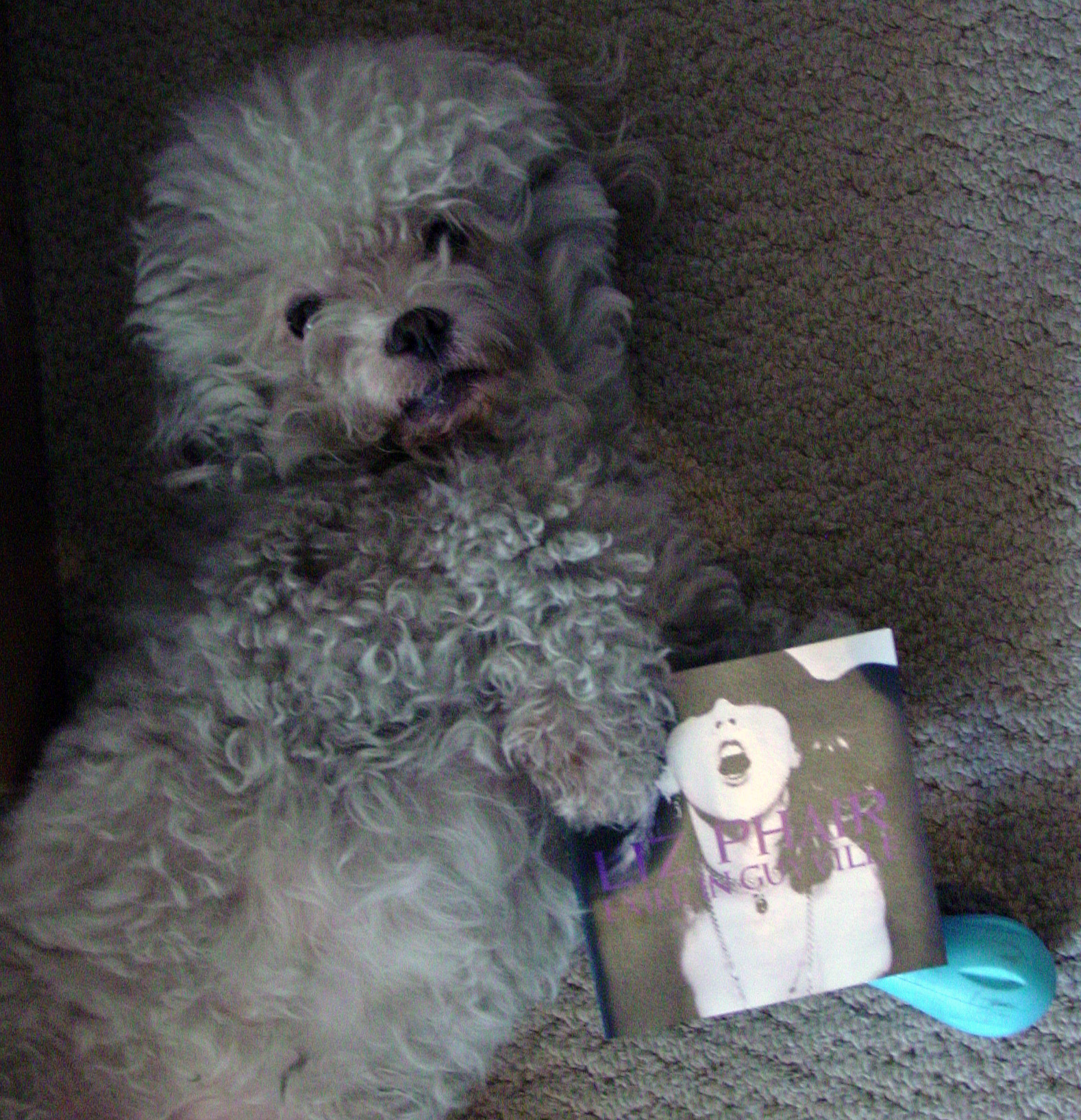
I’m still making my list of the top 100 albums of all-time (see here and here). In its most recent iteration, Liz Phair’s Exile In Guyville is nestled at #35, between Pet Shop Boys’ Very and Prince and the Revolution’s 1999.

The Phair album, a song-by-song response to the Rolling Stones’ Exile on Main Street, was a critical favorite upon its release in 1993. Both Spin and the Village Voice listed the album at #1 on their year-end lists, while Rolling Stone gave it 5, Pitchfork gave it a 9.6 and Entertainment Weekly gave it an A.

You needn’t know the Stones’ album to enjoy Guyville. Today’s playlist, in honor of Liz Phair’s 47th birthday, consists of a few songs from her landmark album plus a few other favorites from her follow-up releases.

Ringo + Turtles 003

Your Day Of Happiness Soundtrack

Ringo + Turtles 003
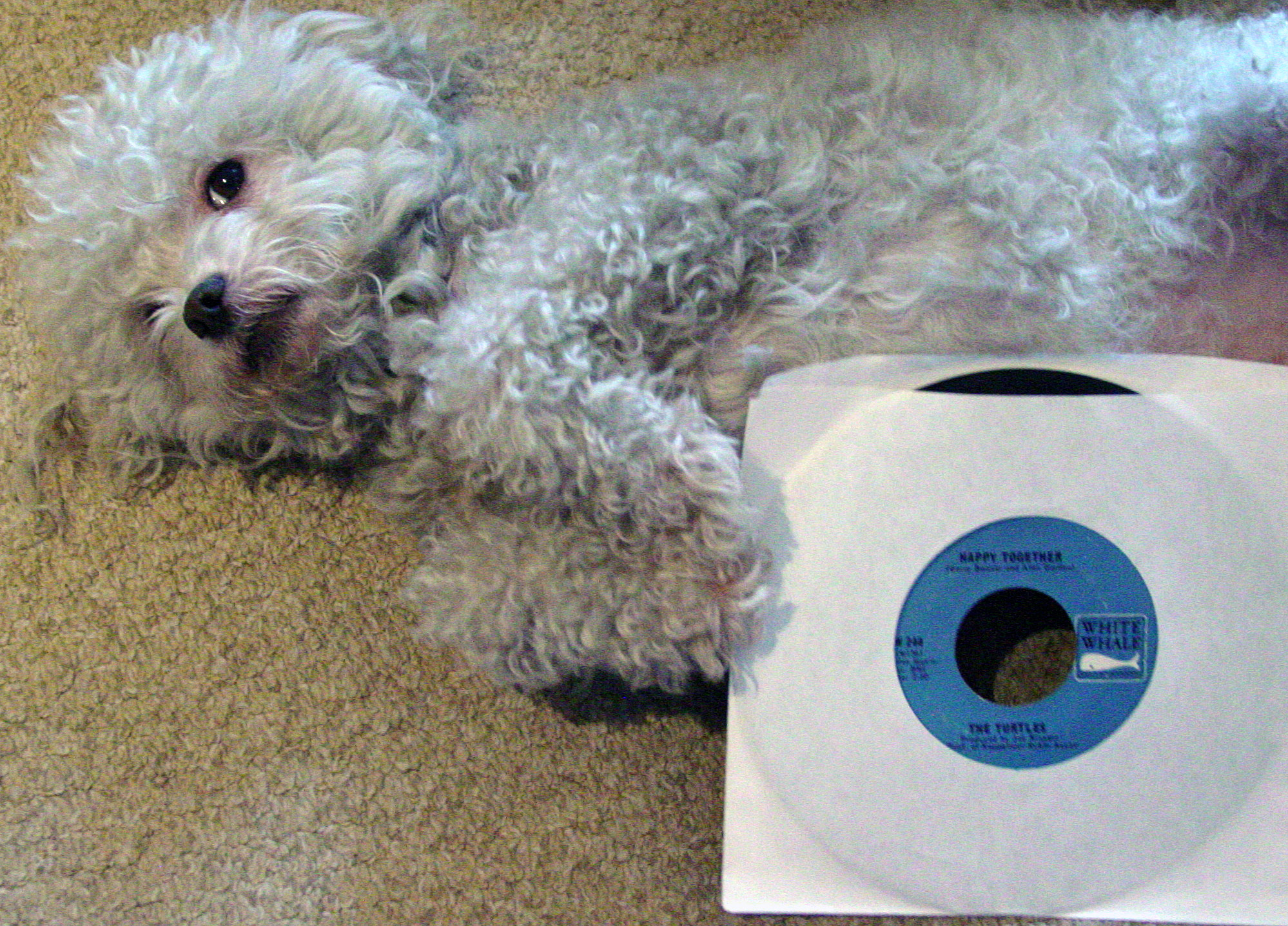
Today is the United Nations International Day of Happiness. Our soundtrack kicks off with The Turtles’ “Happy Together.”

Ironically, this is not a happy song.

Written by Gary Bonner and Alan Gordon, the song is about a one-way love affair. The singer imagines being with the girl to whom he’s singing. He’s in love with her and thinks if they were to be together the skies would be blue. He imagines how the world would be – so very fine – if they were a couple.

She doesn’t feel the same way. When this sinks in to our narrator, he makes small talk. “So how is the weather?” he asks, alternating that line with his repeated sentiment that they would be so happy together.

The song opens on a minor chord, which has a more melancholy sound than a major chord. The chorus – “I can’t see me loving nobody but you for all my life” – opens with a major chord, and the instrumentation is appropriately louder and joyous, the celebratory sound matching his feelings of ecstasy as he imagines his fantasy life with this woman.

For younger folks reading this, there used to exist public phones where one could insert a dime to make a three-minute long local call, hence the lyric “If I should call you up, invest a dime.” If the song were written today, this verse may go “If I should call you up, use up minutes from my cell phone plan / And you say you belong to me, I am your man / Imagine how the world could be, I’m hungry for flan.” Not as strong. Now I’m hungry for flan.

The Turtles recorded “Happy Together” in January 1967. Two months later it knocked The Beatles’ “Penny Lane” out of the #1 spot on the Billboard Hot 100. It stayed on top for three weeks.

Enjoy your Day of Happiness. May all your loves be requited loves.

doggies + Smokey 004

When Smokey Sings Or Writes

doggies + Smokey 004

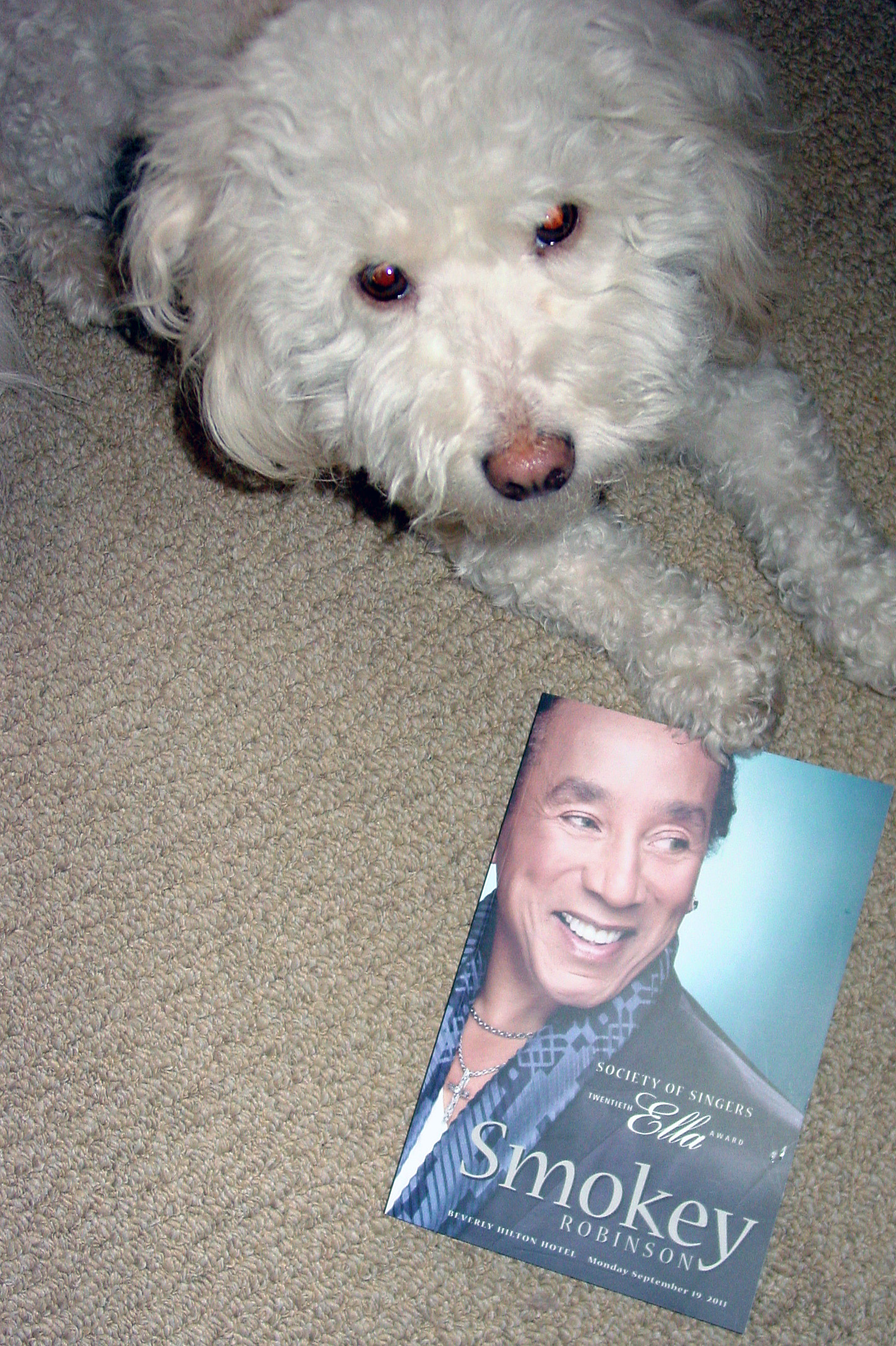
In 2011, I attended the Society of Singers’ tribute to Smokey Robinson. The award was well-deserved, as anyone who has heard him sing knows that Smokey Robinson possesses a sweet, soulful voice, one that he has used to beautiful effect on records going back more than fifty years. The British band ABC paid tribute to him on their top ten single “When Smokey Sings.” In their hit “Genius of Love,” Tom Tom Club sing “No one can sing quite like Smokey, Smokey Robinson.”

doggies + Smokey 005

In addition to his singing talent, Smokey is a writer on many classics in the great American songbook. Chances are you know “The Tracks of My Tears,” “My Girl” (click here for more about that song), “You’ve Really Got a Hold on Me” (originally recorded by Smokey’s group The Miracles as the b-side of a 45), “The Tears of a Clown,” “My Guy,” “Shop Around,” “Ooo Baby Baby,” “I Second That Emotion,” “Cruisin’,” and “The Way You Do the Things You Do.”

doggies + Smokey 006Here’s my cocktail napkin from the Society of Singers event. I need to wash that placemat.

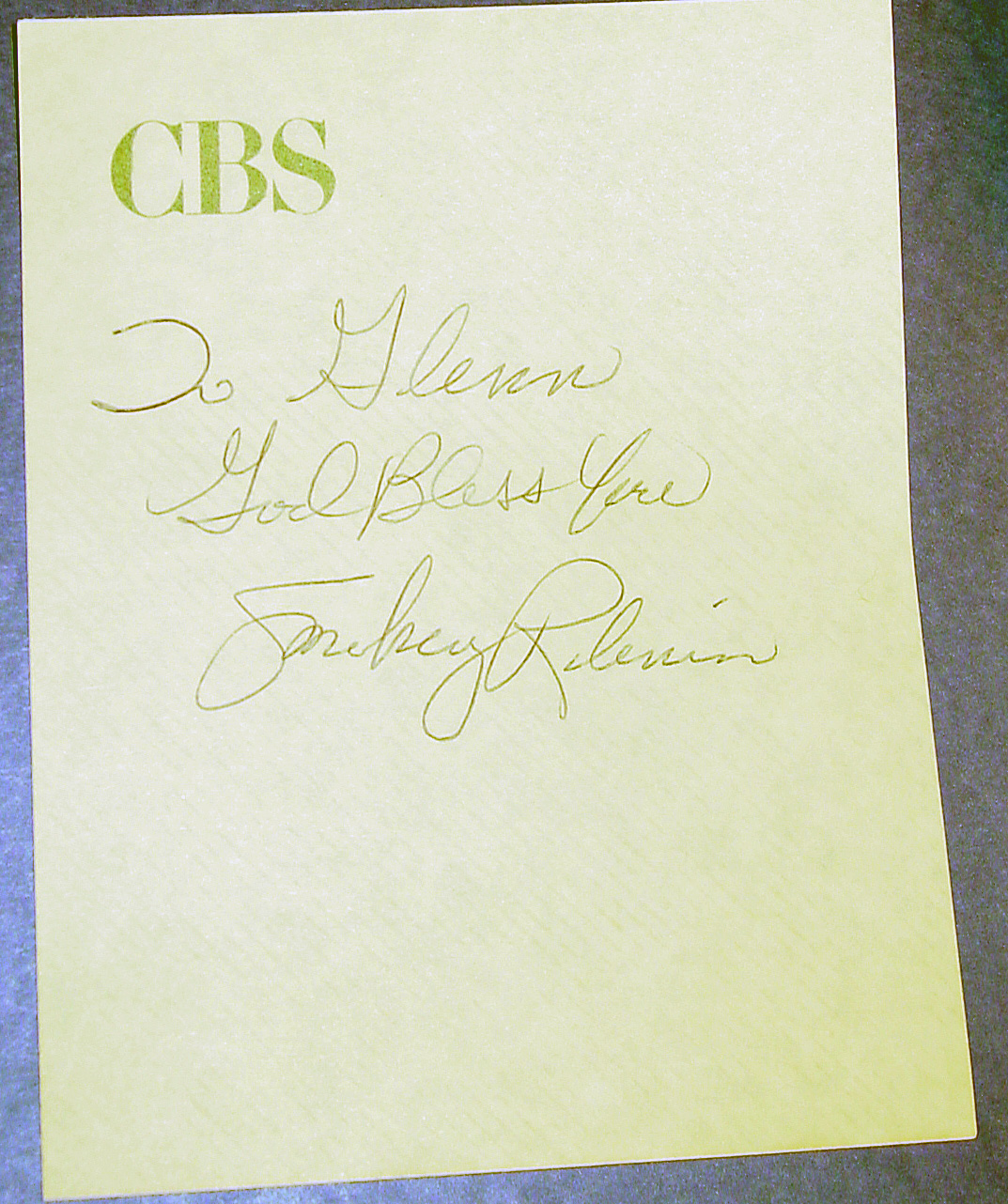
I met Smokey one time in the late 1980s. I was working at CBS Records in midtown Manhattan. Our offices were in the Black Rock building, which was also home to WCBS radio. Smokey had just done an interview at the radio station when I bumped into him in the building’s lobby. I told him I enjoyed the article about him in the new issue of Rolling Stone, which I was holding. He said he hadn’t seen it yet and took my magazine from me to look at it. I wouldn’t let him keep my issue – I was a poor office clerk, after all – but he was gracious enough to sign an autograph for me.

Smokey autograph

Today is Smokey’s 74th birthday. Enjoy this playlist comprised of songs Smokey sings and songs Smokey wrote or co-wrote, songs you know and songs you should know.

Ringo + Buddy

The Day the Music Didn’t Die But Still

Ringo + Buddy

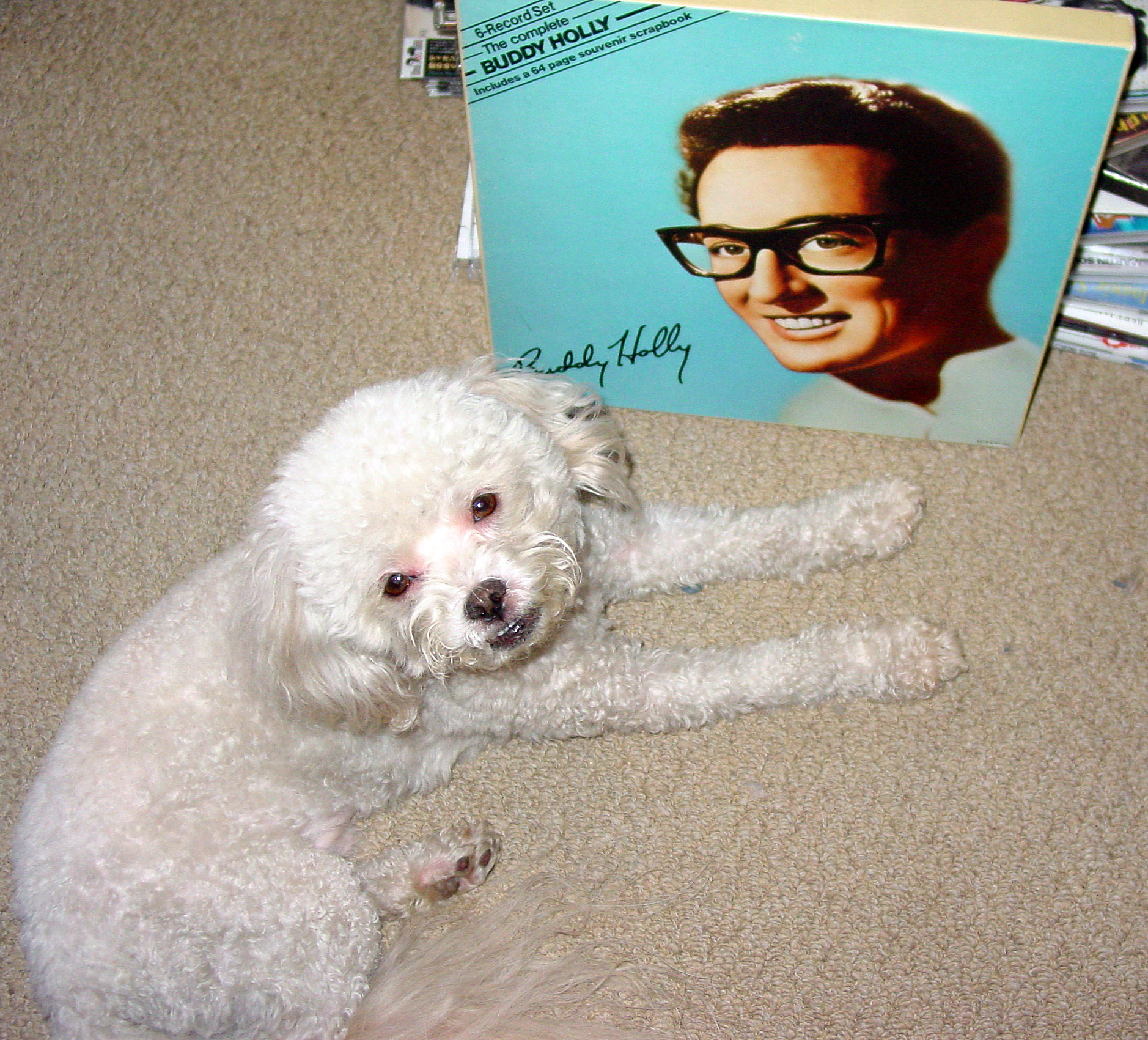
On this date in 1959, Buddy Holly, Ritchie Valens and The Big Bopper died in a plane crash. In his hit “American Pie” Don McLean referred to it as “the day the music died.” A little dramatic, no? The music didn’t die, but it was a tremendous loss nonetheless.

Today Tunes du Jour pays homage to these late, great rock and roll pioneers. On our playlist:
“Chantilly Lace” – The Big Bopper – The man born Jiles Perry Richardson’s only top ten hit, from 1958.
“Think It Over” – Buddy Holly – A top forty single from 1958.
“Donna” – Ritchie Valens – Valens’ only top ten hit, peaking at #2 in early 1959.
“American Pie” – Madonna – Madonna covered Don McLean’s classic for her film The Next Best Thing at the suggestion of her co-star, Rupert Everett, who sings backing vocals on the recording.
“Oh, Boy!” – Buddy Holly – A top ten single from early 1958. I recall Olivia Newton-John performing it on one of her television specials with guest stars Andy Gibb, Elton John and Cliff Richard. If memory serves, it went on for about forty minutes.
“Heartbeat” – Buddy Holly – The Knack covered this for their breakthrough album, Get The Knack.
“It’s So Easy” – Linda Ronstadt – Ronstadt had a top five hit with her cover of this song, written by Buddy Holly and Norman Petty. Ronstadt also charted with covers of Holly’s hits “That’ll Be the Day” and “It Doesn’t Matter Anymore.”
“Not Fade Away” – The Crickets – An English quintet who went by the name The Rolling Stones charted in the US for the first time with their version of this tune. Not sure what happened to them.
“Buddy Holly” – Weezer – Buddy Holly couldn’t have predicted this song’s opening lines – “What’s with these homies dissing my girl? / Why do they gotta front?”
“Everyday” – Buddy Holly – James Taylor charted with his cover of this in 1985.
“La Bamba” – Ritchie Valens – It’s hard to believe this song only peaked at #22 upon its release in 1958. “La bamba” is Spanish for “the bamba.”
“Peggy Sue” – Lou Reed – This song was co-written by Buddy Holly, who took it to #3 in 1957.
“It Doesn’t Matter Anymore” – Buddy Holly – Holly didn’t write this posthumous hit; Paul Anka did. This and “My Way” are my two favorite Anka compositions. I also love “(You’re) Having My Baby,” but in a different way.
“Words of Love” – Patti Smith – A pop combo from England covered this Holly composition on their album that in the US was titled Beatles VI. Not sure what happened to them.
“Maybe Baby” – The Crickets – The Beatles’ name was inspired by the name of Holly’s band, The Crickets.
“I’m Gonna Love You Too” – Buddy Holly – Blondie covered this for their breakthrough album Parallel Lines.
“Come On, Let’s Go” – Los Lobos – Los Lobos performed Valen’s music for the biopic of Valen’s life, La Bamba.
“That’ll Be the Day” – Modest Mouse – Written by Buddy Holly and Jerry Allison, “That’ll Be the Day” was Holly’s first hit, going to #1 in 1957. Given his immense influence on rock and roll, it’s hard to believe he died a year and half later.
“Rave On” – Buddy Holly – One of five top forty singles Holly had in 1958.
“True Love Ways” – My Morning Jacket – Holly wrote “True Love Ways” for his wife as a wedding gift. What did your husband get you?